Frost Free vs Direct Cool: Which Should You Actually Buy?
By Samiya
 Samsung 256 L 3 Star RT40H30U3THLConvertible, Digital Inverter frost free double door₹32,000Amazon, 8 Nov 2026★ 4.2Check price ↗
 Whirlpool 235 L 3 StarFrost-free inverter double door refrigerator₹27,000Amazon, 8 Nov 2026★ 4.0Check price ↗
 Haier 190 L 5 Star HED-205DSA-PDirect cool inverter single door refrigerator₹16,600Amazon, 8 Nov 2026★ 4.0Check price ↗
 IFB 197 L 5 StarAdvanced inverter direct-cool single door refrigerator₹18,000Amazon, 8 Nov 2026★ 4.0Check price ↗
Prices and ratings in the boxes above are Amazon selling prices read on 8 Nov 2026, rounded to the nearest ₹100. Products are the most-rated ones of each type that we found, shown as examples, not a ranking. Prices quoted in the text below are from the dates given beside them and may differ from today’s Amazon price.
Frost free vs direct cool sounds like a settled question until you read what the manufacturers publish. LG’s own magazine says every LG refrigerator is frost free, while LG India sells a single-door range its product pages call “LG Direct Cool”. Godrej sells a direct-cool model that defrosts itself. And not one manufacturer in the material we read tells you how often to defrost a direct-cool fridge by hand. This page sets out what each maker actually says, where they contradict themselves, and what that means for you.
The short answer. Choose direct cool if you are willing to defrost the freezer yourself when frost builds up, and you want the lower annual kWh figures that LG and Haier publish for their single-door models. Choose frost free if you never want to defrost by hand and accept that the fan and automatic defrost system, in LG’s words, “may use more energy”. The compressor type (inverter or not) is a separate choice that exists on both sides.
Frost free vs direct cool at a glance
| Dimension | Direct cool | Frost free |
|---|---|---|
| How cold air moves | Natural convection (LG, Haier India) | Fans circulate the air (LG, Haier India) |
| What happens to frost | Haier India: “Cooling happens through ice formation on the back wall” | Haier India: fans and heating cycles “prevent ice buildup” |
| Defrosting | By hand, per the mechanism. Samsung adds a push Defrost button; one Godrej model auto-defrosts | Automatic. Voltas Beko: “approximately 25 to 45 minutes, usually once to twice a day” |
| Energy, in the maker’s words | Haier India: “Lower” | Haier India: “Slightly higher”. LG: “may use more energy” |
| BEE scheme | “Direct Cool Refrigerator” | “Frost Free (No-Frost) Refrigerator” |
| Inverter compressor | Offered by Samsung, LG, Godrej and Haier | Offered by Samsung, LG, Godrej and Haier |
How each technology works, in the manufacturers’ own words
Haier India publishes the clearest mechanism prose, across two blog posts on its own storefront. Direct cool: “Direct Cool refrigerators use natural convection to circulate cold air. No fans. No automation layers.” Its second post adds: “The evaporator cools the air directly, which eventually results in frost forming inside the freezer section over time. That means manual defrosting becomes necessary whenever the frost layer gets thicker.” Frost free: “Frost Free refrigerators use electric fans and heating cycles to prevent ice buildup,” and “Because moisture doesn’t accumulate into thick ice layers, frost simply doesn’t build up.”
LG’s magazine (page dated 13 November 2023) puts it in one line each: “Frost-free refrigerators circulate cool air to reduce frost formation and provide more even cooling. Direct-cool models rely on natural convection and may require manual defrosting when frost builds up.” Notably, none of the 12 LG single-door product pages we read describes the direct-cool mechanism at all. The only direct-cool description they carry is about connecting the fridge to a home inverter during power cuts.
Samsung does not describe the direct-cool mechanism on its 21 one-door product pages or in the RR21/RR23 user manual. It labels instead: one-door spec tables read “Cooling Type: Direct Cooling” and “No Frost: No”. Its frost-free double doors read “No Frost: Yes”, and it describes Twin Cooling Plus as adjusting the fridge and freezer “using independent evaporators, fans and vents”.
Voltas Beko explains what a frost-free fridge does when it defrosts: its frost-free double doors “activate a defrost heater in the evaporator section at the rear of the freezer. Most models defrost for approximately 25 to 45 minutes, usually once to twice a day.”
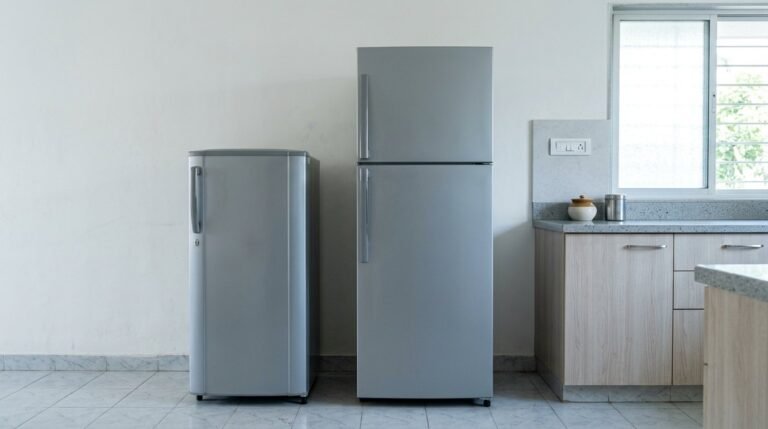
Godrej publishes no mechanism prose for either type on the 69 product pages we read; its category names (“Single Door Direct Cool”, “Double Door Frost Free”) do the explaining. That pairing holds across the catalogues we read: of 96 single-door models on the Samsung, Godrej, Haier and LG India storefronts, none is sold as frost free, and of 97 double-door models, none is sold as direct cool. The price, warranty and running-cost side of that split is covered on our single door vs double door refrigerator page.
LG contradicts itself, twice
LG’s magazine article states three times that its whole range is frost free: “All LG Refrigerators are completely Frost-Free thanks to LG’s Total No Frost technology”, “Every model offered by LG utilises the Total No Frost technology”, and “As a core feature of all LG Refrigerators, self-defrosting technology…”
LG’s product pages say otherwise. Of the 12 LG India single-door models we read, the words “Direct Cool” appear on 10 of their product pages (one reads “LG Direct Cool refrigerator”), and the other 2 do not name a cooling type. LG’s own 2026 range catalogue is a single-door direct-cool series. Where a manufacturer’s magazine and its product pages disagree, we carry the product pages: the magazine claim does not describe LG’s current India range.
The same article also contradicts itself on frost-free maintenance. It says a frost-free fridge “can still get condensation in the fridge and a buildup of ice in the freezer, which will need to be defrosted every 6 months”, and elsewhere that you “never have to manually defrost the unit.” Both sentences sit on the same page. We cannot tell you which one LG means.
The exception to “direct cool means manual defrost”
The mechanism the manufacturers describe does mean manual defrosting. The products do not always follow it.
Godrej sells the Edge Impress 207 L 5 Star in its “Single Door Direct Cool” category, with the spec “Type: Direct Cool”. Its page says: “Say goodbye to manual defrosting with Auto Defrost on Command. It prevents ice buildup intelligently, ensuring consistent cooling and a hassle-free experience every day.”
Samsung’s direct-cool models sit in between. They carry a push Defrost button that starts the defrost for you, but you still decide when to press it.
So the honest rule is: direct cool usually means you manage the frost yourself, and you should check the product page before assuming.
How to defrost a direct cool fridge, and the interval nobody publishes
The only full manufacturer procedure we could read is Samsung’s, from the user manual for its RR21 and RR23 one-door models:
- “Check the layer thickness of the frost/ ice formed on the walls of the ice making compartment. If more frost is formed, please defrost.”
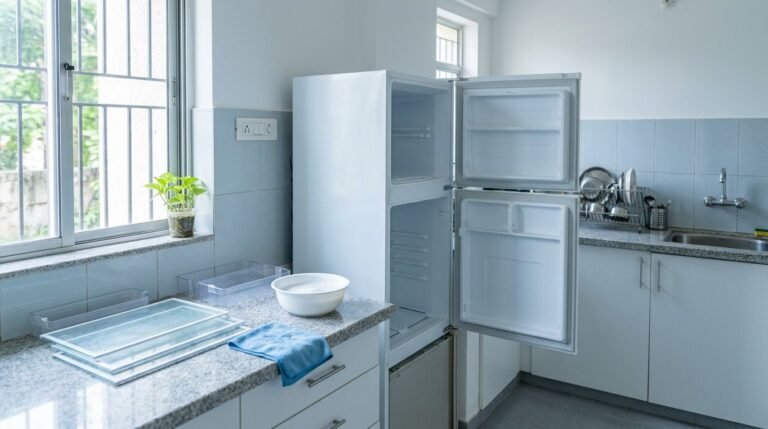
- “Push the Defrost button to defrost. Frost on the surface of the evaporator will begin to melt and can be easily removed. After defrosting is finished, the refrigerator will start automatically.”
The button “remains pressed during the defrost process, and returns to normal state when complete.” Samsung also notes that if you press it “in higher inner temperatures (ambient temperature), the button would not be pressed and stays normal.”
The warning worth reading twice, printed under a CAUTION heading: “In order to remove ice from the ice making compartment, do not use a keen tool, knife or screw driver.” For cleaning, Samsung says not to use benzene, thinner or household detergents, and “Do not spray water onto the refrigerator. This may cause electric shock.”
Haier India describes the manual routine only by what frost free spares you from: “So, no scraping ice with a spoon. No unplugging the refrigerator for hours. No waiting for melted water to drain.”
How often? We found no manual-defrost interval for direct cool in any manufacturer material we read: Samsung’s RR21/RR23 manual, the 12 LG single-door product pages, the 39 Godrej direct-cool product pages, Haier India’s blog posts, and the Voltas Beko and TCL guides. Samsung’s trigger is frost thickness, “If more frost is formed”, and it gives no thickness in millimetres. The only defrost timings we found are for frost-free automatic cycles (Voltas Beko’s once or twice a day) and LG’s self-contradicting “every 6 months” for frost free. In practice, the frost itself is your schedule.
Energy: why star ratings do not compare across the two types
The Bureau of Energy Efficiency lists two separate mandatory refrigerator schemes on its Star Label portal: “Frost Free (No-Frost) Refrigerator” and “Direct Cool Refrigerator”. A star count is awarded within its own scheme, so “2 star” on a direct-cool fridge and “2 star” on a frost-free fridge are not the same measure.
The manufacturers’ own figures show it:
| Brand | Direct cool, 2 star | kWh/year | Frost free, 2 star | kWh/year |
|---|---|---|---|---|
| Haier | HRD-2742CRKA-N, 253 L | 176 | HRF-2902 series, 240 L | 230 or 270, by variant |
| LG | GL-D199OSFC, 185 L | 190 | GLT2526XWDS, 251 L | 233 |
Same star count, same brand, different annual consumption. The capacities differ too, so treat these as examples of the pattern, not a like-for-like test.
On which type uses more, the makers’ wording is careful. LG: “Frost-free refrigerators may use more energy because of their fan and automatic defrost system. Actual consumption depends on the model, capacity, energy rating, usage, and operating conditions.” Haier India’s table marks direct cool “Lower” and frost free “Slightly higher”. Haier’s Bangladesh site says the opposite, listing lower energy consumption as a benefit of No Frost; we carry the India wording for an India page. Across the five same-brand LG and Haier pairs we compared, the frost-free double door publishes 43 to 150 kWh a year more than the direct-cool single door. Capacities differ within each pair, and in three of the five the star ratings differ too (5 star against 1 star, 3 star against 2 star, 5 star against 2 star); the two pairs matched at 2 star show the smallest gaps, 43 and 54 kWh.
Inverter vs direct cool: two different questions
“Inverter or direct cool?” compares two separate things. Direct cool describes how the fridge cools and handles frost. Inverter describes the compressor. You can have both at once.
The spec sheets show inverter compressors are common inside direct cool. All 21 Samsung one-door models we read list a “Digital Inverter Compressor”. Nine of the 12 LG single-door models are inverter; the other three list a “Recipro Compressor”. Godrej and Haier each sell direct-cool models with and without an inverter compressor. For inverter compressors in air conditioners, see our inverter AC vs non-inverter AC guide.
Stabiliser-free claims come with the models, not the category:
- Samsung: “Stabilizer Free Operation range: 100 ~ 300V” on the RR21H2G2, RR21H2H2, RR23H2H3 and RR26H3832BR one-door pages and the RT31H4522S9 double door. Samsung’s general support article gives 135 to 290 V; we carry the model pages.
- LG GL-D211HSEZ: “Stabilizer Free 90V ~ 310V”. Six other LG inverter direct-cool pages claim stabiliser-free operation with no range stated.
One trap: LG’s “Smart Connect” and Haier’s “Runs on Home Inverter” refer to running the fridge from a home battery inverter during a power cut. That is not an inverter compressor.
What we could not verify
- BEE star thresholds. We looked at the Star Label scheme list, its search tool and the BEE programme pages. We could not obtain the kWh bands behind each star from them, so we state no star limit on this page.
- Samsung and Godrej energy figures. None of the 52 Samsung product pages publishes kWh a year, and no Godrej direct-cool page does either.
- LG GL-D199OSFC. Its product page says 190 kWh a year; LG’s catalogue lists 170 for a 185 L 2 star model but prints no model numbers, so we carried the product page.
- LG, Godrej and Haier India defrost procedures. None was published in a form we could read.
- 13 Samsung “All Around Cooling” double doors state no frost-free status, so we did not count them either way.
- Whirlpool and Panasonic. Their India sites would not load for us. That is an access failure, not evidence of anything.
- LG’s magazine and a Haier Bangladesh page each carry a statistic with no source given. We do not repeat them.
Shopping on a budget of about ₹15,000? See Best Refrigerator Under 15000 in India (2026): 16 Models Compared.
FAQs
What are the disadvantages of a direct cool refrigerator?
The main one is defrosting. Haier and LG describe direct cool as relying on natural convection, with frost building up until you defrost by hand, and no manufacturer we read tells you how often. Godrej’s Edge Impress 207 L is the exception, with “Auto Defrost on Command”. On energy, direct cool published the lower annual figure in all five same-brand LG and Haier pairs we compared, so that is not a disadvantage.
Which is better, an inverter or a direct cool refrigerator?
Neither, because they are not alternatives. Direct cool is a cooling method; inverter is a compressor type. Samsung lists an inverter compressor on all 21 of its one-door direct-cool models we read, and LG on nine of 12. You can buy a direct-cool fridge with or without one.
How do DC refrigerators work?
On this page, DC means direct cool. The evaporator cools the air directly and cold air moves by natural convection, with no fan. In Haier India’s words, “Cooling happens through ice formation on the back wall”, and “manual defrosting becomes necessary whenever the frost layer gets thicker.”
Which fridge is better, frost or No Frost?
It depends on what you want to manage. A direct-cool (“frost”) fridge asks you to defrost when frost builds up; Samsung’s manual says to check the frost layer and use the Defrost button. A No Frost fridge defrosts itself with fans and a heater. LG says frost free “may use more energy” and Haier India rates it “Slightly higher”, and star ratings cannot settle it because BEE rates the two types separately.