How to Clean a Refrigerator Inside: What LG, Samsung, Haier, IFB and Godrej Each Allow, Compared
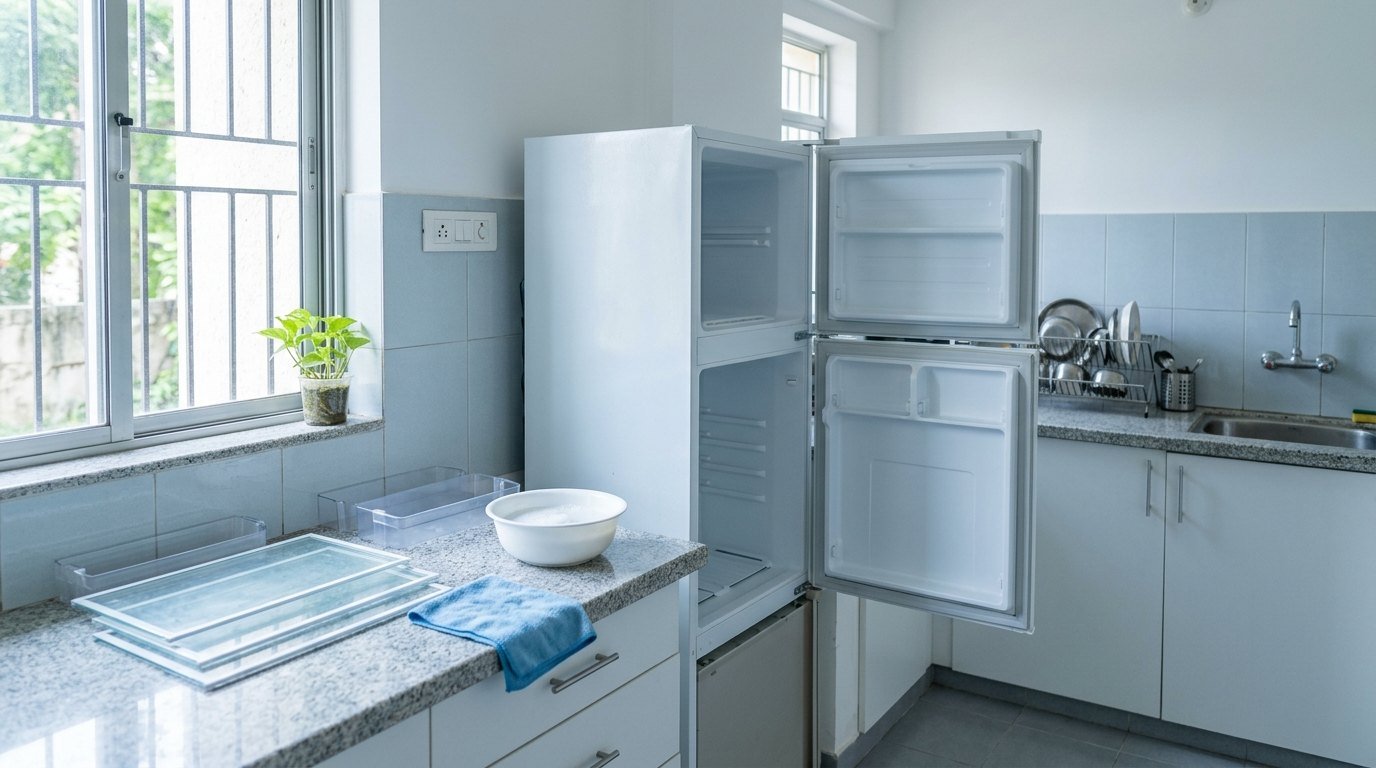
Five fridge makers’ manuals, support pages and blogs, read side by side: what each lets you clean the inside with, what each forbids, and the order their steps run in.
 Samsung 256 L 3 Star RT40H30U3THLConvertible, Digital Inverter frost free double door₹32,000Amazon, 8 Nov 2026★ 4.2Check price ↗
 Whirlpool 235 L 3 StarFrost-free inverter double door refrigerator₹27,000Amazon, 8 Nov 2026★ 4.0Check price ↗
 Haier 190 L 5 Star HED-205DSA-PDirect cool inverter single door refrigerator₹16,600Amazon, 8 Nov 2026★ 4.0Check price ↗
 IFB 197 L 5 StarAdvanced inverter direct-cool single door refrigerator₹18,000Amazon, 8 Nov 2026★ 4.0Check price ↗
Quick answer: unplug, empty the fridge, take out the shelves and bins, wash them, wipe the inside with a soft damp cloth, dry everything and refit it. The makers split on what goes on the cloth. LG’s manual allows water and a mild detergent on shelves, drawers and gaskets; Samsung’s manuals forbid home or car detergent such as Clorox, and Samsung’s support pages disagree with each other about detergent. In the fridge documents we read, only Haier mentions baking soda or vinegar.
What each maker allows and forbids inside the fridge
Each row covers one maker’s documents only. “Not mentioned” means not mentioned in the documents we read.
| Maker and document | Detergent | Baking soda | Vinegar | Abrasives | Solvents |
|---|---|---|---|---|---|
| LG manual MFL05806603 (GLT22/25/28, frost free) | Mild detergent on shelves, drawers, gaskets | Not mentioned | Not mentioned | Forbidden: abrasives, toothpaste, rough or metal brushes and sponges | Forbidden: alcohol, thinner, bleach, benzene |
| Samsung manual, RT34HG5A23S8HL (frost free) | Home or car detergent such as Clorox forbidden | Not mentioned | Not mentioned | No line in what we read | Forbidden: benzene, thinner |
| Samsung manual, RR21/RR23 (direct cool) | Same warning as RT34 | Not mentioned | Not mentioned | No line in what we read | Forbidden: benzene, thinner |
| Samsung India support pages | Split: mild detergent (January 2026), lemon juice instead (October 2025), no detergent at all (October 2020) | Not mentioned | Not mentioned | Forbidden: abrasive or harsh cleansers, incl. scouring cleansers | Forbidden: benzene, thinner, bleach |
| Haier India blogs | Mild detergent (2023) | Allowed: a solution for spills (2023); an odour absorber (2025) | Allowed: equal parts with water (2025) | None stated | None stated |
| IFB help page, IFBFF-2902FBB | No agent named | Not mentioned | Not mentioned | None stated | None stated |
| Godrej maintenance blog | No agent named | Not mentioned | Not mentioned | None stated | None stated |
Baking soda and vinegar are a Haier-only instruction in what we read. Haier’s 2023 maintenance blog says spills and residues “can be removed with a baking soda solution or mild detergent”. Its 2025 summer-cleaning blog says to clean the interior walls, doors and seals with equal parts vinegar and water. No LG, Samsung, IFB or Godrej fridge document we read mentions vinegar, and none of the documents we read forbids baking soda. That is one maker’s advice, not a consensus.
Samsung disagrees with itself on detergent. Its cleaning page (updated 28 January 2026): “Clean the accessories with a mild detergent and then wipe with a dry cloth.” Its shelves page (15 October 2025) recommends “a few drops of lemon juice in lukewarm water” instead. Its precautions page (13 October 2020): “Do not use any kind of detergent”. The RT34 manual draws a narrower line: “Do not use benzene, thinner, or home/car detergent such as Clorox™ for cleaning purposes. They may damage the surface of the refrigerator and cause a fire.”
LG’s manual spells out what counts as flammable. “Do not use cleaning agents containing flammable substances”, which LG defines as “alcohol (ethanol, methanol, isopropyl alcohol, isobutyl alcohol, etc.), thinner, bleach, benzene, flammable liquid, abrasive, etc.”
How to clean a refrigerator inside, step by step
This sequence is ours, put together from the makers’ documents, with each step credited.
- Switch off and unplug. LG manual: “Disconnect the power cord before cleaning the appliance interior or exterior.” Samsung’s RT34 manual opens with “1. Unplug the power cord of the refrigerator.” Samsung’s odour support page: “It is essential to clean the refrigerator, so first of all, unplug the power.”
- Empty it. Samsung’s RR21 manual: “When cleaning the inside of the fridge, store food elsewhere and unplug the appliance.” LG warns that cleaning “while food is stored in the freezer can raise the temperature of the food and reduce its storage life.”
- Take out shelves, drawers and door bins. LG: remove all stored food from a shelf or drawer first “to prevent injury or damage to the appliance.” Samsung RT34: “To prevent accidents, empty the door bins before removing them.”
- Wash the parts, but not hot. LG says to “clean them with water and a mild detergent, and then dry them sufficiently, before replacing them.” It adds: “Never clean the shelves, door baskets, or containers in the dishwasher or in hot water. The parts may become deformed, and glass may shatter due to the heat.” Samsung’s shelves page: “Do not clean glass shelves or covers with warm water when they are cold.”
- Wipe the inside. Samsung RT34: “Use a moistened soft lint-free cloth or paper towel to clean the refrigerator’s interior and exterior.” Both Samsung manuals add: “Do not spray water onto the refrigerator. This may cause electric shock.”
- Clean the door gasket (below).
- Empty the drain tray, where your model has one (below).
- Dry it. Samsung RT34: “When done, use a dry cloth or paper towel to dry well.” Samsung’s RR21 manual says to wipe with a dry dishcloth after 2 to 3 hours, then circulate air inside. LG: “Do not use a hair drier to dry the inside of the appliance or place a candle inside to remove the odours.” Samsung’s shelves page also rules out a hairdryer.
- Refit and switch on. Samsung RT34: “Do not insert it upside down or back to front.” Then: “4. Plug in the power cord of the refrigerator to turn the refrigerator on.”
Removing shelves, by model
- LG GLT22/25/28 series: “Hold the both side of the shelf. Lift the shelf up and remove it by pulling it out.” Door basket: “Hold both edges of the basket and remove it by lifting it upward.”
- Samsung RT34HG5A23S8HL: “To remove the shelf, hold it with both hands and lift it to release it from the rear hook. Then, tilt it on one side and pull it out.”
- Samsung RR21/RR23 direct cool: “To remove a shelf, first open the door completely. Pull the shelf forward, lift up, and then pull out.” Also: “Do not attempt to tilt the shelf into position.”
One Samsung manual tells you to tilt the shelf out; the other tells you not to tilt it in. Follow the manual for your model.
Reassembly matters. LG’s manual lists “Were the shelves properly assembled?” as a check when a door will not close, with the fix “Refit the shelves if needed.” If your door will not shut after cleaning, see our guide to a refrigerator door not closing properly.
The door gasket
Each maker below says to clean it. They disagree on what with.
- LG manual: “Regularly wipe the door gaskets and door seals with water and a mild detergent.”
- Samsung: its door page says a soft cloth with warm water; its cleaning page warns “If the rubber door seals are dirty, the door will not close properly”, says to clean the doors with “a mild detergent and damp cloth” and suggests “a wooden skewer or chopstick wrapped in a small cloth to clean between the grooves.” The RT34 manual’s fix for frost on interior walls includes “Clean the door gasket.”
- Haier: warm, soapy water (2023 blog); equal parts vinegar and water (2025 blog).
- Bosch India (outside this page’s five brands; included as the strictest line we read): “please only clean the seal using clean water, as cleaning products are too aggressive for the sensitive rubber and will erode it.”
Haier says its anti-bacterial gasket “can be removed easily, cleaned and put back with ease.” Samsung says its anti-fungal gasket can also be removed.
The drain tray and drain hole
- Samsung odour page: “If there’s any water in your drain tray, then you will need to empty it down the sink or a drain.”
- Samsung leak page: “Check for blockages or clogs and clean them if necessary.”
- Haier: its not-cooling blog says to check that the drain hole is not blocked.
- LG single-door manual (GLD215/GLD1956): defrosted water flows to the fresh-food tray and some may drip elsewhere; wipe it up with dry dishcloths.
If a smell remains after cleaning, our guide on how to remove smell from a fridge covers what the makers say next.
Direct cool vs frost free: where defrosting fits
Frost free: LG’s GLT manual says “Users do not need to defrost it manually.” Samsung’s no-frost page says its no-frost model “does not build up any ice”.
Direct cool: you defrost it yourself, and how often depends on whose document you read. Three of the four documents attach a condition.
| Document | What it says | Condition attached |
|---|---|---|
| Samsung India defrost page (15 July 2026) | “It is advised to defrost the refrigerator twice a week for best results and optimal cooling performance.” | None |
| Samsung India excess-ice page (2 March 2026) | “twice a week, or whenever excess ice buildup is observed” | Ice buildup |
| Samsung manual, RR21/RR23 | “If more frost is formed, please defrost.” | Frost thickness; no interval, no thickness figure |
| LG single-door manual (GLD215/GLD1956) | “Push the defrost knob after every 3 days/Ice level reaches defrost indicator.” | Ice reaching the indicator |
Samsung’s support pages give a weekly figure; the RR21 manual itself gives no interval. Samsung’s excess-ice page says the push-button defrost “will take about 2 hours” and the fridge restarts automatically.
Before defrosting, LG’s single-door manual says to make sure “no Ices, ice cream or Frozen foods are stored in the freezer”. It warns against sharp tools on the ice tray because “you may puncture the evaporator/Freezer resulting gas leakage”. Samsung’s RR21 manual: “do not use a keen tool, knife or screw driver”.
For a fridge left empty for long periods, LG’s GLT manual gives the order “switch off, defrost, clean, dry, and leave the door open to prevent mould developing within the appliance.”
How often to clean the inside
- Samsung odour page: “clean the inside using lukewarm water and a soft cloth twice a month.”
- Samsung shelves page: “We recommend cleaning your shelves and bins at least once a year.” Also: “When food is spilled, wiping it off immediately is the best way to prevent odors and bacteria.”
- LG manual: “Regularly clean any surfaces that can come in contact with food.” No interval.
- IFB (IFBFF-2902FBB help page): “Practice regular cleaning inside of the refrigerator to avoid bad odor”. No interval.
- Haier and Godrej: no interval in the documents we read.
What it costs
This page lists no rupee price for a fridge-cleaning service or any cleaning product, so it carries no ₹ figures.
What we could not verify
- Named cleaners. No maker document we read names Colin or Dettol. Samsung’s manuals and a Samsung support page name Clorox only to forbid it. Samsung’s shelves page forbids window sprays on interior liners and gaskets, and LG forbids alcohol and bleach, but this page has no source on what any branded product contains. We do not suggest combining any cleaners.
- Whirlpool. Whirlpool India’s site returned a “Link paused” page, so this page has no Whirlpool instruction. That is an access failure, not proof Whirlpool publishes nothing.
- Godrej and IFB. Neither names a cleaning agent in the documents we read.
- Samsung RR21 chiller tray. The English text of one drain-water row in our copy of the RR21 manual is cut off, so we did not use it.
FAQ
What is the best way to clean the inside of a fridge?
Put together from LG’s and Samsung’s documents: unplug, empty, remove shelves and bins, wash them without hot water, wipe the inside with a soft damp cloth, dry, refit, plug in.
Can I use vinegar to clean my fridge?
In the documents we read, only Haier says so: its 2025 blog suggests equal parts vinegar and water for the walls, doors and seals. No LG, Samsung, IFB or Godrej fridge document we read mentions vinegar either way.
How often should I clean my fridge?
Samsung’s odour page says twice a month for the inside; its shelves page says at least once a year for shelves and bins. LG and IFB say to clean regularly without an interval. Haier and Godrej give none in what we read.
Do I need to unplug the fridge to clean it?
Yes, according to LG’s GLT manual, both Samsung manuals and Samsung’s odour page.
Related reading on HomeVerdicts: How to remove smell from a fridge · Refrigerator door not closing properly · How we research