Air Conditioner Not Cooling: The Checks in Order, and What a Technician Costs in India (2026)
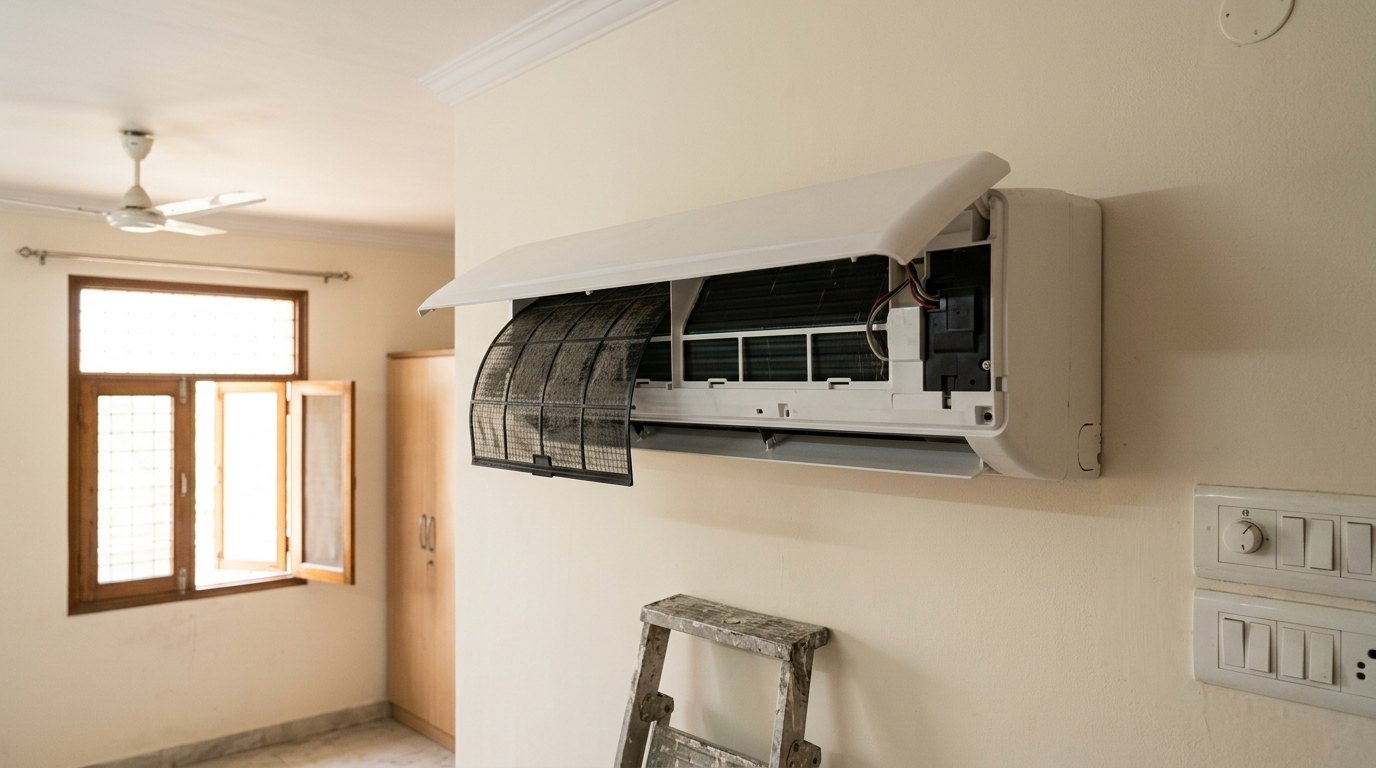
Published service prices put a rupee figure on the moment you stop checking things yourself: ₹299 for someone to look, ₹3,000 if the answer is gas, in Delhi NCR and Mumbai as of September 2026.
By Samiya, HomeVerdicts. Researched from manufacturer documentation, BEE’s labelling documents and published service listings on 13 September 2026. We do not test products. Every number here traces to a page someone published, or is labelled as something we could not source.
 LG 1.42 Ton 5 StarSmart Inverter split AC, 5800W max cooling, copper tubes₹47,000Amazon, 8 Nov 2026★ 4.0Check price ↗
 Panasonic 1.5 Ton 3 StarPremium Wi-Fi inverter smart split AC₹37,000Amazon, 8 Nov 2026★ 3.9Check price ↗
 Hitachi 1.5 Ton 3 StarSmart Choice inverter split AC, copper₹35,500Amazon, 8 Nov 2026★ 4.0Check price ↗
 Carrier 1 Ton 3 StarFlexicool inverter split AC, copper₹32,000Amazon, 8 Nov 2026★ 4.2Check price ↗
The finding first: what the decision costs in rupees
Almost everything you can check yourself is free. The real question is when to stop and pay someone, and that is a rupee question, so here are the only rupee figures we could source. Urban Company publishes an AC price list on its city pages, read on 13 September 2026:
| Service, as published 13 September 2026 | Delhi NCR | Mumbai |
|---|---|---|
| AC repair, “complete check-up to identify issues before repair” | from ₹299 | from ₹299 |
| Gas refill and check-up, 2 hrs 30 mins | ₹3,000 | ₹3,000 |
| AC service, indoor deep clean, foam and jet spray | from ₹599 | not listed |
In band form: ₹299 to ₹3,000 covers a diagnostic visit through a gas refill, as of September 2026. “From ₹299” is a floor the listing sets, not a final bill.
One vendor, two city pages, one source. Those pages agree exactly on ₹299 and ₹3,000, and they are still the same company, so we count them as one source, not two that agree. Nothing here establishes a market rate.
Now the comparison that gives ₹3,000 its weight. Moving from a 3-star to a 5-star 1.5-ton split is worth a computed ₹2,154 to ₹3,849 a year. That range is arithmetic, not a published claim: we computed it from the BEE-label annual consumption figures of three 1.5-ton brand pairs, at Maharashtra residential tariff slabs for FY 2026-27, on BEE’s statutory basis of 1,600 cooling hours a year. Side by side, one published gas refill costs roughly a full year of the entire 3-star to 5-star efficiency gap.
The ₹3,000 is Urban Company’s published price, the ₹2,154 to ₹3,849 is our arithmetic over two sourced inputs, and setting the two against each other is our own reading rather than anyone’s published finding.
Air conditioner not cooling: the checks, in order
Onida, Haier India and Kelvinator India each publish the same core causes: a dirty or clogged air filter, low or leaking refrigerant, a blocked or dirty condenser or outdoor unit, a wrong thermostat setting, and a frozen or dirty evaporator coil. Onida puts some on its do-it-yourself side and some firmly on the technician’s. One of them is the ₹3,000 one.
- Check the mode and the setpoint before touching anything. Onida’s published instruction is to set the unit to Cool at 24°C, and it states that “temperatures above 26°C provide minimal cooling”. It also notes Fan Only mode “often activates after a power cut”. A unit left in Fan Only moves air and cools nothing, and nothing else on this list fixes that.
- Pull the filter out and look at it. All three brands name a dirty or clogged filter among the core causes, and Onida lists it as safe to handle yourself.
- Walk to the outdoor unit. Onida asks for 30cm of clearance around it. Check what has piled up against it since last summer, and whether it now sits in direct afternoon sun.
- Think about your supply voltage, especially on an older unit. A compressor that trips repeatedly in the afternoon is a different problem from a dirty filter.
- Flush the drain pipe. Onida publishes a six-month interval for this and lists a clogged drain pipe as safe to clear yourself.
- Check the room against the tonnage. If the unit has never cooled this room properly, the fault may not be a fault at all.
Stop here if you hear unusual hissing or bubbling, if the compressor will not start or keeps tripping, or if you suspect a gas leak. Onida’s published rule is direct: “anything involving refrigerant, the compressor, or electrical components is not a DIY task.”
The India-calibrated numbers behind those checks
Nearly every figure below comes from one manufacturer page, Onida’s, read 13 September 2026. Treat it as one manufacturer’s position. Where a second brand publishes something different, both are here.
Dust sets the filter interval, and the interval is disputed. Onida states that in dusty cities like Delhi and Ahmedabad, filters can clog in as little as 2 to 3 weeks during peak summer, and recommends cleaning every 2 to 4 weeks. Kelvinator publishes a different interval: inspect the filter every 30 days during peak usage. Both are manufacturers, neither outranks the other, and we will not average them into a number nobody published. The honest version is the spread itself, every 2 weeks to every 30 days, and toward the short end in Delhi or Ahmedabad dust. Onida also states a blocked filter can raise electricity consumption by 10% to 25%.
Heat derates the machine you already own. Onida publishes that at 45°C, a blocked outdoor unit can reduce a 1.5-ton AC’s cooling capacity by up to 20%, which is what makes the 30cm clearance a specification rather than housekeeping. A unit in direct afternoon sun runs 5% to 10% less efficiently, per the same page, which frames its whole list against “the harsh Indian summer”, defined there as 40°C to 45°C with high dust.
Voltage is a cooling problem, not only an electrical one. Onida states that Indian power grids “can dip below 200V during peak summer, causing the compressor to trip”, and that its inverter range runs without a stabiliser from 140V to 290V. For older ACs it recommends a stabiliser. That window is Onida’s figure for Onida’s own inverter units, not an industry specification. The wider compressor question sits on our inverter AC vs non inverter AC page.
Sizing sets a ceiling nothing else can lift. Onida publishes that a 1-ton AC works best for rooms up to 120 sq ft, and that in larger spaces at 45°C it cannot reach the set temperature. If that is your room, no filter cleaning and no gas refill changes the outcome.
Where DIY stops and a technician starts
Onida publishes an explicit split. This is one manufacturer’s position, published on its own site, not an industry consensus:
| Onida lists as safe to do yourself | Onida says call a technician |
|---|---|
| Dirty air filter | Low refrigerant or a gas leak |
| Wrong thermostat mode or setting | Compressor not starting, or tripping |
| Clogged drain pipe | Unusual hissing or bubbling |
| Adjusting for a room that is too large | PCB replacement |
| Outdoor unit fins, partial | Recurring voltage-fluctuation trips, partial |
| Thawing ice on the indoor unit, partial |
Crossing from the left column to the right is where money starts. On the published prices above, a diagnostic visit starts at ₹299 in both Delhi NCR and Mumbai, and a gas refill is listed at ₹3,000 in both, as of September 2026.
Manufacturers do not publish what their own service costs. We looked. Voltas’ own service-charges page shows a page-not-found error, and none of the Voltas, Daikin India, Onida, Haier or Kelvinator pages we read carries a rupee price for a service call or a gas refill. The brand that sold you the machine and tells you to call a technician does not, on the pages we could reach, tell you what calling one costs. That is why the only priced answer here comes from a third-party platform, in two cities, from one source.
What a technician visit actually buys
The ₹299 entry is described on the listing as a complete check-up to identify issues before repair, so it buys a diagnosis, not a fix. The ₹3,000 gas refill is listed at 2 hours 30 minutes and includes a check-up. Both city pages publish 30 days of warranty on service and repairs, worth knowing before agreeing to a quote.
Onida publishes what a full pre-summer service should contain, which makes a usable checklist: booked in February or March, covering coil washing, drain flushing, a refrigerant check and an electrical inspection. Onida also publishes its warranty terms as 1 year comprehensive, 5 years on the PCB and 10 years on the compressor. Those are Onida’s terms for Onida units, and PCB and compressor are precisely the failures on the technician side of the split above, so read your own warranty before paying for either.
What we could not verify
Being specific about this is deliberate, not an apology.
- Any manufacturer service price. Searched across Voltas, Daikin India, Onida, Haier and Kelvinator. Voltas’ service-charges page shows a page-not-found error. No rupee figure found on the pages we read.
- A second service-pricing provider. Only Urban Company was sourced, and only for Delhi NCR and Mumbai. Those two cities do not establish a national rate, and we cannot tell you what is normal in Bengaluru, Chennai, Pune or Hyderabad.
- The filter cleaning interval. Two manufacturers publish two different intervals. We report both and pick neither.
- Most of the India-specific numbers. The voltage window, the dust figure, the 20% derating, the sun penalty and the 120 sq ft sizing figure each come from one manufacturer page. One source is one source.
- Any regulator backing for the 24°C setpoint. That number is Onida’s published recommendation. The BEE requirement for a 24 °C default setting that we could source sits in Schedule 24, which covers light commercial air conditioners above 10.5 kW rather than residential room ACs, so it does not corroborate a recommendation for a home split.
- The “3-minute rule”. We searched the manufacturer pages we read and found no published statement of any 3-minute rule. See the FAQ below.
How we decide what counts as sourced is set out at how we research. The dust that shortens your filter interval settles elsewhere in the same room too, which is what our ceiling fan cleaning page covers.
Frequently asked questions
Why is my AC running but not cooling?
Work the order above. Mode and setpoint first, since Onida notes Fan Only often activates after a power cut, which runs the unit without cooling. Then the filter, which Onida, Haier India and Kelvinator India each name among the core causes. Then the outdoor unit, its 30cm clearance and its sun exposure. If it is still not cold and you hear hissing or the compressor keeps tripping, that is the technician’s side of Onida’s split, from ₹299 to diagnose.
What is the 3-minute rule for air conditioners?
We could not source it. Nothing in the material we read from Onida, Haier India, Kelvinator India and Voltas describes a “3-minute rule”. That is not the same as saying no manufacturer publishes one anywhere. It means we found nothing we could attribute, and we would rather say so than write a confident answer without a source.
How do I reset an AC that is not cooling?
The only reset in the manufacturer guidance we read is a settings reset: put the unit back into Cool mode at 24°C, since Onida notes Fan Only often activates after a power cut and that anything above 26°C gives minimal cooling. We could not source a published power-cycle or button sequence from any manufacturer page we read, so we will not invent one.
Why is my AC blowing warm air?
Air that is not cold lands back on the list Onida, Haier India and Kelvinator India publish as the core causes of an AC that is not cooling: filter, refrigerant, outdoor unit or condenser, thermostat setting, frozen or dirty evaporator coil. Two of those sit at opposite ends of the cost range. A blocked filter is free to clean and, per Onida, can raise consumption by 10% to 25%. A refrigerant leak is not yours to fix, per Onida’s rule about refrigerant, compressor and electrical components, and a gas refill is the ₹3,000 line item.
When should I call a technician instead of doing it myself?
Onida’s published line is refrigerant, compressor and electrical components. Everything else on its DIY list, filter, thermostat, drain pipe and room-size mismatch, costs nothing to check first. Priced, that decision is from ₹299 for a diagnostic in Delhi NCR or Mumbai as of September 2026, and ₹3,000 if it turns out to be gas, which is roughly a full year of the 3-star to 5-star efficiency gap we computed above.
Related reading on HomeVerdicts: