AC Gas Leakage (2026): Signs, Safety, Refill Cost and What to Ask Before You Pay
What Daikin, LG, Samsung, Voltas and Panasonic publish about refrigerant leaks in Indian room ACs: the signs, the error codes, the safety data, the rate cards and the warranty lines on gas charging.
 LG 1.42 Ton 5 StarSmart Inverter split AC, 5800W max cooling, copper tubes₹47,000Amazon, 8 Nov 2026★ 4.0Check price ↗
 Panasonic 1.5 Ton 3 StarPremium Wi-Fi inverter smart split AC₹37,000Amazon, 8 Nov 2026★ 3.9Check price ↗
 Hitachi 1.5 Ton 3 StarSmart Choice inverter split AC, copper₹35,500Amazon, 8 Nov 2026★ 4.0Check price ↗
 Carrier 1 Ton 3 StarFlexicool inverter split AC, copper₹32,000Amazon, 8 Nov 2026★ 4.2Check price ↗
AC gas leakage: the short answer
LG’s service guide says gas refilling is needed “when the cooling performance of the AC is low”, and that this “generally happens when there is a leakage of the refrigerant.” Daikin’s R32 manual says the refrigerant “is safe and normally does not leak”, and that after a leak you should not use the AC “until a qualified service person confirms that the leakage has been repaired.”
- Signs: LG lists warm air, ice on the coils, hissing and longer cooling time. Daikin shows U0 for refrigerant shortage; Samsung shows EC, which Samsung says can also be a sensor issue.
- Safety: every current Daikin, Panasonic and LG India room AC model we read uses R32. Daikin’s table citing ISO 817 places it in the lower-flammability class; the safety data sheets we read call it extremely flammable under GHS.
- If you suspect a leak now: Daikin’s R32 operation manual says “Do not use the air conditioner until a qualified service person confirms that the leakage has been repaired”, and warns that in a leak, contact with “a naked burner, heater or cooker may result in generation of noxious gas.” An R32 safety data sheet (RGAS) says “Ventilate the area.” Full wording in the safety section below.
- Cost: for gas charging, LG’s inverter-AC line and Samsung’s inverter-split line both list ₹2,750, taxes extra.
- Before you pay: ask where the leak is and how it was found. LG: “Gas refill should always include leak detection.”
Signs of AC gas leakage, and the error codes that name it
LG’s list. LG India’s service guide names four signs: “AC blowing warm air · Ice formation on coils · Hissing sound from unit · Longer cooling time”.
Daikin’s version is shorter. Its R32 manual: “If the air conditioner is not operating correctly, i.e. not generating cool air, refrigerant leakage could be the cause. Consult your service centre for assistance.”
Ice, then water. Samsung India: “If there is a refrigerant leak, the first symptom may be coil icing.” Daikin and Voltas both list low refrigerant among the reasons an AC leaks water, through a frozen coil. That route is covered in our AC leaking water guide.
Error codes, as the makers publish them:
| Brand | Code | What the maker says |
|---|---|---|
| Daikin | U0 | “REFRIGERANT SHORTAGE” (error-code page and manual agree) |
| Samsung | EC | “appears if a gas leakage is detected or the sensor is not functioning” |
| Samsung | C 554 | “Lack of Refrigerant. (For Inverter model only)” · “Check for refrigerant leaks” |
| Samsung | C 422 | “Refrigerant flow blocking error” · “Check for refrigerant leaks” |
Samsung’s C 554 and C 422 are installer codes from its Smart Install guide. For EC, Samsung gives a check before anyone is called: “switch off the AC from the main power supply and then turn it ON. If the error disappears, there might have been a sensor issue.” We found no refrigerant-loss code in the LG, Voltas, Panasonic or Blue Star pages we read.
If your AC runs warm with none of these signs, the wider diagnosis is in our AC not cooling guide.
Is AC gas leakage dangerous?
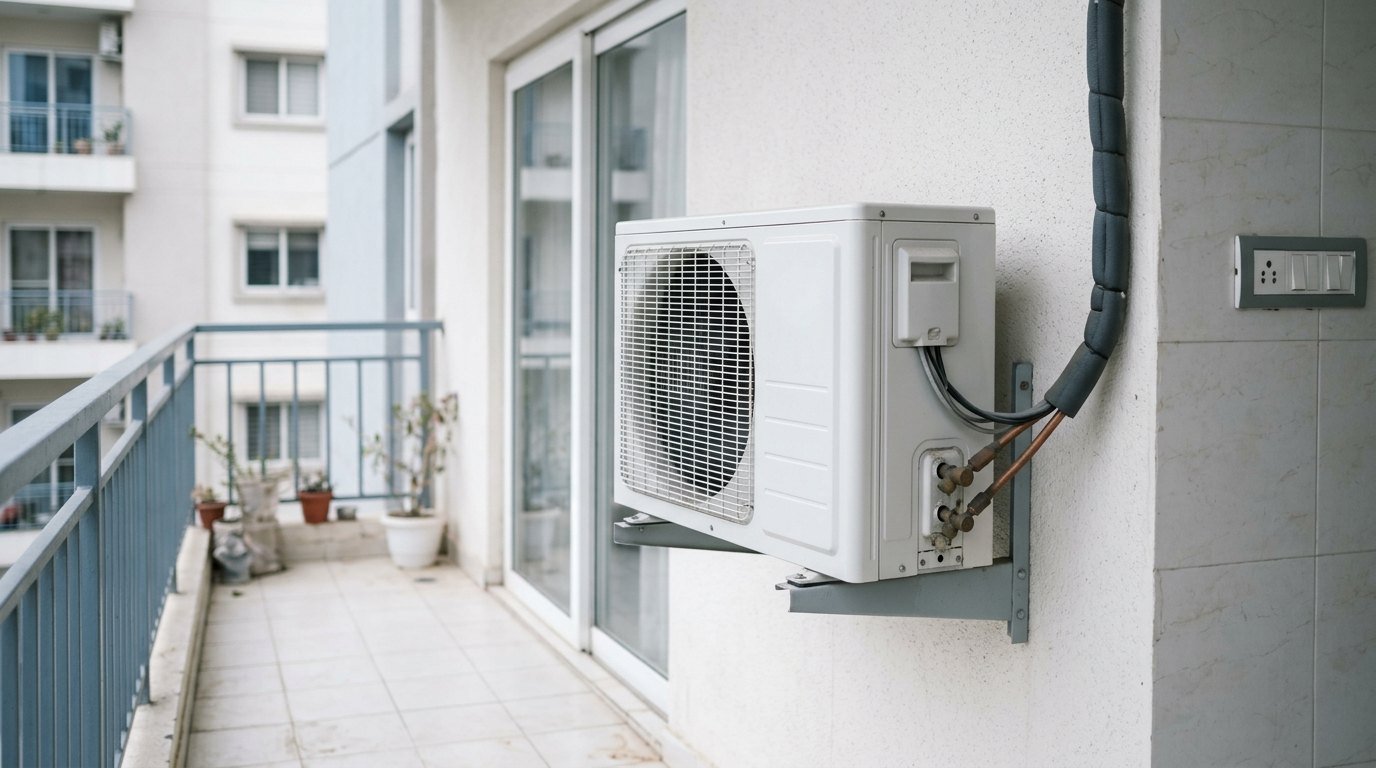
Which gas is in your AC. Every current Daikin, Panasonic and LG India room AC model we read lists R32. Daikin India says its India-made room AC models use R-32 and that it “phased out all R-22 model”. To check your own unit, Daikin’s manual points to the outdoor unit: “Do not use a refrigerant other than the one indicated on the outdoor unit (R32).”
Flammability class, per Daikin’s table citing ISO 817:2014:
| Refrigerant | Class on Daikin’s table | Daikin’s description of the class |
|---|---|---|
| R-32 | A2L | “Lower flammability” |
| R-410A | A1 | “No flame propagation” |
| Propane (R-290 is propane’s designation) | A3 | “Higher flammability” |
Daikin adds that 2L refrigerants “present the lowest risk of the 3 flammable categories”. The three R32 safety data sheets (SDS) we read use a different scheme, GHS, and each classifies R32 as “Extremely flammable gas” (H220). The two R-410A SDSs we read say “Non-flammable”.
What Daikin’s R32 manual says, verbatim: “Beware of fire in case of refrigerant leakage. … The refrigerant within the air conditioner is safe and normally does not leak. However, in the event of a leakage, contact with a naked burner, heater or cooker may result in generation of noxious gas. Do not use the air conditioner until a qualified service person confirms that the leakage has been repaired.” The installation section of the same manual adds: “When refrigerant gas leaks occur, ventilate the room as soon and as much as possible.”
What an R32 SDS says. RGAS’s sheet: “Evacuate personnel to safe areas.” “Eliminate all ignition sources.” “Ventilate the area. Vapors are heavier than air and can cause suffocation by reducing oxygen available for breathing.”
Where the brands differ. Samsung’s page for a gas smell of unknown origin and Daikin’s R32 manual differ on when to run the AC; both are quoted in full in our guide to a smell from an air conditioner.
Refilling it yourself. Voltas: “Never try to refill refrigerant yourself”, because it is “a technical job for certified professionals.”
AC gas refill cost: the manufacturer rate cards
| Whose card | Item, as printed | ₹ | Taxes | Date |
|---|---|---|---|---|
| LG India | Gas Charging, “Inverter AC / Cassette AC” | 2,750, plus transport 600 | Extra | w.e.f. 17 February 2026 |
| LG India | Gas Charging, “Split AC (R22)” | 1,500 | Extra | w.e.f. 17 February 2026 |
| LG India | Gas Charging, “Window AC (R22) / Inverter” | 1,100 | Extra | w.e.f. 17 February 2026 |
| Samsung India | “Gas charges (Inverter Split AC)” | 2,750 | Extra | No effective date given on this page; read 30 September 2026 |
| Samsung India | “Gas charges (Non Inverter Split AC)” | 1,500 | Extra | Read 30 September 2026 |
| Samsung India | Window AC “Gas charges” | 1,100 | Extra | Read 30 September 2026 |
| Urban Company (a third-party service vendor, not a manufacturer) | “Gas refill & check-up”, Delhi NCR and Mumbai | 3,000 | Not given on this page | Read 13 September 2026 |
Samsung’s terms say its gas charges “shall be inclusive of consumables used in gas charging” and that “For On-Site service transportation charges may apply.” LG’s terms say gas charging is among the “Additional standard service charges also to be paid by customer”.
With tax, our arithmetic. Both cards say taxes are extra. At 18%, the GST rate Daikin’s own installation card applies, ₹2,750 becomes ₹3,245, before LG’s ₹600 transport line. That is our sum, not a figure LG or Samsung prints.
Cards we could not use. Daikin’s installation rate card has no gas-charging line; its Annual Service Care plan includes “Refrigerant Gas charging at the time of Compressor / Sensor / Four way valve replacement”. Panasonic’s out-of-warranty chart is an image that refused our request: an access failure, not proof it lacks a gas price. The Blue Star service pages we checked carried no room-AC rate card.
The repair itself. No manufacturer page we read prices the leak repair. The only pressure-test prices we found are installation lines: Daikin ₹600 per unit (₹708 including GST, rates w.e.f. 1 March 2026) for nitrogen pressure testing, and Voltas ₹750 per unit for “nitrogen flushing & pressure testing” on old refrigerant pipes.
Is AC gas leakage covered by warranty?
Daikin and Voltas put gas charging on the customer during the additional compressor warranty after year 1; LG does so during its compressor warranty for purchases from 1 August 2024. In the Panasonic warranty pages we read, gas appears only in a paid plan:
- Daikin: the additional compressor warranty, after year 1, “shall not cover gas charging, related labour and transportation charges”. Daikin’s Annual Service Care plan also excludes “Refrigerant leakage due to corrosion in environmental conditions”.
- Voltas: in the additional compressor warranty after year 1, “the additional/ancillary cost associated with Gas, Labour, Transportation or any other parts shall be borne by the purchaser.”
- LG: its rate-card note says that for compressor failure during the compressor warranty, “From 1st Aug 2024 purchase both gas and labor amount to be paid by customer.” Purchases before 31 July 2024 pay labour only. Two LG listings on Amazon.in add “*Free Gas charging during comprehensive period only | T&C Apply”; that line is on Amazon, not on the LG pages we read.
- Panasonic: its free “1+9” compressor scheme on selected inverter models is “Part Cost Payable by Company”. In those pages, gas appears only in a separate paid plan, the “1+5 Year Extended Promotional Warranty@499+tax”: compressor “Part cost + Gas charging Payable by Company” from the 1st to the 6th year, part cost only from the 7th to the 10th. Its published offer window ran from 1 March to 30 September 2026, and under it visit, labour and transport charges fall to the customer after the first year.
LG’s parts table gives a replaced split-AC part 12 months, listing “Gas charging (Gas Top-Up not to be considered)”.
Before you pay for gas: questions to ask
We found no manufacturer checklist for checking a leak diagnosis. These questions are ours, and each traces to a published line.
- Where is the leak, and how was it found? LG: “Gas refill should always include leak detection.” Voltas lists “Get professional leak detection”, then “Refill refrigerant after repair”.
- Has the leak been repaired? Daikin: do not use the AC “until a qualified service person confirms that the leakage has been repaired.”
- Does the unit show a code? Daikin U0 reads “REFRIGERANT SHORTAGE”. On a Samsung showing EC, run Samsung’s power-cycle check first; Samsung says EC can also be a sensor issue.
- Is it inside warranty, and what do your brand’s terms say about gas? See the warranty section. On LG, the answer depends on whether you bought before 31 July 2024 or from 1 August 2024.
- Is this a repeat after a recent LG service? LG: “No service charges applicable if complaint repeats within 3 months from date of service invoice.”
- Whose copper pipe is it? Daikin: “If copper pipe Supplied by customer, any leakage from copper pipe is in customer’s scope.” Voltas: “In case of leakage in Copper pipe provided by customer there will be no Gas Leakage warranty.” Both price a nitrogen pressure test for pre-laid (Daikin) or old (Voltas) pipes, listed above.
- Does the charge match the maker’s card, and are taxes and transport extra? Compare against the LG and Samsung lines in the table.
- Is the technician authorised by the brand? Daikin’s warranty document says the warranty is void if the compressor fails because of a lack of proper preventive maintenance “or if the Product is repaired or attended by an unauthorized person.”
The four manufacturer pages behind the LG and Samsung rate-card lines, LG’s service-guide lines and the Daikin-manual lines on this page: LG India’s warranty terms and rate card, Samsung India’s out-of-warranty repair charges, LG’s AC service guide and Daikin’s MTKM50XV16 manual, all read 30 September 2026.
What we could not verify
- Stop-leak or sealant products: no Indian manufacturer page we read mentions them.
- Whether gas leaks from an unused AC, or how long an AC runs with a leak: no manufacturer we checked publishes either.
- Refrigerant-loss error codes for LG, Voltas, Panasonic and Blue Star: not in the pages we read.
- Refrigerant safety groups from ASHRAE directly: its designation page did not show them, so the classes above are Daikin’s.
- An Indian room AC on R-290: none of the pages we read names one.
FAQ
Is AC gas harmful?
The sources behind this page address oxygen, fire and noxious gas. RGAS’s R32 SDS says vapours “can cause suffocation by reducing oxygen available for breathing” and says to ventilate. Daikin says contact with “a naked burner, heater or cooker may result in generation of noxious gas.”
What is the AC gas leakage repair cost?
For gas charging, LG’s inverter-AC line and Samsung’s inverter-split line both list ₹2,750, taxes extra (LG adds ₹600 transport). Urban Company listed ₹3,000 for a gas refill and check-up in Delhi NCR and Mumbai on 13 September 2026. We found no manufacturer price for the leak repair itself.
Can AC gas leakage cause death?
The sources behind this page do not answer that directly, and we add no scenario of our own. What they do say: RGAS’s R32 SDS warns of suffocation, and Daikin warns of fire and of noxious gas on contact with a flame. What to do is in the short answer at the top: Daikin says not to use the AC until a qualified service person confirms the repair, and the R32 safety data sheet says to ventilate the area.