AC Leaking Water: Is It Normal, Where Is It Coming From, and Whose Fix to Follow?
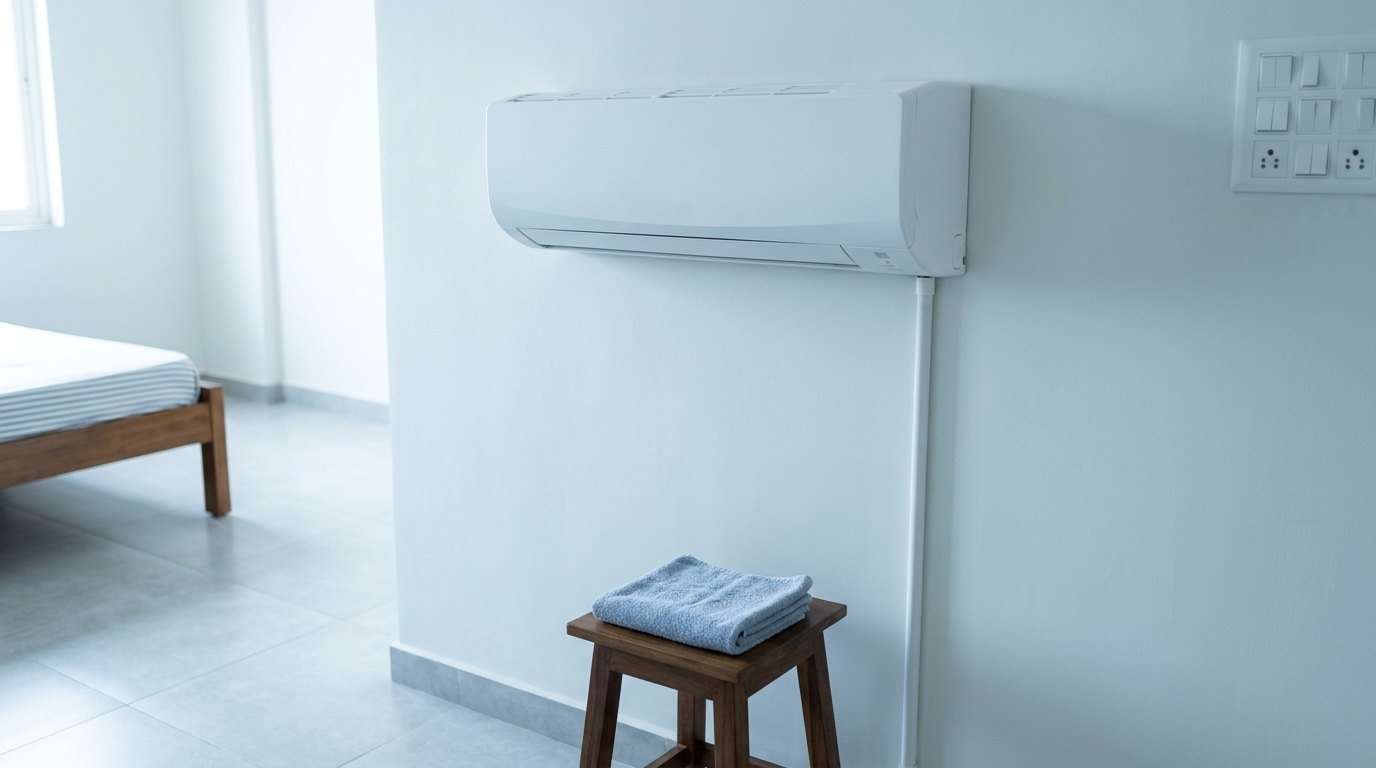
What Daikin, Voltas, Samsung and Panasonic publish about water from an air conditioner: which water is expected, what causes a leak, and where the makers disagree on what you should do.
 LG 1.42 Ton 5 StarSmart Inverter split AC, 5800W max cooling, copper tubes₹47,000Amazon, 8 Nov 2026★ 4.0Check price ↗
 Panasonic 1.5 Ton 3 StarPremium Wi-Fi inverter smart split AC₹37,000Amazon, 8 Nov 2026★ 3.9Check price ↗
 Hitachi 1.5 Ton 3 StarSmart Choice inverter split AC, copper₹35,500Amazon, 8 Nov 2026★ 4.0Check price ↗
 Carrier 1 Ton 3 StarFlexicool inverter split AC, copper₹32,000Amazon, 8 Nov 2026★ 4.2Check price ↗
The short answer. Daikin says water dripping from the outdoor unit in cooling is normal, and Samsung calls condensation on the outdoor coil connection “standard”. Water leaking from the indoor unit is different: Daikin says to stop operation and switch off, and Voltas says it is “not advisable to run an AC when water leakage is visible.” Samsung tells owners to change settings first. Daikin also says moisture “may condense on the indoor unit and drip on certain conditions”; its drain-flow check is below. None of the manufacturer pages we read publishes an amount of water that separates normal from a fault.
Can I keep running my AC if it is leaking water?
Two makers say no, one says try settings first. Their words, each under its publisher’s name:
- Daikin India, troubleshooting page: “Water leaks from the indoor unit. Stop operation, unplug the power cord or turn off the circuit breaker, and contact the place of purchase.” Its operation manual lists “Water leaks from the indoor unit” among symptoms where you should “call your service centre immediately”.
- Voltas, FAQ: “It is not advisable to run an AC when water leakage is visible. … Water can come into contact with electrical parts and increase the risk of short circuits or system damage. It is better to switch off the unit and identify the cause before using it again.”
- Samsung India, indoor-unit leak article (updated 15 July 2026): “Increase your set temperature and it is recommended to keep it at 24° C · Run AC in Dry Mode for 3-4 hours before switching back to Cooling Mode · Set the fan speed to medium or high”. If the leak continues, “contact Samsung customer care”.
Whose instruction to follow: your own brand’s. These are instructions each maker writes for its own units, and we have not merged them into one rule.
Water that is not a leak
Before treating water as a fault, check whether the manufacturers call it expected.
The outdoor unit dripping. Daikin’s product-care page, for the outdoor unit in cool mode: “Moisture in the air condenses into water on the cool surface of the outdoor unit pipe, which causes water to drip. Water from the outdoor unit must be discharged to a place of good drainage.” Its manual lists the same thing under “These cases are not problems.” Samsung India says condensation on the outdoor coil connection “is standard and does not suggest any complications”.
More water than usual. Daikin’s FAQ: “The amount of drained water varies depending on room temperature and humidity. A large amount of drained water does not denote a malfunction.”
Some indoor dripping. Daikin’s product-care page says: “Moisture in the air may condense on the indoor unit and drip on certain conditions.” It advises not to place “anything which is not water resistant under the indoor and outdoor unit.” On the pages we read, Daikin gives no amount that separates this dripping from a leak. The same page also gives a drain-flow check, set out under the cause table below.
Other things that look like water trouble:
- Mist from the vents (Daikin): cold air “sometimes generates a mist.”
- A water-splashing sound (Samsung): “It is a normal operational noise. When the fan rotates it shoots water from the base and splashes it on condensing coils.”
- Droplets on the service valves (Samsung): “Water droplets may appear on the service valve due to high levels of humidity.” Samsung lists the causes as “High Humidity & Refrigerant Overcharge”. It does not call this normal on the page we read.
How much dripping is normal?
The only water-quantity figure any manufacturer page we read gives is Panasonic’s. Its spec tables for the 1.5 ton EU18, SU18 and HU18 splits and the CW-XU185CGT window AC state “Moisture Removal Rate (l/h) 1.2”. That is a rated figure: the water the unit is rated to pull out of the air per hour at test conditions. It is not a leak threshold, and no Panasonic page we read presents it as one. Daikin says the amount of drained water “varies depending on room temperature and humidity.” We found no manufacturer figure for how much water counts as abnormal.
Why an AC leaks water: causes, and who names each
Sources: Daikin India’s leak blog (undated), Voltas’s leak blog (25 May 2026), Daikin’s manual and support pages, and Samsung India support articles, all read 30 September 2026. “Two or more” means at least two makers name the cause; “one maker” means only that maker does in what we read.
| Cause | Who names it | Their words |
|---|---|---|
| Clogged drain pipe | Daikin, Voltas (two or more) | Daikin: “dust, dirt, rust, debris and algae”. Voltas: “Clogged Drainpipe” |
| Dirty air filter, coil freezes | Daikin, Voltas (two or more); Samsung names the icing | Voltas: “Ice formation on coils · Water leakage when the ice melts” |
| Low refrigerant, coil freezes | Daikin, Voltas (two or more); Samsung names the icing | Samsung: “If there is a refrigerant leak, the first symptom may be coil icing” |
| Improper installation or slope | Daikin, Voltas (two or more) | Voltas: “The indoor unit needs a slight tilt for water to flow toward the drain outlet” |
| Broken condensate pump | Daikin, Voltas (two or more) | Voltas lists it “(if applicable)” |
| High humidity | Voltas, Daikin’s manual (two or more) | Voltas: “Use dry mode”. Daikin’s manual: run outside its operating range (indoor humidity “80% max.”) in COOL or DRY and dew may form on the indoor unit and drip from it. The Samsung leak page we read gives Dry Mode advice and names no cause |
| Damaged or rusted drain pan | Voltas (one maker) | “Damaged or Rusted Drain Pan” |
| Disconnected drain pipe | Daikin (one maker) | “Disconnected drainpipe” |
| Dirty evaporator coils | Daikin (one maker, as a leak cause); Samsung names the icing | “Dirty coils” |
Two rows share one route: the coil freezes, and, in Voltas’s words, “Water leakage when the ice melts”. Daikin’s blog says dirty filters make the coils “get too much cold and then freeze”, and that “Low refrigerant levels or a defective expansion valve can also cause … the evaporator coil to freeze.” Samsung’s frost article names a dirty filter and low refrigerant as causes of coil frost and icing; the step from ice to leaking water comes from Daikin’s and Voltas’s leak pages.
On the pump: Daikin’s leak blog lists “Broken condensate pump”, and Voltas lists it “(if applicable)”. Daikin’s FAQ describes a drain pump that runs “for several minutes” after cooling stops on business-use models.
Daikin’s product-care page gives a check anyone can make: look at whether “the water from the drainage end of the pipe is flowing smoothly during cooling.” The same page says: “If there is no drain water, water may be leaking from the indoor unit. Stop operating and consult the service shop for general servicing.”
Where the water appears
- Dripping from the front panel. Voltas lists “Visible dripping from the front panel” as a sign of a clogged drainpipe.
- Water at the edges of the unit. Voltas lists “Leakage from the edges of the unit” as a sign of improper installation.
- Water running down the wall. No manufacturer page we read diagnoses this. What Daikin publishes is the installation rule its manual sets for a split: drill the wall hole “at a downward angle toward the outside”, and “The drain hose should be inclined downward. No trap is permitted. Do not put the end of the hose in water.” That is an installation requirement, not a diagnosis of your leak.
- Window AC leaking water. Not published on any manufacturer page we read; the Daikin, Voltas and Samsung leak pages address split units.
What you can do yourself, and when to call service
The makers draw the line in different places.
Voltas lists DIY fixes: “Clean or flush the drainpipe”, “Clean filters at regular intervals”, “Adjust the AC angle for proper drainage” and, for icing, “Turn off the AC to allow defrosting”. Voltas says to call a technician if “Leakage continues after cleaning the filters and the drainpipe”, “You notice signs of refrigerant issues”, “Cooling performance drops significantly” or “Electrical or internal components show faults”. For low refrigerant: “Get refrigerant checked and refilled by a technician.”
Samsung gives a frost fix: “turn the unit to Fan only … and set the speed to high. The unit should defrost fairly quickly ( 5 – 15 minutes). Then, run the unit in Fan mode until the coils or vents are dry”.
Daikin tells owners to stop and call service. Its manual: “Do not attempt to repair, dismantle, reinstall or modify the air conditioner yourself as this may result in water leakage, electric shock or fire hazards.” Its instruction for an indoor leak is to turn off the circuit breaker and call the service centre.
So Voltas lists drainpipe flushing as a fix, while Daikin’s manual tells owners to call the service centre. Your brand’s own instructions govern.
If the unit is also not cooling properly, that diagnosis is in our AC not cooling guide. If the leak comes with a damp or musty smell, see smell from air conditioner.
Water leak or gas leak?
They are different leaks, but Daikin and Voltas both list low refrigerant as a cause of water leaks, through a frozen coil; Samsung names low refrigerant as a cause of coil icing (table above). Some units also show a published error code:
- Daikin: code U0, “REFRIGERANT SHORTAGE”, and code A5, “FREEZE-UP PROTECTOR” (Daikin’s error-code page and manual).
- Samsung: “EC error code appears if a gas leakage is detected or the sensor is not functioning.” Samsung’s Smart Install guide lists code C 554 as “Lack of Refrigerant. (For Inverter model only)”.
LG, Voltas, Panasonic and Blue Star refrigerant-loss codes were not published on the pages we read. For refrigerant leaks themselves, see our AC gas leakage guide.
What we could not verify
- A “normal vs abnormal” amount of water: not on any manufacturer page we read. Panasonic’s 1.2 l/h is a rated moisture-removal figure, not a threshold.
- Window AC leak causes: not published on the pages we read; we found no window AC manual.
- A diagnosis for water coming from the wall: not published on the pages we read; only Daikin’s installation rule.
- How long an AC lasts with a leak: no manufacturer figure on the pages we read.
FAQ
Can I still use my AC if it’s leaking water?
Daikin says stop operation, switch off at the plug or circuit breaker and contact the place of purchase. Voltas says it is “not advisable to run an AC when water leakage is visible.” Samsung tells owners to set 24° C, run Dry Mode for 3-4 hours and set the fan to medium or high, then contact customer care if it continues. Follow your own brand’s instruction. Daikin calls outdoor-unit dripping in cooling normal, and Samsung calls outdoor coil-connection condensation “standard”. Daikin also says moisture “may condense on the indoor unit and drip on certain conditions”, and gives no amount that separates this from a leak on the pages we read.
How much water dripping from AC is normal?
No manufacturer page we read gives a normal-versus-abnormal amount. Panasonic rates its 1.5 ton EU18, SU18 and HU18 splits and CW-XU185CGT window AC at a moisture removal rate of 1.2 l/h at test conditions; that is a rating, not a leak limit. Daikin says drained water “varies depending on room temperature and humidity” and that a large amount “does not denote a malfunction.”
Why is my AC leaking water inside the room?
Daikin and Voltas both name a clogged drain pipe, and both name a frozen coil, from a dirty filter or low refrigerant, as a leak cause; Samsung names the same two as causes of coil frost or icing. Voltas ties front-panel dripping to a clogged drainpipe and water at the unit’s edges to improper installation. Of the pages we read, only Voltas names a damaged drain pan, and only Daikin names a disconnected drain pipe, and only Daikin names dirty coils as a leak cause; Samsung links debris-blocked coils to icing.