Difference Between 1 Ton and 1.5 Ton AC: Which Should You Actually Buy?
By Samiya
 Carrier 1 Ton 3 StarFlexicool inverter split AC, copper₹32,000Amazon, 8 Nov 2026★ 4.2Check price ↗
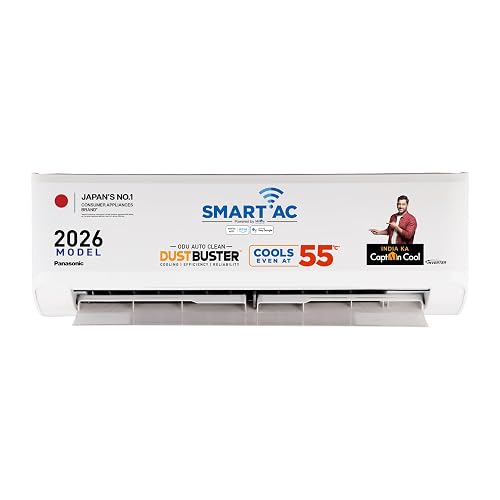 Panasonic 1 Ton 3 StarPremium Wi-Fi inverter smart split AC₹36,000Amazon, 8 Nov 2026★ 4.0Check price ↗


Prices and ratings in the boxes above are Amazon selling prices read on 8 Nov 2026, rounded to the nearest ₹100. Products are the most-rated ones of each type that we found, shown as examples, not a ranking. Prices quoted in the text below are from the dates given beside them and may differ from today’s Amazon price.
This page puts the difference between a 1 ton and a 1.5 ton AC into watts and rupees, using same-maker pairs from Daikin, LG and Voltas, and sets the makers’ room-size tables side by side. Maker and retail pages were read on 30 September 2026; BEE’s 1,600-hour rating basis and Maharashtra’s tariff order were read on 13 September 2026. Every difference between figures is our arithmetic.
The short answer. A ton is a cooling rate: 1 ton is 12,000 BTU per hour, about 3.517 kW, so 1.5 ton is 18,000 BTU per hour, about 5.28 kW. On Daikin’s same-series pairs, the 1.5 ton unit’s label shows about 42% to 43% more electricity a year than the 1 ton unit, at the same ISEER. At Maharashtra’s ₹12.40 per kWh slab, that is about ₹2,524 a year more at 5-star and ₹3,234 at 3-star (our arithmetic, on BEE’s 1,600-hour basis). On the voltas.com pairs we read on 30 September 2026, the 1.5 ton cost ₹7,500 more at 5-star and ₹3,500 more at 3-star.
- Choose 1 ton if your room falls inside LG’s or Voltas’s 1 ton band. Those bands end at 120, 130 or 150 sq ft depending on which page you read.
- Choose 1.5 ton if it falls inside their 1.5 ton band: 120 to 180 sq ft (LG), 131 to 190 (Voltas chart) or 150 to 200 (Voltas article). Past those, LG’s guide and Voltas’s chart move to 2 ton. On LG’s advice, go one size up if the room “faces direct sunlight, is on the top floor, or is in a high-heat city”.
What a ton is, and why the label is a class
Daikin prints “1TR (Ton of Refrigeration) = ~3.517 kilowatt” on its product pages, and its 2 ton blog says “each ton is equivalent to 12,000 BTUs”. Voltas gives one ton as 12,000 BTUs per hour and a 1.5 ton AC as 18,000 BTUs.
The “1.5 ton” on a box is a class, not a measurement. Rated capacity of five units, in tons at Daikin’s 3.517 kW:
| Model | Rated capacity | Maker’s label | Tons |
|---|---|---|---|
| Daikin MTKM35XV | 3.50 kW | 1.00 Tr | 1.00 (Daikin prints it) |
| Daikin MTKM50XV | 5.00 kW | 1.42 Tr | 1.42 (Daikin prints it) |
| LG AS-Q12CNXE | 3,345 W | “(~1.0)” | 0.95 (our arithmetic) |
| LG AS-Q18JNXE | 4,400 W | “(~1.5)” | 1.25 (our arithmetic) |
| Panasonic CS/CU-HU18CKY5XFMH-P | 5,280 W | “Tonnage Class (TR) 1.5” | 1.50 (our arithmetic) |
So the last two, both labelled as 1.5 ton class, differ by 880 W of rated cooling (our arithmetic). Compare the rated watts, not the ton label. On units: power is a rate, in watts; energy is power over time, in kWh.
1 ton vs 1.5 ton: same series, same star
Daikin publishes a 1 ton and a 1.5 ton unit in the same series at 5-star and at 3-star:
| Daikin model | Star | Rated capacity | ISEER | Annual energy, kWh |
|---|---|---|---|---|
| MTKM35XV (1 ton) | 5 | 3.50 kW | 5.70 | 475.37 |
| MTKM50XV (1.5 ton) | 5 | 5.00 kW | 5.70 | 678.92 |
| MTKL35XV (1 ton) | 3 | 3.52 kW | 4.40 | 619.31 |
| MTKL50XV (1.5 ton) | 3 | 5.0 kW | 4.40 | 880.1 |
Source: Daikin India’s product page for each model, read 30 September 2026. Amazon.in’s listings agree on the ISEER and annual kWh of the two 1.5 ton units; the 1 ton rows are Daikin’s alone.
The finding. At 5-star, the 1.5 ton label shows 203.55 kWh a year more (42.8% more); at 3-star, 260.79 kWh more (42.1%). Rated capacity rises by about the same share: 42.9% and 42.0%. ISEER does not change within either pair. All percentages are our arithmetic.
In rupees. The kWh figures rest on BEE’s statutory basis of 1,600 cooling hours a year, about 4.4 hours a day averaged over a year (our arithmetic). It is a yardstick, not your bill. We use Maharashtra’s MSEDCL residential slabs (FY 2026-27, effective 1 April 2026), leaving out the ₹130 monthly fixed charge. Pick the slab your household’s monthly units reach.
| MSEDCL slab | ₹ per kWh | Extra for 1.5 ton, 5-star pair | Extra for 1.5 ton, 3-star pair |
|---|---|---|---|
| 1 to 100 units | 5.56 | About ₹1,132 a year | About ₹1,450 a year |
| 101 to 300 units | 12.40 | About ₹2,524 a year | About ₹3,234 a year |
| 301 to 500 units | 16.64 | About ₹3,387 a year | About ₹4,340 a year |
All our arithmetic: the kWh gap multiplied by the slab rate. At ₹12.40, that averages about ₹210 and ₹270 a month across the year, not a peak-summer month.
LG’s watts. The part of LG’s product pages we could read (the key-spec block) gives a rated cooling power input, not a kWh figure:
| LG model | Star | Rated capacity | Rated power input |
|---|---|---|---|
| AS-Q14ENZE (“(1.0)”) | 5 | 3,500 W | 779 W |
| AS-Q19YNZE1 (“(~1.5)”) | 5 | 5,000 W | 1,176 W |
| AS-Q12CNXE (“(~1.0)”) | 3 | 3,345 W | 940 W |
| AS-Q18JNXE (“(~1.5)”) | 3 | 4,400 W | 1,267 W |
At 5-star, the 1.5 ton’s rated input is 397 W higher (about 51%) for 42.9% more rated capacity; at 3-star, 327 W higher (about 35%) for about 32% more capacity. Our arithmetic, from LG’s figures. This page has no kWh figure from LG for these four.
Which size for your room: the makers disagree
Every band below is as its publisher prints it (ranges written out), with its conditions quoted. We have not merged them into one rule, because they do not agree, including inside Voltas.
| Publisher | 1 ton | 1.5 ton | 2 ton | Conditions stated |
|---|---|---|---|---|
| LG capacity guide (12 May 2026) | Up to 120 sq ft | 120 to 180 sq ft | 180 to 240 sq ft; 240 and above labelled “2 Ton+” | “go one size up if your room faces direct sunlight, is on the top floor, or is in a high-heat city” |
| Voltas size chart (6 October 2023) | 91 to 130 sq ft | 131 to 190 sq ft | 191 to 250 sq ft | “The table assumes two people are in the room”; “Above Chart is for Rooms with ceiling height of 10 feet” |
| Voltas 1 ton vs 1.5 ton article (27 December 2024) | “rooms up to 150 square feet”, and in the same article “rooms up to 120 sq. ft.” | “150-200 square feet” | Not given | “with proper insulation” |
| Daikin 2 ton blog | Not given | Not given | “up to 300-350 square feet” | “strongly recommended to consult an air conditioning expert” |
None of these tables cites a method or standard for its bands, on the pages we read. Listing copy on Amazon.in differs again: Daikin’s MTKM50XV16 says “up to 150 sq.ft”, LG’s AS-Q18JNXE “111 to 150 sq.ft.”, and Panasonic’s SU18BKY3W “120-170 sq ft”, all for 1.5 ton class units.
Worked rooms. Floor area is our arithmetic; the size is what that column’s published band says.
| Room | LG guide | Voltas chart | Voltas 1 ton vs 1.5 ton article | Voltas room article |
|---|---|---|---|---|
| 10 x 10 ft = 100 sq ft | 1 ton | 1 ton | 1 ton | “a 0.75-ton or 1-ton AC is typically the best choice” |
| 12 x 12 ft = 144 sq ft | 1.5 ton | 1.5 ton | 1 ton under “up to 150”; under “up to 120”, no band (its 1.5 ton band starts at 150) | “a 1-ton AC is the most effective”, and also “A 1 to 1.5-ton AC is usually ideal” |
| 12 x 15 ft = 180 sq ft | Top of the 1.5 ton band and bottom of the 2 ton band | 1.5 ton | 1.5 ton | None read |
| 20 x 20 ft = 400 sq ft | “240 and above”, labelled “2 Ton+”, with no upper limit | Beyond its top band (2.5 ton, 251 to 310 sq ft) | Beyond its bands | None read |
At 12 x 12, the makers split between 1 and 1.5 ton. No 1 ton band in the tables we read reaches 180 sq ft. For 400 sq ft, LG says only “2 Ton+” and no other page we read names a size; Daikin’s 2 ton blog stops at “300-350 square feet”.
How to tell whether your AC is 1 ton or 1.5 ton
- Daikin prints both on the product page, “kW (Tr): 5.00 (1.42)”, and its manual says “Unit size available on name plate.”
- Samsung says where its model and serial number sticker is: “Indoor unit: New: it is pasted on right side (bottom)” and, outdoors, “on discharge pipe/suction pipe/control box”. It adds that the “Model Number would be same for indoor and outdoor units”.
- The BEE label, per Samsung, shows capacity and star rating: “All AC’s will have a BEE label on them.”
- Model numbers, an observation, not a published rule. Daikin’s digits track rated kW (MTKM35 is 3.50 kW, MTKM50 is 5.00 kW). Voltas’s 123INV and 125INV are its 1 ton 3-star and 5-star, 183INV and 185INV its 1.5 ton. LG’s do not map: AS-Q14ENZE is 3.5 kW and AS-Q18JNXE is 4.4 kW. None of the pages we read publishes a decoding rule.
Can a 1.5 ton AC run like a 1 ton?
The makers describe inverter capacity modes, all marketing claims: LG’s “Tonnage adjustment from 40% to 110%”, Panasonic’s converti8 cooling “ranging from 40% to more than 100%”, and Voltas’s “6 Step Adjustable Mode”. These vary output on an inverter unit, as the makers describe them. None of the pages we read describes physically converting a 1.5 ton AC into a 1 ton. For how inverter compressors differ, see inverter vs non-inverter AC.
Price difference, as of September 2026
Voltas pairs on voltas.com:
| Voltas pair | 1 ton | 1.5 ton | Gap (our arithmetic) |
|---|---|---|---|
| 5-star: 125INV vs 185INV Vertis AI Zest Gold | About ₹42,000 (3,450 W) | About ₹49,500 (5,050 W) | ₹7,500 |
| 3-star: 123INV Vertis Elite Gold vs 183INV Vertis AI Zest Gold | About ₹34,500 (3,350 W) | About ₹38,000 (5,100 W) | ₹3,500 |
Prices on voltas.com, 30 September 2026 (rounded). The 3-star pair spans two Vertis lines. Voltas’s pages we read give no energy figure for these four.
Makers’ own indicative bands: Voltas, 1 ton “around ₹25,000-₹35,000”, 1.5 ton “₹30,000-₹45,000 or more” (27 December 2024); LG, split 1 ton ₹30,000 to ₹45,000, 1.5 ton ₹38,000 to ₹55,000 (“Actual Prices vary”, 26 May 2026). For star ratings, see 5 star vs 3 star AC; for form factor, split AC vs window AC.
What we could not verify
- A method behind any sizing table. None of the pages we read cites one.
- A specific size for a 400 sq ft room from any maker page we read (LG’s “2 Ton+” sets no upper limit).
- A published model-number decoding rule from any maker page we read.
- Energy figures for LG’s and Voltas’s pairs. This page has none from either maker.
- Daikin’s 1 ton prices. This page has none. Rupee figures for other states’ tariffs are not on this page; it prices Maharashtra’s slabs.
FAQs
What size AC for a 12×12 room?
A 12 x 12 room is 144 sq ft. LG’s guide and Voltas’s chart put that in 1.5 ton. Voltas’s 12×12 article says “a 1-ton AC is the most effective” and also “A 1 to 1.5-ton AC is usually ideal”. Check your maker’s own table and LG’s step-up conditions.
Can we convert 1.5 ton AC to 1 ton?
None of the pages we read describes a physical conversion. LG, Panasonic and Voltas describe inverter modes that vary output (LG: “40% to 110%”).
How do I check if my AC is 1 ton or 1.5 ton?
Daikin’s manual says the unit size is on the name plate, and Samsung says the BEE label shows capacity. Divide the rated kW by 3.517 (Daikin’s conversion). Daikin’s product pages print the ton figure itself.
Does 1.5 ton AC consume more electricity than 1 ton?
On Daikin’s same-series labels, yes: 203.55 kWh a year more at 5-star and 260.79 kWh more at 3-star, on BEE’s 1,600-hour basis.
Related reading on HomeVerdicts: 5 star vs 3 star AC · Inverter vs non-inverter AC · Split AC vs window AC · How we research