Washing Machine Smell: What Does Each Smell Mean, and Whose Fix to Follow?

What Bosch, Haier, LG and Samsung publish about washing machine odours in India: the likely cause behind each type of smell, the habits each maker recommends, and where they disagree on vinegar and cleaners.
 LG 7 Kg 5 Star Front Load FHB1207Z2MFully automatic, DD technology, steam wash₹30,000Amazon, 8 Nov 2026★ 4.2Check price ↗
 Bosch 7 kg 5 Star Front LoadFully automatic front load washing machine₹28,000Amazon, 8 Nov 2026★ 3.9Check price ↗
 Samsung 7 kg 5 Star Top Load WA70BG4441YYTLFully automatic, Eco Bubble, Digital Inverter₹17,500Amazon, 8 Nov 2026★ 4.1Check price ↗
 VW Visio World 7.5 kg 5 StarAqua Spin semi automatic top load₹7,200Amazon, 8 Nov 2026★ 4.0Check price ↗
Burning or charred smell? Stop first. Bosch’s support page says that if the smell is more of a charred one, switch the machine off immediately and call customer service.
The short answer. Bosch, Haier and LG all tie washing machine smell to detergent dosing or residue inside the machine, and all three tell you to let the drum air after a wash. For a sewer or rotten-egg smell, Bosch says to check the supply and drain hoses first, and the same Bosch page also names washing at low temperatures with small detergent doses. On vinegar the makers disagree, so follow your own machine’s manual. For a Bosch, the answer is no vinegar.
Which washing machine smell is it?
Sources: Bosch India’s ten washing-machine-smell support pages, Haier India’s odour blog (30 June 2025) and LG India’s odour article (28 November 2025), all read 30 September 2026. Samsung India’s odour support article is a video with no text instructions; Samsung appears on this page through its WW90DG manual, a product page and a support article on detergent type.
| Smell | Likely cause, and who names it | What to check | Who fixes it |
|---|---|---|---|
| Burning or charred | Bosch names no cause on the page we read; it treats this as a stop signal | Nothing yourself | Bosch: switch off, call customer service |
| Musty or mildew, from the drum | Detergent dosing or residue (Bosch, Haier, LG); washing often at low temperatures (Bosch); damp in a sealed front-load drum with detergent build-up (Haier); overloading, which LG says prevents proper rinsing | Your dose, how often you wash hot, whether the door stays shut, the gasket and drawer | You, with the habits below |
| Sweaty or sour | Haier: protein left behind by sweat-soaked clothes feeds bacteria in the drum and gasket | Gasket, drum, sportswear loads | You; Bosch says breathable sports fabrics need an appropriate detergent |
| Sewer or rotten eggs | Bosch: the water inlet or a blocked drain system; water running back into the machine; its rotten-egg page also names low temperatures with small detergent doses | Supply and drain hoses; whether water runs back in; your wash temperature and dose | You can check the hoses and your habits; if water isn’t running out, Bosch recommends a service engineer |
| Stagnant water | Haier: lint, hair and dirt clogging the filter | Drain filter and drain pipe | You, on your maker’s filter interval |
| New machine | Bosch: new machines always carry a certain smell | Nothing | Bosch says it fades over the first few washes |
Dosing: the makers warn in opposite directions. Bosch’s support pages say smells can develop if you often wash at low temperatures with small amounts of detergent, and tell owners to wash regularly at 60 °C or higher with the correct dose for the manufacturer’s recommendation and the amount of laundry. Haier says “An excess of detergent leaves a residue that feeds bacteria.” LG says overdosing leaves residues that build up gradually. Too little and too much both appear as causes; what all three ask for is the correct dose.
Sewer smell: check the drain first, then your habits. Bosch’s rotten-egg page says to check the supply and drain hoses, because the smell can come from the water inlet or a blocked drain system. The same page says constant low-temperature washing with small detergent doses can also cause smells, and recommends a Bosch washing machine cleaner. Bosch’s separate page on domestic cleaners says to check that the drain hose is clear and that water can’t run back into the machine, and of that cause adds: “Domestic cleaners won’t help here.” Its trap page says: “The reason for trapped smells in your washing machine could be that water isn’t running out. We recommend you make an appointment with a service engineer.” We found no standpipe height, trap or air-gap requirement tied to odour on any page we read.
New machine smell. Bosch: “These smells evaporate during the first few washes and aren’t harmful to health.” It adds: “Let the drum air additionally to help this process.”
How to stop a washing machine smelling: each maker’s habits
What you need: your machine’s manual, a clean cloth and a small brush (the last two from LG’s gasket and drawer advice). Step-by-step gasket and filter cleaning is in our front-loading washing machine cleaning guide.
- Let the drum air. Haier: after every cycle, leave the door slightly open so moisture can evaporate. LG: leave the door open after every wash to prevent moisture buildup and discourage mould. Bosch: make sure the drum is continuously aired.
- Wipe the gasket. LG says the rubber door seal traps lint, detergent and grime “that you should wipe down every week with a clean cloth.” Haier says to clean the door seal and detergent drawer after use.
- Rinse the detergent drawer. LG: remove and rinse it at regular intervals, using a small brush on the corners where residues collect.
- Clean the drain filter on your own maker’s interval. Samsung’s WW90DG manual advises cleaning the debris filter every 2 months. Haier says to clean the filter and drain pipe “at least once a month.” LG says to inspect the lint filter and gives no interval on the page we read. Samsung’s manual also says to clean the water-hose mesh filter once or twice a year.
- Use the detergent type your maker names. Samsung’s support page says to use low-suds detergent designed for automatic machines. LG says to opt for high-efficiency detergents and measure correctly. Bosch’s manual warns that the wrong quantity of detergent, softener or cleaning agent may impair the appliance.
- Use heat. Bosch: wash regularly at 60 °C or higher. LG: once a week, run a high-temperature cycle without clothes.
- Take laundry out promptly. Bosch says laundry left in the drum at the end of the programme can quickly develop unpleasant smells.
Built-in clean cycles, and when each maker says to run them
Full cleaning steps are in our washing machine drum cleaning guide.
| Maker and source | Cycle | What the maker says it does | How often |
|---|---|---|---|
| Samsung, WW90DG manual and product page | Drum Clean+ | Heats water to between 60 and 70 °C and removes dirt from the rubber door gasket | A reminder after every 40 washes; the product page: “Provides a notification after every 40 cycles.” |
| Bosch, WGA244ZTIN manual | No named cycle in this manual: run Cottons 90° empty | With washing powder containing oxygen bleach, or a cleaning agent for the inside of the appliance | After 20 washes at 40 °C or lower, when the indicator flashes, or after a long idle spell; at least once a year |
| LG, India cleaning guide and odour article | Tub Clean; the odour article also suggests LG’s Scal-Go powder in an empty cycle | Scal-Go is sold as a descaling powder | Scal-Go once a month; a hot empty cycle once a week |
| Haier, two India blog posts | Self Clean | One post describes a Self-Clean program on the HW90-DM14959CS8U1 that uses higher temperatures; another describes Self Clean as smart balls in the drum | Not stated |
Haier’s two posts use one name for two different things, so check which one your Haier has. A Bosch spec sheet for the discontinued WAT28469IN lists a Drum Clean programme; we could not confirm a named cycle on current Bosch India models from their product pages.
Vinegar, bleach and cleaners: the manufacturers disagree
| Maker | Position |
|---|---|
| Bosch, support pages | No vinegar: “please don’t use vinegar. It’s too aggressive and can attack the rubber parts.” Advises against domestic cleaners; recommends using the Bosch-recommended washing machine cleaner instead |
| Bosch, WGA244ZTIN manual | Washing powder containing oxygen bleach is allowed for the empty drum clean. Do not use cleaning agents containing solvents (it warns of poisonous fumes) or products with a high alcohol content |
| Samsung, WW90DG manual | Use no cleaning agents when cleaning the drum; the manual says chemical residue may damage the laundry or the drum |
| LG | Its cleaning guide (read 13 September 2026) allows vinegar occasionally, with a warning that it can corrode the rubber seal. Its odour article says LG’s own descaling powder, unlike generic cleaners, is safe for the drum, heating element and seals. On bleach LG’s channels disagree: a Tub Clean support article published for Nepal says to avoid bleaches, while the India cleaning guide says not to overuse bleach and suggests applying it carefully around the seal |
| Haier, odour blog | Recommends it: “Running an empty cycle with a cup of vinegar and baking soda is a classic home remedy for washing machine odour, helping break down grime and deodorise the drum.” |
| Godrej, drum-cleaning blog (read 13 September 2026) | Recommends vinegar in the drum |
What to do: follow your own machine’s manual. For a Bosch, that means no vinegar and no domestic cleaners. Bosch’s oxygen-bleach permission covers washing powder containing oxygen bleach in its drum-clean run; the Bosch pages we read say nothing about chlorine bleach, so do not read that permission as covering it. For a Samsung WW90DG, the manual says no cleaning agents in the drum clean.
Bosch’s India warranty terms list, among the cases where the warranty is not applicable, the use of “incorrect / not suitable detergents” in laundry appliances. The same terms say the warranty does not include routine maintenance, cleaning or de-scaling. The terms do not mention vinegar.
Front load vs top load washing machine smell
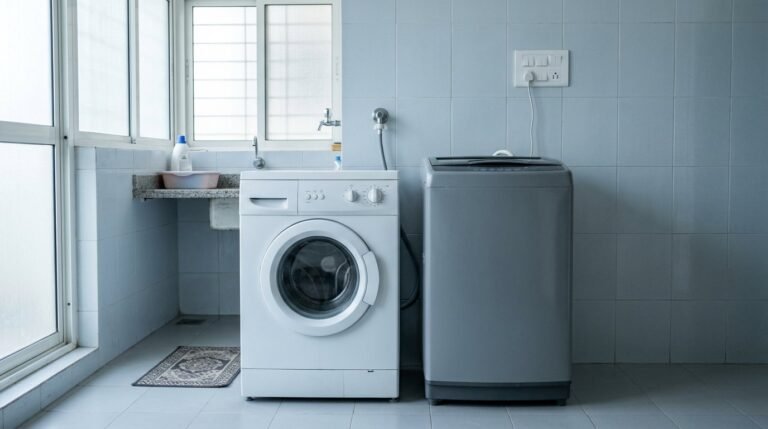
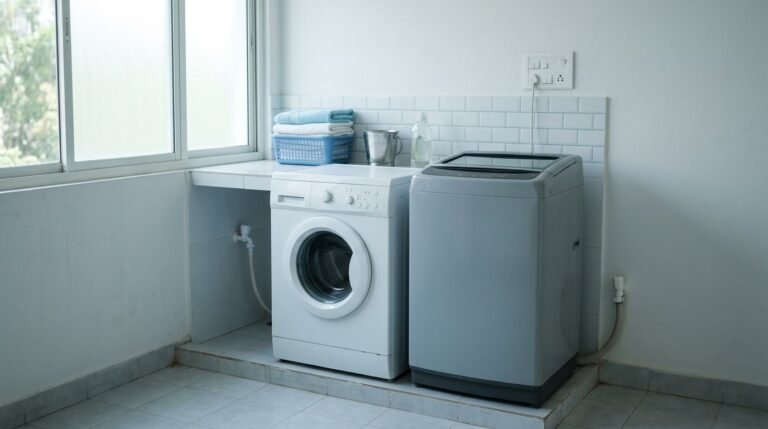
Some of the causes the makers name are front-load specific: Haier’s sealed front-load drum, and gasket advice from LG, Haier and Samsung that applies to machines with a door seal. Others, such as dosing, wash temperature and overloading, are named without reference to machine type. The odour pages we read on 30 September 2026 carry no guidance specific to top loaders. LG India’s cleaning guide, read 13 September 2026, does give one lid habit: “To prevent mould and mildew growth, leave the lid open after each wash to allow air circulation.” Samsung’s Eco Tub Clean article is video-only, and its top-load filter article was not read. We did not search specifically for semi-automatic odour guidance. Top loaders do have cleaning features: LG’s top-load category page mentions auto tub clean, and IFB lists Tub Clean on the three IFB top loaders we checked (both read 13 September 2026). For how the machine types differ, see fully automatic vs semi automatic washing machines.
What we could not verify
- A drain standpipe, trap or air-gap requirement for sewer smell: not on any page we read.
- Top-load odour guidance: not in the text of the odour pages we read on 30 September 2026, apart from LG India’s lid-open line above. Semi-automatic odour guidance: not searched for specifically.
- Samsung’s odour tips: published as a video; there was no text to cite.
- The price of LG’s Scal-Go: not in the text we could read on LG’s product page.
- Whether vinegar or a maker’s cleaner removes odour better: none of the pages we read compares them.
FAQ
How do I stop my washing machine from smelling like a sewer?
Bosch’s rotten-egg page says to check the supply and drain hoses first, since the smell can come from the water inlet or a blocked drain system, and also names washing at low temperatures with small detergent doses. Its domestic-cleaners page says to make sure the drain hose is clear and water can’t run back in, and that domestic cleaners won’t help with that cause. If water isn’t running out, Bosch recommends a service engineer.
Why do my clothes still smell bad after washing in the washing machine?
Bosch names washing regularly at low temperatures, wrong detergent dosing, and laundry left in the drum after the programme ends. For breathable sportswear it says to use an appropriate detergent, and it recommends a hygienic conditioner.
Why does my washing machine still smell even after I clean it?
Bosch says to check the water outlet, because smells sometimes occur when water runs back into the machine. Its page on smells inside the machine says that once you have followed its temperature, dosing and cleaner advice and checked the water discharge, the machine should smell normal again. If the smell seems trapped because water isn’t draining, Bosch recommends a service engineer.