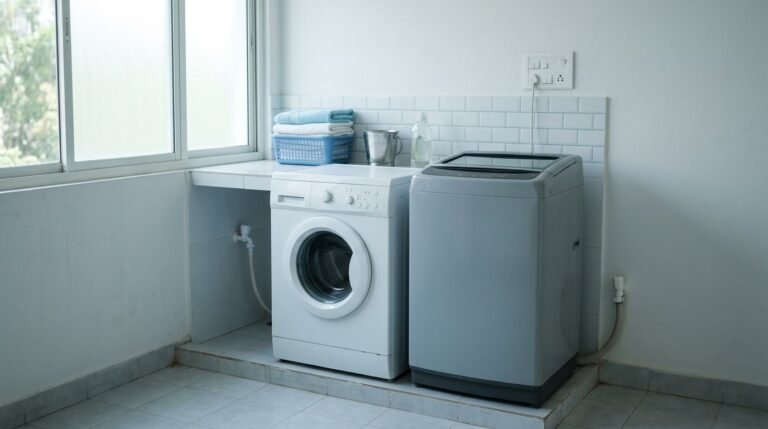
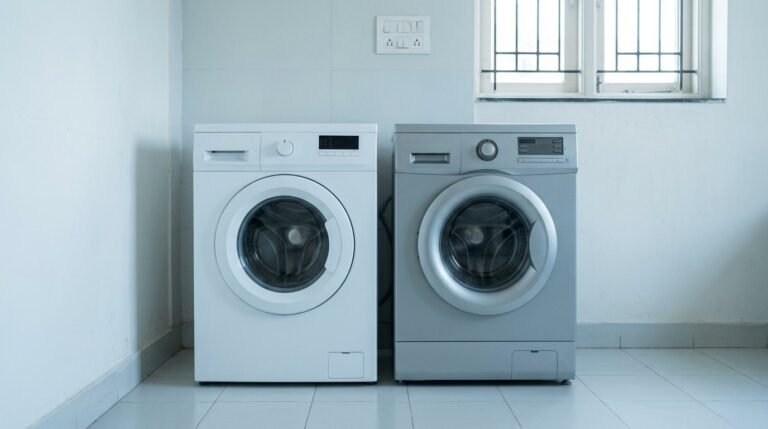
Front vs Top Load Washing Machine: Which Should You Actually Buy?
By Samiya
 LG 7 Kg 5 Star Front Load FHB1207Z2MFully automatic, DD technology, steam wash₹30,000Amazon, 8 Nov 2026★ 4.2Check price ↗
 Bosch 7 kg 5 Star Front LoadFully automatic front load washing machine₹28,000Amazon, 8 Nov 2026★ 3.9Check price ↗
 Samsung 7 kg 5 Star Top Load WA70BG4441YYTLFully automatic, Eco Bubble, Digital Inverter₹17,500Amazon, 8 Nov 2026★ 4.1Check price ↗
 Bosch 7 kg 5 Star Top Load WOE70AH0INFully automatic top load washing machine₹17,500Amazon, 8 Nov 2026★ 4.0Check price ↗
Prices and ratings in the boxes above are Amazon selling prices read on 8 Nov 2026, rounded to the nearest ₹100. Products are the most-rated ones of each type that we found, shown as examples, not a ranking. Prices quoted in the text below are from the dates given beside them and may differ from today’s Amazon price.
Samsung, LG, IFB and Haier each publish their own front vs top load comparison. This page sets the makers’ claims against the makers’ declared figures where those exist: IFB’s water and energy figures, LG’s water figures, and Bosch’s published spin, noise and footprint figures, with model numbers attached.
The short answer
Choose a front loader if water is scarce, you want higher maximum spin (on Bosch’s figures) and you have floor space for a door that swings out. Choose a top loader if you would rather not bend to load, your spot is narrow, or you want a lower price band: on Bosch’s and IFB’s own stores on 30 September 2026, top-load offer prices start well below front-load ones. On water, the declared figures favour the front loader. On electricity, the makers’ articles and IFB’s spec table disagree.
Front vs top load washing machine at a glance
| Front load | Top load | Whose figures | |
|---|---|---|---|
| Declared water, L/kg/cycle | 8.9 (IFB Serena GXN 7012) · 7.2 (LG FHP1412Z5O) | 20 (IFB TL701AG1ID) · 17.24 (LG T80KMMB3Z) | IFB, 30 Sep 2026 · LG, read 13 Sep 2026 |
| Declared energy, kWh/kg/cycle | 0.07 (IFB Serena GXN 7012) | 0.0065 (IFB TL701AG1ID) | IFB, one 7 kg pair |
| Maximum spin | 1,000 to 1,400 rpm (1,400 on 19 of 37, 1,200 on 15, 1,000 on 3) | 680 to 700 rpm (680 on 27 of 34, 700 on 7) | Bosch category filters, 30 Sep 2026 |
| Washing noise | 53 dB | 59 to 65 dB | Bosch, the four models below |
| Depth with door open | 1,073 mm | 560 to 565 mm | Bosch, the four models below |
| Offer price band, 30 Sep 2026 | Bosch ₹36,590 to ₹48,990 (category page 1) · IFB ₹32,690 to ₹62,490 | Bosch ₹21,590 to ₹28,790 (category page 1, 12 of 34) · IFB ₹20,690 to ₹42,090 | Makers’ own stores |
Water: the claims against the declared figures
IFB prints per-kg figures in its spec tables. Its 7 kg Serena GXN 7012 CMS front loader lists “Water Consumption (L/kg/cycle)” as 8.9; its 7 kg TL701AG1ID top loader lists 20 (both read 30 September 2026). Our arithmetic at the rated 7 kg: about 62.3 litres per rated cycle against 140 litres. That is derived, not an IFB figure.
LG gives a second pair, which it says comes from the BEE sticker of each named model: 7.2 L/kg/cycle for the FHP1412Z5O front loader and 17.24 for the T80KMMB3Z top loader. LG adds: “Actual consumption may vary depending on load size, program selected, water pressure, and usage conditions.”
The makers’ general claims point the same way, but their magnitudes differ, so each keeps its own subject:
| Maker | Front load | Top load | Attached to it |
|---|---|---|---|
| Samsung | 60 L per wash | 140 L per wash | “The above details are generic however water consumption depends upon the specification of Washing Machine.” |
| Haier, 10 Mar 2025 | “between 40 and 60 litres” | “up to 120 litres” | per cycle, no model |
| LG, 19 May 2026 | “uses ~40% less water with TurboWash” | no litre figure | one named feature |
On every model-numbered pair on this page where one maker declares both types, the front loader is declared to use less water.
Electricity: the makers’ articles against IFB’s spec table
Three makers’ articles say front loaders win on power too. Samsung (updated 19 December 2023): “Front-loading washing machines use less water and electricity than the average top-loading washing machine.” Haier (31 May 2022): “Some research suggests that the front load washing machines use about 25% to 30% less energy compared to top load machines with impeller motors.” The research is not named. LG’s checklist (29 May 2026) rates front-load electricity “Lower (5-star rated models)” and top load “Moderate”.
IFB’s spec tables for the same 7 kg pair point the other way. The Serena GXN 7012 CMS lists “Energy Consumption (kWh/kg/cycle)*” as 0.07; the TL701AG1ID lists 0.0065. Our arithmetic at 7 kg: 0.49 kWh per rated cycle for the front loader against 0.0455 kWh for the top loader.
The caveats travel with those numbers:
- Both carry a BEE 5-star rating on IFB’s pages, but only the star row names BEE. The per-kg rows are declared spec-table figures next to that rating, not BEE-labelled figures.
- The asterisk on the energy row has no footnote, and the IFB pages we read state no test programme.
- The front loader lists wash temperatures up to 95°C; the top loader lists a “Cold” water inlet only. IFB does not say whether that explains the gap.
- Other IFB front loaders print other figures: the 11 kg Executive Plus VSG 1114 lists 8 L/kg and 0.066 kWh/kg (read 13 September 2026). And 12 of the 21 top loaders on IFB’s listing name an “In-Built Heater” in their titles, so one cold-inlet model does not stand for IFB’s top-load range.
This is one pair from one maker. It does not show that front loaders use more electricity in general. It does mean the claim that front loaders use less electricity is not something the spec figures on this page confirm. If power matters, compare the energy row on the two exact models you are considering.
Spin, noise and footprint: one maker, both types
Bosch publishes the same specs for its front and top loaders, so the two can be read side by side.
| Bosch figure | WAJ24266IN (front) | WAJ2826BIN (front) | WOE80AH0IN (top) | WOE10DV0IN (top) |
|---|---|---|---|---|
| Maximum spin | 1,200 rpm | 1,400 rpm | 680 rpm (spec sheet) | 680 rpm |
| Noise, washing | 53 dB | 53 dB | 65 dB | 59 dB |
| Net weight | 72.1 kg | 72.1 kg | 33.6 kg (spec sheet) | 33.6 kg |
| Depth with door open 90° | 1,073 mm | 1,073 mm | 565 mm | 560 mm |
| “Loading sensor” | Yes | Yes | No | No |
The WOE80AH0IN’s product page says 700 rpm and 31.0 kg; its spec sheet says 680 rpm and 33.6 kg, and we use the sheet. Across Bosch’s top-load category, 27 of 34 products are listed at 680 rpm and 7 at 700 rpm.
Samsung says front loaders “generally spin about 33% faster than typical top loaders” in the final spin. Bosch’s maximums are a different measure, with a wider gap (our arithmetic: 1,200 rpm is about 71% above 700).
Wash action and fabric care, in the makers’ words
IFB: “Front load washing machines use a tumbling action, lifting and dropping clothes as the drum rotates.” Samsung: “Front loaders are much gentler with clothes.”
LG contradicts itself across two dates. Its 19 March 2024 guide calls front-load tumbling “better for delicate fabrics” and says the top-load agitator “can be harsher on delicate fabrics.” Its 2026 top-load myths page answers “Top-loader washing machines damage clothes. Truth: No.”
On bulky items, Samsung says “Top-loaders also have a difficult time washing larger items, such as pillows or comforters, as they won’t fully immerse in the water.” LG’s 2026 page says “many large capacity top load washers are specifically designed to accommodate comforters, blankets, towels”.
Space and loading
Samsung, LG, IFB and Haier each present the top loader as the no-bending option. Samsung: “Top-loading washers are normally more convenient since you don’t have to bend over to load and unload clothes.” IFB: “Front loaders require bending to load and unload clothes, and the door needs enough clearance to open fully.”
LG and Haier raise clearance too. LG lists “Your home has limited installation space with no front clearance” as a reason to pick a top loader. Bosch’s figures for the four models above size it: 1,073 mm of depth with a front-load door open, against 560 to 565 mm for the two top loaders.
Maintenance and smell
Samsung and LG both single out the front-load door gasket. Samsung: “One of the biggest complaints about front-loading washers is that over time mold can buildup around the door’s rubber gasket.” LG: “front load machines may need regular gasket cleaning to avoid an unpleasant smell.” Samsung’s cycle table says to run Drum Clean+ “once every 40 washes with no detergent or bleach applied.” Our guide on how to clean a front loading washing machine covers the steps.
On top-load mould, the makers do not say the same thing. Samsung says flatly that top loaders “don’t have this issue”. Haier calls the chances “minimal”. LG answers “Truth: No”, but only with maintenance: “Tub Clean” cycles and “leaving the lid open after washing”. None of the three gives a test basis.
Price: front load vs top load on the makers’ own stores
Makers’ own stores, 30 September 2026. Compare offer to offer; MRPs are shown apart.
| Maker and type | Offer band | MRP band | Products counted |
|---|---|---|---|
| Bosch front load | ₹36,590 to ₹48,990 | ₹59,390 to ₹79,890 | 12, category page 1 |
| Bosch top load | ₹21,590 to ₹28,790 | ₹30,890 to ₹39,590 | 12 of 34, page 1 of the top-load category |
| IFB front load | ₹32,690 to ₹62,490 | ₹37,990 to ₹73,690 | 20 |
| IFB top load | ₹20,690 to ₹42,090 | ₹23,590 to ₹47,890 | 21 |
The IFB top-load band is a page state, not a stable figure: on 29 September 2026 the same listing showed 8 products at ₹29,590 to ₹42,090, all 9 to 12 kg. For IFB against LG at brand level, see IFB vs LG washing machine.
Who should buy a front load washing machine
- Homes where water is the constraint.
- Buyers who want higher maximum spin: Bosch’s category filters list its front loaders at 1,000 to 1,400 rpm against 680 to 700 rpm for its top loaders.
- Anyone with room for the door to open, and a plan to clean the gasket.
Who should buy a top load washing machine
- Anyone who would rather not bend to load and unload.
- Tight spaces where a front door cannot swing fully open.
- Buyers working to a lower offer price band on Bosch’s and IFB’s stores.
Weighing a semi automatic too? That is a separate question about automation: see fully automatic vs semi automatic washing machine.
Claims we could not verify
Makers’ claims with no test report on the pages we read:
- Samsung’s “about 33% faster” spin, and the electricity half of its “less water and electricity” line.
- Haier’s “25% to 30% less energy” and “about 50% less water”.
- LG’s “All LG washing machines are 5-star.” We did not check this across LG’s catalogue.
- LG’s TurboWash “28% more energy efficiency” and “16% less clothes damage”: footnoted “Tested by Intertek, based on IEC 60456 : edition 5.0”, but no report is on the page.
- IFB’s Oxyjet “up to 25% less water, and up to 40% less energy”, with no baseline stated.
- Samsung’s, Haier’s and LG’s positions on top-load mould.
Nor could we compare Bosch’s two types on water or electricity. The WAJ24266IN sheet prints “Consumption: energy 0.98 kwh, water 55 l” with no programme or basis named (the 8 kg WGA1320TIN sheet prints the same figures); the WOE80AH0IN top-load sheet has no such line.
FAQs
What is the disadvantage of a front load washing machine?
You bend to load it, it needs space for the door, and Samsung and LG both flag gasket mould or smell. The two Bosch front loaders in our table each weigh 72.1 kg, against 33.6 kg for the two Bosch top loaders in our table (the WOE80AH0IN figure is from its spec sheet). On one IFB 7 kg pair, the front loader’s declared energy figure is the higher one.
What is the disadvantage of a top load washing machine?
It is declared to use more water on every per-kg pair on this page, its maximum spin is lower on Bosch’s figures, and the two Bosch top loaders we read list louder washing (59 to 65 dB) than the two front loaders in our table (53 dB). Samsung says top loaders struggle with pillows and comforters; LG disagrees for large-capacity models.
Which washers last longer, top load or front load?
We found no lifespan figure for either type on the maker pages we read. Warranty terms do not separate them at IFB or LG: IFB prints “4 Years Super Warranty + 10 Years Spare Parts Support + 10 Years Motor Warranty” on all five IFB washing-machine pages we read on 30 September 2026 (four front loaders, one top loader). LG’s policy page gives 2 years on the product and 10 years on the direct drive motor for both fully automatic types, parts only.
Why is front load costly compared to top load?
We can show that it is, not why. On 30 September 2026, page 1 of Bosch’s front-load category started at ₹36,590 offer against ₹21,590 on page 1 of its top-load category; across all 37 Bosch front-load pages that day, the lowest in-stock offer was ₹30,690. IFB’s front-load band started at ₹32,690 against ₹20,690 for top load. No maker page we read gives the cause.
Which type of washing machine is best for a home?
LG’s table pairs a nuclear family of 3 to 4 members with a 7 to 9 kg top loader, and a joint family of 5 or more with a 10 to 15 kg front loader. IFB’s listing says “a front load washing machine 7kg is right for a family of three to four”. Both types come in family sizes: IFB lists front loaders from 6.5 to 11 kg and top loaders from 6.5 to 12 kg.
Related reading on HomeVerdicts: Fully automatic vs semi automatic washing machine · How to clean a front-loading washing machine · IFB vs LG washing machine