Smell From Air Conditioner: What Does Each Smell Mean, According to Indian Manufacturers?
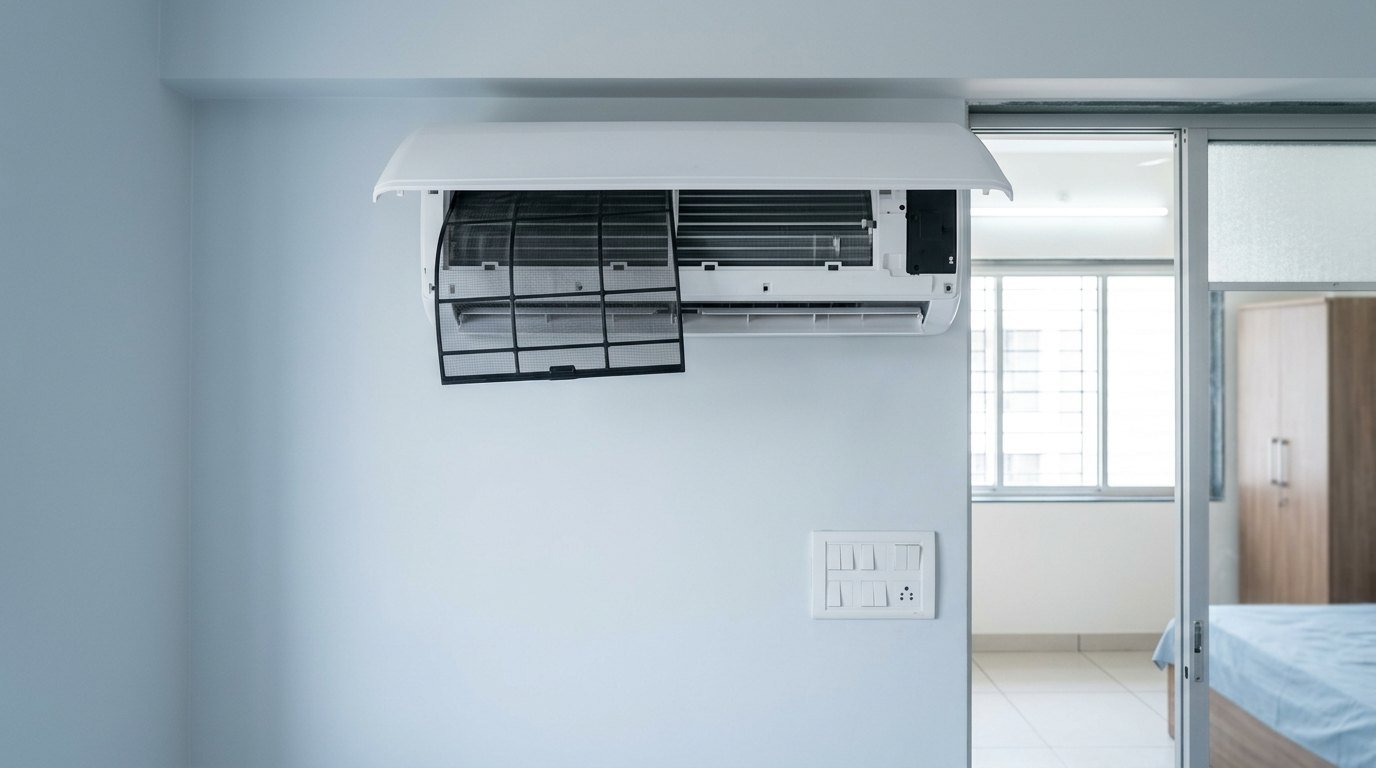
What Voltas, Daikin, Samsung, LG and Hitachi publish about each kind of AC smell, where they contradict each other, and what the refrigerant safety data sheets say that the brands do not.
 LG 1.42 Ton 5 StarSmart Inverter split AC, 5800W max cooling, copper tubes₹47,000Amazon, 8 Nov 2026★ 4.0Check price ↗
 Panasonic 1.5 Ton 3 StarPremium Wi-Fi inverter smart split AC₹37,000Amazon, 8 Nov 2026★ 3.9Check price ↗
 Hitachi 1.5 Ton 3 StarSmart Choice inverter split AC, copper₹35,500Amazon, 8 Nov 2026★ 4.0Check price ↗
 Carrier 1 Ton 3 StarFlexicool inverter split AC, copper₹32,000Amazon, 8 Nov 2026★ 4.2Check price ↗
A smell from an air conditioner often comes back to moisture inside the indoor unit, in what Voltas, Samsung and LG India publish. Voltas ties musty odour to mould on a wet coil and to stagnant water in the drain pan. Burning and gas smells are different in kind. A gas or chemical smell may be refrigerant, and there the manufacturers contradict each other and the safety data sheets for the refrigerant itself.
What to do if you smell gas near your AC
These instructions are quoted word for word, each under its publisher’s name, with any omissions inside a quote marked. We have not softened or combined them.
Daikin India, operation manual for R32 units, WARNING: “Beware of fire in case of refrigerant leakage. If the air conditioner is not operating correctly, i.e. not generating cool air, refrigerant leakage could be the cause. Consult your service centre for assistance. The refrigerant within the air conditioner is safe and normally does not leak, However, in the event of a leakage, contact with a naked burner, heater or cooker may result in generation or noxious gas. Do not use the air conditioner until a qualified service person confirms that the leakage has been repaired.” (Wording as printed.) The same manual: “To avoid fire, explosion or injury do not operate the unit when harmful gases (e.g. flammable or corrosive) are detected near the unit.“
Samsung India, on a page written for a gas smell of unknown origin, which checks your household gas pipe before the AC: “If you smell gas, open the window in the room and let some fresh air in immediately. Also, stop using electronic products during the time you smell gas. Then check the gas pipe around the location. If there is no problem, then you may check now the air conditioner.” It then says: “Run the air conditioner a Turbo (speed) mode and check if cool wind come out of the outlet … Keep the air conditioner working for 3- 5 minutes.” And: “Note: If Gas is smelled, lock all gas valves of gas pipe and products for safety.“
The R32 safety data sheet, or SDS (RGAS): “Evacuate personnel to safe areas.” “Eliminate all ignition sources.” “Ventilate the area. Vapors are heavier than air and can cause suffocation by reducing oxygen available for breathing.”
Where they disagree. Samsung’s procedure runs the AC for 3 to 5 minutes as a check, after the household gas supply has been ruled out. Daikin’s says not to use the AC until a qualified service person confirms the repair. The SDS guidance (ventilate, eliminate ignition sources) aligns with Daikin’s instruction, not with running an electrical appliance.
Refilling. Voltas: “Never try to refill refrigerant yourself” because it is “a technical job for certified professionals.”
This page covers smell only. If your AC is also not cooling, that diagnosis is on our AC not cooling guide.
The short answer.
- Burning smell: Voltas: “Turn off the AC immediately” and “Contact a technician for inspection”. Daikin’s manual: “turn off power to the unit and contact your local service centre”, and “stop operation and turn off the circuit breaker.”
- Gas or chemical smell: Samsung, Daikin and an R32 safety data sheet publish different steps for different situations, each quoted word for word and attributed under “What to do if you smell gas near your AC” above.
- Musty or damp smell: Voltas: “Clean filters and coils thoroughly” and “Ensure proper drainage flow”. Samsung: dry the filter “completely in the shade”.
- A smell of the room itself: Daikin lists this among “cases … normal” and recommends a technician wash of the indoor unit.
Smell from air conditioner, by type: cause and fix
Voltas is the only Indian manufacturer we found that publishes a smell-by-type table. In the first six rows below, the first three columns are Voltas’s table, verbatim (article dated 1 June 2026). The last two rows are smells it does not cover.
| Type of smell | Voltas: possible cause | Voltas: fix, verbatim | Who else publishes it |
|---|---|---|---|
| Musty or damp | Mold or mildew buildup | “Clean filters and coils thoroughly” · “Ensure proper drainage flow” · “Use dry mode after cooling to reduce moisture” | Hitachi (global site) names “Mold or mildew” as a musty-smell cause. LG India: dirt, dust and bacteria in the coil cause “a foul smell”. |
| Burning smell | Electrical issue or dust | “Turn off the AC immediately” · “Contact a technician for inspection” | Daikin India manual agrees (quoted below). Hitachi (global): burning smells “may need prompt professional intervention”. |
| Rotten smell | Bacteria or trapped debris | “Clean internal components carefully” · “Schedule professional servicing if required” | No other Indian manufacturer we read. Voltas’s cause: insects or debris that “decompose and produce a strong, unpleasant smell.” |
| Chemical smell | Refrigerant leakage | “Get professional leak detection” · “Refill refrigerant after repair” | Contested. Samsung India says refrigerant has no smell. See the refrigerant section below. |
| Stale | Dirty filters | “Wash filters at regular intervals” · “Replace filters if worn out” | Daikin manual: operation with dirty filters “may cause odour”. |
| Damp | Stagnant Water in Drain Pan | “Clean the drain pan” · “Ensure proper drainage flow” | Hitachi (global) agrees on clogged drainage. WHO, on air-conditioning systems generally, names “drip pans in air-conditioning units” as a place microorganisms grow. |
| Rotten egg or sulphur | Not in Voltas’s table | None published by an Indian manufacturer we read | Only TCL (global site): “a gas leak or a dead animal in the system”. Retailer Vijay Sales: “an external gas leak near your system”. |
| Exhaust | Not published | None | No source we read. |
A damp filter, from two other articles. Voltas’s filter-cleaning article: “Do not reinstall while damp: Moisture trapped inside the unit promotes mould growth and creates unpleasant odours.” Samsung India: “The odor may occur if the dust filter is not dried completely.”
The burning smell, in Daikin’s words. Daikin India’s operation manual, under WARNING: “If the air conditioner is malfunctioning (giving off a burning odour, etc.), turn off power to the unit and contact your local service centre. Continued operation under such circumstances may result in a failure, electric shock or fire hazards.” And: “When an abnormality (such as a burning smell) occurs, stop operation and turn off the circuit breaker.”
Daikin frames most odour differently. Its product-care page lists indoor-unit odour under the heading “The cases mentioned below are normal”: “This happens when smells from the room, furniture or cigarettes are absorbed into the unit and discharged with air flow. If this happens, we recommend you have the indoor unit washed by a qualified technician.” Daikin’s troubleshooting page adds that its Streamer function generates “a very small amount of ozone”, that “you may notice some odor at the air outlet”, and that the ozone “causes no health hazards.”
Whose do-it-yourself line? Hitachi’s global site tells users to wipe the drip pan after removing the filters. Daikin’s manual says: “Do not attempt to repair, dismantle, reinstall or modify the air conditioner yourself as this may result in water leakage, electric shock or fire hazards.” Each is that brand’s instruction for its own units.
Does a refrigerant leak smell? The brands and the safety data sheets disagree
Samsung India’s support page says: “The refrigerant of air conditioner does not have smell.” Voltas says a refrigerant leak produces a chemical smell. TCL’s global site calls it “a sweet, chemical odor”.
The SDS is the technical document for the refrigerant itself. We read three for R32 from three publishers, and none says it has no smell:
| Refrigerant | Odour, per SDS | Flammability, per SDS |
|---|---|---|
| R32 (refrigerants.com, Jan 2024) | “Faint ethereal odor” | “Extremely flammable gas” |
| R32 (RGAS, Jan 2024) | “Weak, ether-like” | “H220 : Extremely flammable gas.” |
| R32 (Eurorefrigerant, 2011) | “Ethereal Poor warning properties at low concentrations.” | “Extremely flammable gas.” |
| R410A (two SDSs) | “ethereal and faint sweetish odor”; “Ethereal” | “Non-flammable” |
Two things follow, and both matter. R32 is not odourless. And you cannot rely on smelling it: one SDS says the “Odour threshold is subjective and inadequate to warn for over exposure.”
On fire risk, R32 is classed “Extremely flammable gas” (H220) on all three SDSs we read. The refrigerants.com sheet’s physical-data line also reads “Mildly flammable”; the GHS classification is the formal one. Daikin India’s R32 manual warns: “Beware of fire in case of refrigerant leakage.” Samsung India: “Refrigerants are too dangerous at higher temperature as it can catch flame.” Voltas’s refrigerant comparison table describes R32’s flammability differently; we carry the SDS classification.
Is there a “3 minute rule” for AC smell?
Not in anything we read. We searched every source behind this page (Voltas, Daikin India, Samsung India, LG India, Hitachi, TCL, retailer blogs, five safety data sheets and the WHO guideline) for “3 minute rule” and “three minute rule” and found no match.
Apart from a 3 to 5 minute step inside Samsung’s gas-smell check (quoted with its conditions in the gas section above), the only manufacturer-published “3 minutes” we found for Indian split ACs is Daikin’s restart protection, which has nothing to do with smell: “To reduce excessive load in a restart, the air conditioner does not operate for three minutes when the ON switch is pressed immediately after it is shut down or when the operation mode (setting) is changed using the remote controller.” Daikin’s manual lists it under “These cases are not problems.” How the compressor itself differs between types is covered in inverter vs non-inverter AC.
Self-clean features: four different mechanisms, not one
These features do different things and run for different times, as published.
| Brand and feature | What it does, as published | Published duration |
|---|---|---|
| Voltas Auto Clean | After switch-off, “the system continues to run the fan for a short period, and the compressor remains off” | “about 20 to 30 minutes” |
| LG HimClean | Freezes the coil, melts the ice to wash it, then “warm air dries the unit” | “approximately 30 minutes” |
| Samsung Freeze Wash | “freezes and de-freezes the heat exchanger to clean itself”, then “dries up any moisture” | “30 to 80 mins (running the outdoor unit)” |
| Daikin Dew Clean | Manual: “aids in cleaning the accumulation of dust and stains on the Indoor Heat Exchanger” | “Approx. 95 minutes” |
Voltas adds that Auto Clean “supports maintenance but does not replace it.” Samsung warns Freeze Wash may produce “a cracking sound” that ends with the process.
Daikin contradicts itself on Dew Clean. Its product page says Dew Clean gets “rid of bacteria, moulds” and ensures “odour-free” airflow. Its operation manual mentions neither mould, bacteria nor odour, and recommends it “once a month … to achieve better cooling effects.” We follow the manual, because it is the instruction document for the unit. The manual also says to avoid staying in the room during Dew Clean, and that it “will not operate if the room temperature is lower than 10°C.”
Daikin also has a SMELL PROOF operation, and its own manual is candid about it: “SMELL PROOF operation can prevent some odours, but not all.”
Dry mode: Voltas and Samsung disagree on how long
Voltas’s smell article says: “Use dry mode after cooling to reduce moisture.” Voltas’s dry-mode article says it is “suitable for short durations of about 1 to 2 hours.” Samsung India says: “Run the dry mode for 3-4 hours, then switch to the Cool mode.” Neither ties its figure to odour, and this page has no neutral source to settle it.
Voltas’s own dry-mode article also describes air passing over the cooling coils where “Moisture condenses into water droplets”, which wets the coil rather than drying it. The drying-after-shutdown cycle Voltas describes elsewhere is Auto Clean, not dry mode. Voltas’s pages do not reconcile the two, so we do not recommend a duration.
What we could not verify
- Rotten-egg and exhaust smells: none in Voltas, Daikin India, 11 Samsung India support articles or LG India product pages; no source we read covers exhaust smell.
- A “run fan-only for N minutes after every use” instruction from an Indian manufacturer: not found. The nearest is Voltas’s “Run in fan mode once a week”, and its automatic Auto Clean cycle.
- Samsung India’s odour article is a video with no text, so we could not quote it.
- Hitachi India names “ice Clean (FrostWash)” and “Odour-free air (Soft Dry)” without describing them.
- Blue Star and Godrej: the pages we read had no smell content. Lloyd, Panasonic India and Carrier India: their sites did not respond or refused access, so this is an access failure, not proof of absence.
- R290: we could not read a safety data sheet, so this page makes no R290 claim.
- An Indian health body’s statement on mould in ACs: our search was blocked before it ran. In the passages we read, WHO’s guideline addresses air-conditioning systems generally, not split units.
- Service prices: this page has no rupee figure for a technician’s indoor-unit wash.
FAQ
What is the 3 minute rule for AC?
No manufacturer, safety data sheet or health body we read publishes a “3 minute rule” for AC smell. The “3 minutes” Daikin publishes is restart protection: the AC “does not operate for three minutes” when switched on immediately after shutdown. If you smell gas, the instructions from Daikin, Samsung and an R32 safety data sheet are quoted word for word, each with its own conditions, in the section on what to do if you smell gas near your AC above.
Why does my air conditioner smell bad?
Voltas publishes six causes: mould or mildew, an electrical issue or dust, bacteria or trapped debris, refrigerant leakage, dirty filters, and stagnant water in the drain pan. Daikin adds that room, furniture and cigarette smells get absorbed into the unit and blown back out, which it lists as normal.
How do I get my AC to stop smelling?
For musty smells, Voltas says to clean filters and coils, keep the drain flowing, and use dry mode after cooling. Samsung says to dry the filter “completely in the shade”, not in direct sunlight. For absorbed room smells, Daikin recommends a technician wash of the indoor unit. For a strong or unusual smell, Voltas says: “Switch off the AC and inspect basic elements such as filters. If the smell persists, call your technician.”
How often should I clean my AC?
Voltas says to wash filters “at regular intervals”. Daikin’s manuals recommend Dew Clean “once a month” and “periodical maintenance by a specialist in addition to regular cleaning by the user.” Voltas also suggests running fan mode “once a week” to prevent musty smells.