Kitchen Chimney Cleaning: Which Degreaser the Sources Actually Publish
 Faber Pluto 60 cm 1000 m³/hrWall mounted baffle filter kitchen chimney₹6,600Amazon, 8 Nov 2026★ 4.6Check price ↗
 Elica 60 cm 1500 m³/hr AutocleanBaffle filter autoclean kitchen chimney₹13,200Amazon, 8 Nov 2026★ 4.4Check price ↗
 Elica 60 cm 1350 m³/hr FilterlessFilterless autoclean kitchen chimney₹12,200Amazon, 8 Nov 2026★ 4.5Check price ↗
 Elica 60 cm 1500 m³/hr BLDC FilterlessBLDC filterless autoclean kitchen chimney₹15,000Amazon, 8 Nov 2026★ 4.4Check price ↗
Quick answer: Switch the chimney off and disconnect the power, let it cool, remove the filters, soak them in warm water with dishwashing soap, scrub with a soft brush, rinse, and dry them completely before refitting. Soap and water is named by three of the five sources in our research base. Every stronger option is named by one source only.
This page lists every cleaning agent named in our research base, says who named it, and prints where those sources contradict each other. The base is five published Indian chimney-care pages: Beyond Appliances, Koche, Faber, Kaff and House of Sujata.
What you need
- Soap and water. Named by Beyond Appliances, Faber and Kaff.
- A soft brush. Named by Beyond Appliances and House of Sujata. Kaff separately warns against abrasive cleaners and scouring pads, which can damage the surface.
- Space for the filters to air dry completely before they go back in.
- Gloves, goggles and ventilation, but only if you use caustic soda. That is Kaff’s condition on caustic soda specifically, not general kit.
We name no brands because our research base names none: none of the five publishes a degreaser brand, a dilution ratio or a degreaser contact time.
Kitchen chimney cleaning intervals: five sources, one wide spread
| Source | Heavy cooking | Regular or moderate | Light cooking |
|---|---|---|---|
| koche.in | 2 to 3 weeks | 1 month | 6 to 8 weeks |
| beyondappliances.in | Monthly (frequent frying, grilling, oils) | 4 to 6 weeks (daily cooking) | 2 to 3 months (cooking 2 to 3 times a week, minimal frying) |
| kaff.in | More often than regular use, no figure published | 2 to 3 weeks | Not published |
| houseofsujata.com | 1 to 1.5 months for heavy Indian cooking; 30 to 45 days for traditional metal filters | 2 to 3 months | Not published |
faberindia.com sits outside the table: it publishes one flat figure, at least once a month, with no cooking-load split.
For heavy cooking that is 2 to 3 weeks (Koche) against 1 to 1.5 months (House of Sujata). At the lighter end, 6 to 8 weeks (Koche) against 2 to 3 months (Beyond Appliances and House of Sujata, for their own categories). Our notes record none of their reasoning, so there is no consensus interval here to quote.
Beyond Appliances also splits by filter type: aluminium mesh every 4 to 6 weeks, baffle every 6 to 8 weeks, carbon filters replaced every 3 to 6 months because, in its words, they cannot be cleaned effectively. It puts aluminium filter lifespan at 2 to 3 years with regular cleaning. House of Sujata gives the one figure we hold for chimneys without filters: manual cleaning every 5 to 6 months.
The degreaser question: every agent our sources name
| Cleaning agent | Named by | What that source publishes |
|---|---|---|
| Soap and water | Beyond Appliances, Faber, Kaff | Beyond Appliances: soak aluminium mesh 15 to 20 minutes, soft brush, rinse, air dry. Faber: baffle metal panels washed with soap and water. Kaff: soak filters 2 hours in warm water and dishwashing soap. |
| A degreasing agent or detergent solution, unnamed | Faber | Cassette filters removed and soaked in warm water with a degreasing agent or detergent solution. No product named. |
| Baking soda and vinegar | House of Sujata | Soak in warm water mixed with baking soda and vinegar, scrub lightly with a soft brush, rinse and dry thoroughly. No ratio published. |
| Caustic soda | Kaff | Handle cautiously, wear gloves and goggles, ensure proper ventilation. Recommended only for very stubborn grease buildup. |
Those four are the only cleaning agents named anywhere in our research base. Soap and water is the one three separate sources name; each of the other three rests on a single source.
Where the sources openly disagree
- Koche: avoidance. It publishes “Chemicals should be avoided during cleaning” and “Do not use harsh or abrasive cleaning materials.”
- Faber: conditional use. It warns against harsh chemicals that can damage the chimney’s finish, then prescribes a degreasing agent or detergent solution for cassette filters. It does not define where the line falls.
- Kaff: conditional use with protective equipment. It is the only source in our research base publishing any guidance on caustic soda.
- Beyond Appliances and House of Sujata: a warning with no use case. Beyond Appliances: “Avoid harsh chemicals that can damage filter materials or leave harmful residues.” House of Sujata: avoid strong chemicals that may damage the finish.
Two things stand out. Four of the five tell you to avoid harsh or strong chemicals, and none publishes a list of which chemicals qualify. And the stated reason is nearly always the appliance rather than you: filter materials, residues, the finish. Kaff’s caustic soda note is the only guidance we hold aimed at the person doing the cleaning.
On caustic soda specifically
Kaff is a single source and we will not dress that up as agreement. It publishes that caustic soda should be handled cautiously with gloves, goggles and proper ventilation, and is recommended only for very stubborn grease buildup. Our research notes record that the Beyond Appliances, Koche and Faber pages do not mention caustic soda at all; we hold nothing from House of Sujata either way.
We publish no dilution ratio, soak time or rinse procedure for it, because our base holds none. We publish no mixture a source has not published, and no source here publishes guidance on mixing caustic soda with anything. Where your manual disagrees with this page, the manual wins.
Kitchen chimney cleaning step by step
- Switch the chimney off and disconnect the power. Beyond Appliances, Faber and Kaff.
- Let the unit cool completely if it was recently used. Beyond Appliances.
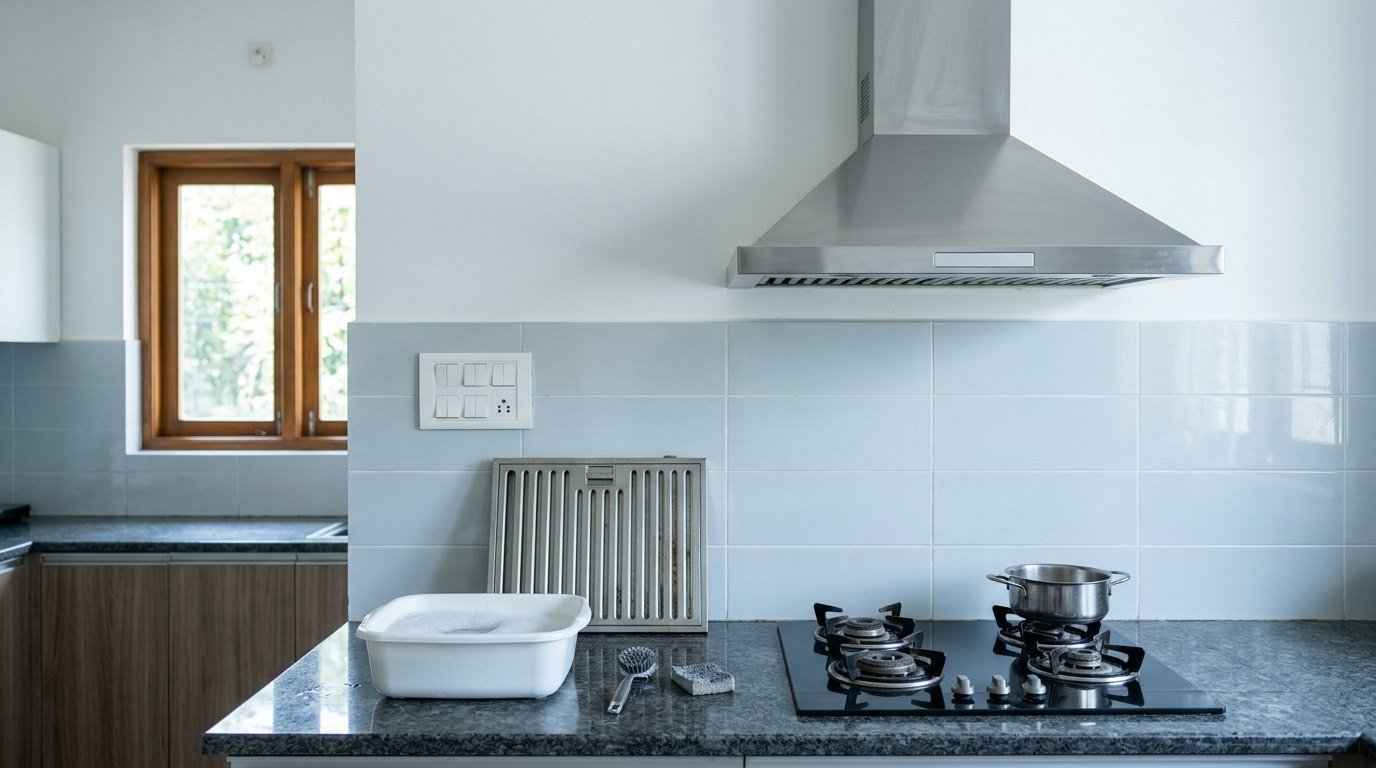
- Remove the filters. Faber describes baffle panels as removable metal panels; Kaff and Beyond Appliances both treat filters as removable for soaking.
- Soak them. Beyond Appliances: 15 to 20 minutes in warm soapy water, for aluminium mesh. Kaff: 2 hours in warm water and dishwashing soap, for filters generally. Different subjects, so treat the longer soak as the default and the shorter as specific to aluminium mesh.
- Work the grease loose with a soft brush. Beyond Appliances and House of Sujata. For baffle filters, Beyond Appliances says the process is similar to aluminium mesh but may take longer, cleaning each baffle section individually.
- Rinse thoroughly, then dry completely before refitting. Beyond Appliances warns that reinstalling wet filters can cause electrical issues. Koche: “Clean filters should be completely dry before they are used again.”
- Wipe the hood. Kaff puts hood cleaning at monthly or as needed, without abrasive cleaners or scouring pads.
Dishwashers, where the sources split again
Beyond Appliances says to avoid putting aluminium filters in dishwashers unless specifically approved. Koche says many baffle filters are dishwasher-safe but to always check the manufacturer’s instructions first. Note the subjects: one is about aluminium filters, the other about baffle filters, and neither addresses the other’s type. Check your manual first.
When to replace instead of clean
- Carbon filters are a replacement item. Beyond Appliances publishes a 3 to 6 month replacement interval and states they cannot be cleaned effectively. Scrubbing one is wasted effort.
- Baffle filters are not. Koche publishes that, unlike carbon filters, a baffle filter does not require frequent replacement. House of Sujata describes stainless steel baffle filters on selected models.
- Aluminium filters have a published lifespan: 2 to 3 years with regular cleaning, per Beyond Appliances.
Our guide to cleaning an air fryer covers different manufacturer rules for another machine that collects cooking grease.
Cost: DIY versus a service visit, and the Bangalore number our sources do not publish
Two sources publish a professional service interval and they are not identical: Beyond Appliances says annually, adding that “Professional service ensures warranty compliance and optimal performance.” Faber says once or twice a year for professional deep cleaning.
Our research base holds no service price at all. Not for Bangalore, not for any other Indian city, not a range, not a starting figure. We checked all five: they publish intervals, methods, warranty terms and safety notes, and none publishes what a professional visit costs. We are not going to invent a band to fill the slot.
The warranty angle is thinner than it looks too. Kaff publishes chimney warranty terms of up to 2 years on the product and 12 years on motors. House of Sujata publishes 5 years on the product and up to 15 years on the motor, for the models it describes. Two different sets of terms from two different sources, and neither transfers to your unit. No source in our base publishes what actually voids a chimney warranty, and our notes record it as not published for both Koche and Faber, so whether DIY cleaning voids your warranty is a question our base cannot settle either way. Kaff publishes its own customer care number, 1800 180 2221, if you own a Kaff unit.
What we could not verify
- The cost of a professional chimney cleaning in Bangalore, or anywhere. No figure in any of the five.
- What voids a chimney warranty. Recorded as not published for Koche and Faber, absent from the other three.
- Whether the other four sources endorse or forbid caustic soda. Three do not mention it at all.
- Any dilution ratio, contact time or brand name for a degreaser. None published, which is why this page names no product.
- Whether baffle and mesh filters differ in cleaning difficulty. Our notes on Koche record this as not published; it compares baffle filters to carbon filters and to filterless chimneys, not to mesh.
- How cleaning differs on an auto clean chimney. Kaff lists Auto Clean among its named types, alongside baffle filter, ducted, ductless, island and wall-mounted, but we hold nothing on how its routine differs.
- Cleaning the ducting, the motor housing or an oil collector cup. Nothing in our base addresses any of the three.
Related: the difference between an oven and a microwave. For how we assemble pages like this one, see our research methodology.
Frequently asked questions
Which chemical is best for chimney cleaning?
Our research base does not support naming one. Four of the five sources warn against harsh or strong chemicals without defining which qualify. The agent the largest number of them name is ordinary soap and water: Beyond Appliances, Faber and Kaff.
What is the best degreaser for kitchen chimneys?
No source in our base names a degreaser product or brand. Faber comes closest, prescribing “a degreasing agent or detergent solution” for soaking cassette filters in warm water, without naming one. Kaff is the only source in our base publishing a stronger option: caustic soda, with gloves, goggles and ventilation, for very stubborn grease buildup only.
How much does it cost to clean a chimney in Bangalore?
We cannot answer that from published material, and we would rather say so. We checked all five sources for a service price and none publishes one, for Bangalore or any other city. Two publish how often to book a visit: annually per Beyond Appliances, once or twice a year per Faber. Neither attaches a figure.
How can I remove grease from my kitchen chimney?
Power off and disconnected first, per Beyond Appliances, Faber and Kaff. Let it cool if recently used. Soak the filters in soapy water, 15 to 20 minutes for aluminium mesh per Beyond Appliances or 2 hours per Kaff, work them with a soft brush, rinse, and dry completely before refitting. Wipe the hood without abrasive pads.
What is the best homemade grease remover?
The only home-mixed preparation named anywhere in our research base is House of Sujata’s: soak in warm water mixed with baking soda and vinegar, scrub lightly with a soft brush, rinse and dry thoroughly. That is one source, no other in our base endorses or contradicts it, and no ratio or soak time is published with it. We publish no mixture a source has not published.