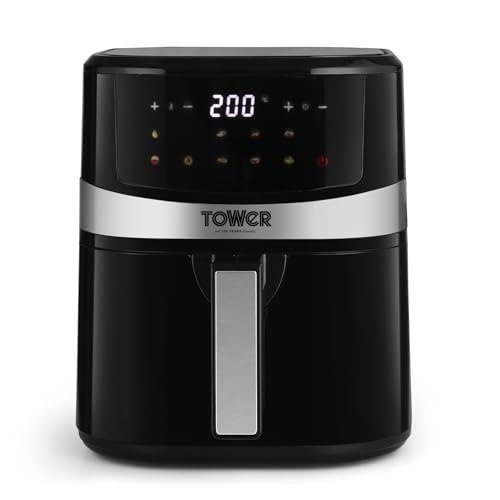
Air Fryer vs Microwave: Which Should You Actually Buy?
By Samiya
 Philips Air Fryer NA120/004.2 litre air fryer₹4,400Amazon, 8 Nov 2026★ 4.3Check price ↗
 Philips Air Fryer NA231/006.2 litre extra large air fryer, touch panel₹8,800Amazon, 8 Nov 2026★ 4.1Check price ↗
 Panasonic 20 L Solo Microwave NN-ST26JMFDGSolo microwave oven, 51 auto cook menus₹7,000Amazon, 8 Nov 2026★ 4.3Check price ↗
 IFB 24 L Solo Microwave 24PM2SSolo microwave oven, 69 auto cook menus₹8,500Amazon, 8 Nov 2026★ 4.4Check price ↗
Prices and ratings in the boxes above are Amazon selling prices read on 8 Nov 2026, rounded to the nearest ₹100. Products are the most-rated ones of each type that we found, shown as examples, not a ranking. Prices quoted in the text below are from the dates given beside them and may differ from today’s Amazon price.
Wattage, capacity and price are the easy half of air fryer vs microwave. The health question is the harder half, and it has published answers that rarely get quoted.
Start with the one that matters most. EFSA’s acrylamide page reports that “tests by industry and consumer organisations indicate hot-air fryers generally produce 30-40% more acrylamide than conventional deep oil fryers”. In the same passage, EFSA writes that “it is important to note that EFSA has not evaluated the validity of these findings”. So it is a summary of third-party tests that EFSA reports and has not validated, not an EFSA finding, and it compares hot-air fryers with deep oil fryers rather than with microwaves. We publish both because EFSA published both. Neither half travels alone.
The short answer
Buy on function, because no authority we searched has published a health comparison between these two machines. Choose an air fryer if browning and crisping are the point: Agaro publishes 80 °C to 200 °C on its Regency 12L. Choose a microwave if reheating is the daily job, where the arithmetic below puts a solo unit at ₹34.50 to ₹46 a month against ₹135 to ₹180 for a 1500 W air fryer. The health material here should change how you use either machine more than which one you buy.
Air fryer vs microwave, side by side
Every cell traces to a manufacturer spec page or an authority document read in September 2026, except the microwave heating mechanism, which comes from a physics source read in August 2026.
| Dimension | Air fryer | Microwave |
|---|---|---|
| How it heats | “Convection, Maillard reaction, and heat transfer” (Agaro, on its own appliance) | 2.45 GHz waves from a magnetron, absorbed by water, fats and sugars |
| Temperature control published | 80 °C to 200 °C (Agaro Regency 12L) | None on the solo spec page; power is rated in watts |
| Rated power | 1500 W (Morphy Richards 5L Digital), 1800 W (Agaro Regency 12L) | 700 W output, 1150 W input (20MWS solo); 900 W output, 1400 W microwave input (27CGF, 30CGD) |
| Price, as of September 2026 | ₹9,999 to ₹14,999, two models | ₹12,599 solo to ₹31,995 convection, one brand |
| Warranty recorded | Not stated on either air fryer page we read | 2 years on the 20MWS, 27CGF and 30CGD |
| Acrylamide position | EFSA reports third-party tests indicating hot-air fryers generally produce 30-40% more than deep oil fryers, and says it has not evaluated their validity | No figure, comparison or “forms none” statement from any authority we searched |
| Regulator statement read | None on air fryers as appliances | WHO: “Microwave ovens meeting the standards are not hazardous to health” |
How an air fryer and a microwave actually cook
An air fryer is a hot-air machine. Agaro describes its own appliance’s mechanism as “convection, Maillard reaction, and heat transfer”, and says “the high heat generated by the air fryer triggers the Maillard reaction, a chemical reaction between amino acids and reducing sugars in the food”, which it credits for browning and crisping.
EFSA names that same reaction, describing acrylamide as forming through “the Maillard Reaction; it is the same reaction that ‘browns’ food and affects its taste.” An appliance maker and a food-safety authority name one chemical process, so the crisping-acrylamide link below is not our inference.
A microwave works differently. A magnetron generates 2.45 GHz waves, water, fats and sugars absorb them, and the food heats dielectrically. The physics source we read, a ScienceDirect article, notes that “microwave energy is not able to directly break chemical bonds”. A solo microwave cannot brown at all: Bajaj Finserv states that solo mode “does not brown or crisp food surfaces, making it unsuitable for baking or grilling”, and warns that metal, foil and metallic-trim crockery cause sparks and can permanently damage the magnetron.
Samsung India segments microwaves three ways on its own site, solo, grill and convection; LG India merges grill and solo into one category and lists three convection variants alongside it. Treating a microwave as one machine is wrong on both manufacturers’ own terms. We separate the types in our guide to the difference between an oven and a microwave.
Acrylamide, and the caveat EFSA attaches to the air fryer number
Two food-safety regulators define acrylamide the same way. EFSA: “Acrylamide is a chemical that naturally forms in starchy food products during high-temperature cooking, including frying, baking, roasting and also industrial processing, at +120°C and low moisture.” The UK Food Standards Agency puts the same threshold at “above 120°C”, in starchy foods such as potatoes and bread, when baked, fried, grilled, toasted or roasted.
Two published relationships follow. UK FSA: “long cooking times and higher temperatures form more acrylamide than short cooking times and lower temperatures.” EFSA: “temperature generally increases acrylamide levels in French fries more than cooking time; frying above 175°C can lead to greatly increased levels.” Note the subject there. EFSA is describing French fries, not an appliance.
EFSA reports that “tests by industry and consumer organisations indicate hot-air fryers generally produce 30-40% more acrylamide than conventional deep oil fryers”, and in the same passage states that “it is important to note that EFSA has not evaluated the validity of these findings”. We found no second authority publishing a hot-air-fryer comparison of any kind. Read it as a reason to care about browning, not as a measurement.
The browning link is quantified on the same EFSA page, and there the subject is the cook rather than the machine: “consumer preferences for crispy and brown French fries and other fried potato products may increase average dietary exposure by 64% (for high consumers, by 80%).”
For scale, Agaro publishes 80 °C to 200 °C on the Regency 12L, and both regulators put acrylamide formation above 120 °C. Those published ranges overlap, and neither authority has published a temperature finding of its own about that model or about air fryers as a class. The only air fryer material we read from either of them is the third-party test summary above.
The absence that belongs here. Neither EFSA, nor the UK FSA, nor the US National Cancer Institute states that microwave cooking forms no acrylamide, or compares microwaving with air frying. EFSA lists boiling, steaming and sautéing among practices that could help reduce exposure and does not name microwaving anywhere. The claim that a microwave produces none cannot be sourced to any of them, so we do not make it.
Does acrylamide cause cancer? Three authorities, three framings
This is a genuine split. EFSA and the NCI both describe the human evidence as inconsistent, and the three bodies differ on what to conclude from that.
EFSA concludes from animal studies that “acrylamide in food potentially increases the risk of developing cancer for consumers in all age groups”, adding that on a body weight basis children are the most exposed age group. On human data: “studies on human subjects have provided limited and inconsistent evidence”.
The UK Food Standards Agency is precautionary: “scientists agree that acrylamide in food has the potential to cause cancer in humans as well. We recommend that the amount of acrylamide we all consume is reduced, as a precaution.” Citing EFSA’s Scientific Committee, it notes that a margin of exposure of 10,000 or higher is of low concern for public health, while its own total diet study puts the margin “between 300 for an average adult consumer and 120 for toddlers”. The 300 and 120 figures are the UK FSA’s own.
The US National Cancer Institute reports the opposite-facing result: “a large number of epidemiologic studies (both case-control and cohort studies) in humans have found no consistent evidence that dietary acrylamide exposure is associated with the risk of any type of cancer.” NCI also records that the National Toxicology Program considers acrylamide “reasonably anticipated to be a human carcinogen”, from studies of laboratory animals given it in drinking water, while noting that humans and rodents absorb and metabolise it differently.
Two pieces of context from the authorities themselves. NCI: “people are exposed to substantially more acrylamide from tobacco smoke than from food”, with smokers carrying three to five times higher levels of exposure markers in their blood than non-smokers. EFSA, having considered effects on the nervous system, on development before and after birth and on male reproduction, records that “these effects were not considered to be a concern” at current dietary exposure.
The UK FSA tells the cook to “aim for a golden yellow colour or lighter when frying, baking, toasting or roasting starchy foods.” EFSA does not give that instruction in its own voice. It reports that, since acrylamide levels are directly related to the browning of these foods, some countries recommend to consumers: “Don’t burn it, lightly brown it.”
Microwave radiation: what WHO and ICNIRP publish
The World Health Organization states it as a key point: “microwave ovens meeting the standards are not hazardous to health.” On leakage, WHO says “effective shielding reduces leakage outside the ovens to almost non-detectable levels”, that leakage “falls very rapidly with increasing distance from the oven”, and that “an oven that meets the manufacturing standards will not present any hazard to the consumer”.
Two numbers on the same WHO page make that checkable. The ICNIRP public exposure limit at 2.45 GHz, the frequency a microwave oven works at, is 10 watts per square metre. The typical maximum public exposure from microwave ovens is listed at 0.5 watts per square metre, 20 times below the limit. That ratio is all those two published figures support, and we do not extend it.
ICNIRP is the body WHO formally recognises for these limits, and it separately confirms microwave ovens fall within its radiofrequency guidance. WHO describes the mechanism as “the heating of tissue” and states that “the overall weight of evidence does not indicate that electromagnetic fields cause long-term health effects such as cancer”.
These are WHO and ICNIRP positions, not Indian ones. We could not source an Indian regulator statement on domestic microwave ovens at all, which is covered below.
Air fryer vs microwave running cost, arithmetic shown
The wattage printed on the front of a microwave is cooking output, not what your meter records. The Morphy Richards 20MWS publishes 700 W output against 1150 W input, and the 27CGF and 30CGD both publish 900 W output against 1400 W microwave input. The cavity-magnetron article we read gives the same relationship, roughly 1.1 kW in for about 700 W of microwave power, an efficiency of around 65 percent. Bill arithmetic uses the input figure.
Formula: kWh = watts x hours / 1000. Electricity is priced here at ₹6 to ₹8 per unit, Glen India’s published figure for most Indian cities (read in July 2026), cited as a manufacturer’s figure because no state tariff schedule could be read.
Declared assumption, not a sourced fact: 30 minutes a day for an air fryer or a convection cycle, 10 minutes a day for microwave reheating, over a 30-day month. No source we searched publishes a typical Indian daily runtime. Substitute your own minutes; the wattages and the tariff band are sourced.
| Appliance and mode | Input power | kWh/month | ₹/month at ₹6 | ₹/month at ₹8 |
|---|---|---|---|---|
| Air fryer 1500 W, 30 min/day | 1.5 kW | 22.5 | ₹135 | ₹180 |
| Air fryer 1800 W, 30 min/day | 1.8 kW | 27.0 | ₹162 | ₹216 |
| Solo microwave 1150 W in, 10 min/day | 1.15 kW | 5.75 | ₹34.50 | ₹46 |
| Convection microwave, microwave mode 1400 W in, 10 min/day | 1.4 kW | 7.0 | ₹42 | ₹56 |
| Convection microwave, convection mode 1950 W in, 30 min/day | 1.95 kW | 29.25 | ₹175.50 | ₹234 |
The gap is runtime, not wattage. Run a convection microwave in convection mode for 30 minutes and it costs more per month than either air fryer; the microwave’s advantage comes from reheating being a 10-minute job. If the purchase is the harder question, our shortlist of air fryers under ₹5,000 covers the budget end.
Who should buy which
Buy the air fryer if you want crisping and browning. Understand what comes with it: browning is the Maillard reaction, and in starchy food that is the reaction acrylamide forms through. No regulator we searched tells you to avoid the appliance. The UK FSA tells you to stop at golden yellow.
Buy the microwave if reheating and everyday warming are the daily jobs. Microwave reheating at 10 minutes a day is the cheapest line in the table above. Pick a solo unit only if you never want browning, since solo mode is documented as unsuitable for baking and grilling.
Buy neither on health grounds alone. No authority we searched has published a comparison between these two machines. Anyone who tells you which is healthier is filling a gap EFSA, the UK FSA and the NCI have all left empty.
What we could not verify
- No Indian authority position on acrylamide. The two FSSAI pages we requested loaded without any body text we could read. Nothing here is attributable to FSSAI.
- No Indian regulator position on microwave ovens. AERB’s FAQ page loaded fully and does not use the word “microwave”. We could not open US FDA pages, and the ARPANSA and Health Canada pages did not respond. Hence WHO and ICNIRP above, and no Indian body.
- No regulator guidance on air fryer baskets, no published temperature at which a domestic non-stick coating releases PFAS, and no definition of a “non-toxic” appliance on any page we read.
- “Why are people getting rid of their air fryers” and “do doctors recommend air fryers” are questions this page has no sourced answer to. We would rather leave them open than reason our way to one.
- No primary Indian electricity tariff. Every DISCOM and state tariff page we requested was not found, did not respond or loaded without content, so the ₹6 to ₹8 band is a manufacturer’s published figure rather than a tariff order.
- No warranty term for either air fryer, while all three Morphy Richards microwaves publish two years.
Buying a New Microwave Oven? Start Here
The full comparison is in Best Microwave Oven in India (2026), the HomeVerdicts guide to microwave ovens. These are the first two products in that guide; the guide compares all of them.
Amazon India prices on 31 October 2026, rounded to the nearest ₹100 (prices change often). As an Amazon Associate, HomeVerdicts earns from qualifying purchases made through these links.
IFB 24PM2S 24L Solo
24 litre capacity, 900 W microwave output
IFB 20PG4S 20L Grill
20 litre capacity, 1000 W grill
Frequently asked questions
Is it healthier to microwave or air fry?
No authority we searched has published an answer. EFSA reports third-party tests indicating hot-air fryers generally produce 30-40% more acrylamide than deep oil fryers, while stating it has not evaluated the validity of those findings, and that comparison is with deep frying, not microwaving. None of EFSA, the UK FSA or the NCI says microwaving forms no acrylamide. WHO says microwave ovens meeting the standards are not hazardous to health.
What is unhealthy about an air fryer?
The sourced concern is acrylamide, which EFSA and the UK FSA say forms in starchy foods above 120 °C. EFSA reports that industry and consumer-organisation tests indicate hot-air fryers generally produce 30-40% more acrylamide than conventional deep oil fryers, and states in the same passage that it has not evaluated the validity of those findings. On the non-stick basket, the US EPA publishes only that PFAS can be present in products including non-stick cookware, and that exposure to certain levels “may lead to” a listed set of effects.
Which air fryer is 100% non-toxic?
No regulator page we read defines or certifies a “non-toxic” air fryer, publishes guidance on air fryer non-stick baskets, or publishes a temperature at which a domestic non-stick coating releases PFAS. The US EPA names non-stick cookware in a list of products where PFAS can be present, which is a different statement. With no such definition available, no product can be checked against one, so we describe none that way.
Can I replace a microwave with an air fryer?
Only if you never do what a microwave does. On published specs the air fryer is a hot-air appliance rated 80 °C to 200 °C with a 1 to 90 minute timer, in 5 L and 12 L sizes. The solo microwave in our set publishes reheat and quick heat and no bake, grill or convection mode, and Bajaj Finserv states solo mode is unsuitable for baking or grilling. This page has no published statement on defrosting in an air fryer, so we make no claim there.
What foods should you not air fry?
No authority we searched publishes a “do not air fry” list. What is published is which foods carry the acrylamide risk when browned: EFSA names fried potato products including French fries, croquettes and roasted potatoes, plus coffee and coffee substitutes, as the most important dietary source for adults, followed by soft bread, biscuits, crackers and crisp breads. The instruction attached to them is the UK FSA’s “golden yellow colour or lighter”.
Related reading on HomeVerdicts: