How Do You Use a Microwave Oven? Mode-by-Mode Steps From Indian-Market Manuals
Microwave, grill, convection and combination modes, the containers each mode allows, and the safety rules the makers repeat, each with the manual and page it comes from.
 Panasonic 20 L Solo Microwave NN-ST26JMFDGSolo microwave oven, 51 auto cook menus₹7,000Amazon, 8 Nov 2026★ 4.3Check price ↗
 IFB 24 L Solo Microwave 24PM2SSolo microwave oven, 69 auto cook menus₹8,500Amazon, 8 Nov 2026★ 4.4Check price ↗
 LG 28 L Convection Microwave MC2846BVConvection microwave oven, Health Plus menu₹14,000Amazon, 8 Nov 2026★ 4.3Check price ↗
 LG 20 L Grill Microwave MH2044DBGrill microwave oven, quartz heater₹8,500Amazon, 8 Nov 2026★ 4.3Check price ↗
The short answer. Place the food in the centre of the turntable, close the door, pick the mode and power level, set the time and press START. Let the food stand before serving. Never run the oven empty, and keep metal out of microwave mode. Those steps come from Samsung’s and LG’s manuals. Button names and the order of presses differ by model, so treat everything below as what these named manuals say, and check your own manual for your buttons.
The seven manuals we read (all read on 30 September 2026):
- Samsung MC28A5013AK (convection), MS23A3513AK (solo), MG23A3515AK (grill)
- LG MC2846BG (convection), MS2043DB (solo)
- IFB 20SC2 (convection), 20PM-MEC2 (solo). IFB page numbers below are the printed page numbers.
Not sure which type you own, or which to buy? That question lives in our convection vs solo microwave comparison. How a microwave differs from an oven is covered in difference between oven and microwave.
Before first use
- Unpack and fit the turntable. Samsung’s convection manual (p.9): remove all packing materials from inside, install the roller ring and turntable, and check that the turntable rotates freely. Then wipe the interior and the door seal with a damp cloth.
- Never run it without the turntable. Samsung (p.9): “DO NOT operate the microwave oven without the roller ring and turntable.” LG’s solo manual (p.15) says the same about the glass tray and rotating ring.
- Countertop only. Samsung (p.4) says the oven “shall not be placed in a cabinet”; LG’s convection manual (p.5): “The microwave oven must not be placed in a cabinet.”
- Leave space. Samsung (p.9): at least 10 cm from the rear wall and both sides, 20 cm above, on a surface about 85 cm above the floor. LG (p.9): at least 8 cm from the front of the door, to avoid accidental tipping.
- The socket. Samsung’s convection manual says two different things. Page 7: “Do not use multiple plug adapters, extension cords, or electric transformers.” Page 9: “Use only approved extension cables if you need to use.” Page 7 is the stricter line.
- First run. Samsung’s convection manual also says (p.5) to operate the oven with water for 10 minutes before first use.
How to use a microwave oven, mode by mode
1. Microwave (solo) mode, including warming food
Samsung’s convection manual (p.13; the same sequence is in its solo manual, p.12):
- Open the door, place the food in the centre of the turntable, close the door. “Never switch the microwave oven on when it is empty.”
- Press Microwave, choose the power level with Up/Down, press Select.
- Set the time with Up/Down.
- Press START. The oven light comes on and the turntable rotates.
LG’s solo manual (p.18 to 19): press Power until the level you want appears, press Time, set the time, press START. If you skip the power step, “the oven defaults to High power.” On LG’s convection model the power button is labelled Micro in its combination steps (p.21), a small example of why button names differ.
Quick start: each press of Samsung’s +30s button adds 30 seconds (convection p.14, solo p.13). On LG, each press of START adds 30 seconds on High; four presses give 2 minutes (solo p.18, convection p.20).
Pausing: open the door or press STOP once; close and press START to resume (Samsung convection p.14, solo p.14). LG’s manuals (convection p.19, solo p.17) say the oven stops cooking when the door is opened.
Warming food: LG’s power table (convection p.19) suggests 80% for all reheating. Samsung (convection p.52) says a lower power level is better if the food is delicate, in a large quantity, or likely to heat up very quickly.
2. Power levels: the manuals’ own tables
| Samsung’s name | Samsung MC28A5013AK (p.14) | Samsung MS23A3513AK (p.13) | LG MC2846BG (p.19) | LG MS2043DB (p.17 to 18) |
|---|---|---|---|---|
| High | 100%, 900 W | 100%, 800 W | 100%, 900 W | 100%, 700 W |
| Medium high | 67%, 600 W | 75%, 600 W | 80%, 720 W | 80%, 560 W |
| Medium | 50%, 450 W | 56%, 450 W | 60%, 540 W | 60%, 420 W |
| Medium-low | 33%, 300 W | 38%, 300 W | 40%, 360 W | 40%, 280 W |
| Defrost | 20%, 180 W | 23%, 180 W | 20%, 180 W | 20%, 140 W |
| Low | 11%, 100 W | 13%, 100 W | not listed | not listed |
Samsung’s rule (convection p.14): a higher power level means a shorter time, a lower level a longer one. LG’s table (convection p.19) suggests 60% for rice and soup and 40% for all thawing. LG also says (convection p.19, solo p.17) that at 100% and 80% for long periods the output is reduced gradually to help prevent the unit from electrically overheating.
3. Grill mode
Samsung (convection p.45; grill p.20): place the food on the rack (Samsung says results are better on the high rack), press Grill, set the time, press START. “You cannot set the temperature of the grill.” The maximum grilling time is 60 minutes.
LG (convection p.20): press STOP, press Grill, press Time, set the time, press START.
Preheat: the manuals disagree. LG says its grill browns and crisps food “without preheating” (convection p.20). Samsung’s convection manual (p.56) says “Preheating the grill for 3-5 minutes will make the food brown more quickly”, and on the same page, “Preheat the grill with the grill-function for 2-3 minutes.” Follow your own model’s manual.
Grill cookware, per Samsung (p.56): flameproof, may include metal, and no plastic of any kind, because it can melt.
Grill plus microwave: Samsung’s Combi setting runs at 600, 450 or 300 W for up to 60 minutes (convection p.46, grill p.20). LG: Combi, Grill, then Micro at 180, 360 or 540 W (convection p.21).
4. Convection mode and preheating
Samsung (convection p.45): press Convection, set 40 to 200 °C in 10 °C steps (the display starts at 180 °C), press Select, set the time, press START. To preheat, skip the time step. Use the low rack and check that the heating element is horizontal. Maximum 60 minutes.
LG (convection p.21): press STOP, press Conv., select a temperature, press START, then START again. The display shows PrH while preheating and the oven beeps at temperature; then put the food in. If you set no temperature, LG uses 180.
IFB (20SC2, p.10): “ALWAYS PREHEAT OVEN BEFORE PUTTING FOOD IN OVEN (unless your recipe directs otherwise).”
All three makers tell you to preheat before convection cooking. We found no general preheat time in minutes in the seven manuals; they give a procedure (wait for the beep). Samsung’s frozen bread rolls programme gives a programme-specific figure: preheat to 180 °C for 5 minutes (convection p.16).
5. Convection plus microwave (combination)
Samsung (convection p.46 to 47): press Combi, select Cb-2, choose 600, 450, 300, 180 or 100 W, set the temperature (default 180 °C), set up to 60 minutes, press START. “No preheating is required as the microwave energy is immediately available.” Samsung lists roast meats and poultry, pies and cakes, and egg and cheese dishes as suited to it.
LG (convection p.22): Combi, Conv., temperature, Micro at 180, 360 or 540 W, Time, START.
Which container in which mode
IFB’s cookware guide (20SC2, p.10), as printed:
| Cookware | Microwave | Grill/Convection | Combination |
|---|---|---|---|
| Heat-resistant glass | Yes | Yes | Yes |
| Non heat-resistant glass | No | No | No |
| Heat-resistant ceramics | Yes | Yes | Yes |
| Microwave-safe plastic dish | Yes | No | No |
| Kitchen paper | Yes | No | No |
| Metal tray | No | Yes | No |
| Metal rack | No | Yes | Yes |
| Aluminum foil and foil containers | No | Yes | No |
Samsung’s convection manual matches the structure: its racks work in grill, convection and combination cooking (p.9), combination mode needs cookware that is both microwave-safe and oven-proof (p.46), and metal cookware is out in combination mode (p.56). Samsung and LG both say metal containers are not allowed in microwave cooking (Samsung p.4, LG p.5).
Foil: the manuals allow small strips; LG’s magazine says never. Samsung (p.49) says foil “Can be used in small quantities to protect areas against overcooking”, and warns of arcing if it is too close to the wall or there is too much. LG’s convection manual (p.224): “Cover the corners of square dishes with strips of aluminum foil to prevent overcooking.” IFB, on the same page as its table: “Narrow strips of aluminum foil may be used to prevent overcooking of exposed areas”, kept 1 inch (2.54 cm) from the cavity. LG India’s own magazine articles, by contrast, tell readers never to put aluminium foil inside. We follow the manuals; your own manual is the final word for your model.
Plastics: Samsung says do not use melamine plastic (p.49); LG says never use ordinary plastic bags (convection p.222). LG’s convection manual publishes a container test (p.223): heat the container beside a glass measuring cup of water for 1 minute on HIGH; if the water warms and the container stays cool, it is microwave-safe.
Safety rules for using a microwave oven: the ones the manuals repeat
Each rule below appears in at least two of the manuals we read.
- Never run it empty. Samsung (convection p.8, solo p.6); LG: “Never operate the appliance when it is empty.” (convection p.8); IFB calls it dangerous (20PM-MEC2, p.18).
- No metal in microwave mode. Samsung p.4 and p.8; LG p.5.
- No sealed containers. “Liquids and other foods must not be heated in sealed containers since they are liable to explode.” (Samsung p.3, LG p.4.)
- No eggs in the shell, and no whole hard-boiled eggs. Samsung p.4, LG p.10, IFB p.7.
- Let heated drinks stand at least 20 seconds and stir them. Samsung p.8 and IFB p.7 give 20 seconds; IFB and LG (p.6) warn against straight-sided containers with narrow necks.
- No deep frying. Samsung p.8, LG p.10, IFB p.7.
- Do not use it with a damaged door or door seal until a competent person has repaired it. Samsung p.3, LG p.4.
- Baby food and bottles: stir or shake and check the temperature. Samsung p.4, LG p.5, IFB p.7. Samsung adds: never heat a bottle with the teat on (p.53).
- If you see smoke, “switch off or unplug the appliance and keep the door closed in order to stifle any flame.” (LG p.6; Samsung p.4 says the same.)
- Popcorn: only microwave popcorn or a microwave popcorn accessory (IFB p.7); LG says never use a brown paper bag (p.10).
- Children and combination mode: adult supervision, because of the temperatures (Samsung p.5, LG p.8).
Standing time
Samsung (convection p.12, solo p.11) says standing times must be respected so food cooks evenly to the centre and reaches the same temperature throughout. After reheating, Samsung recommends 2 to 4 minutes unless its chart says otherwise (convection p.52). LG’s manual: “Foods are often allowed to stand for 3 to 10 minutes after being removed from the oven.” (convection p.223.) LG’s own magazine gives a shorter 1 to 3 minutes. Where LG’s manual and LG’s marketing differ, we follow the manual.
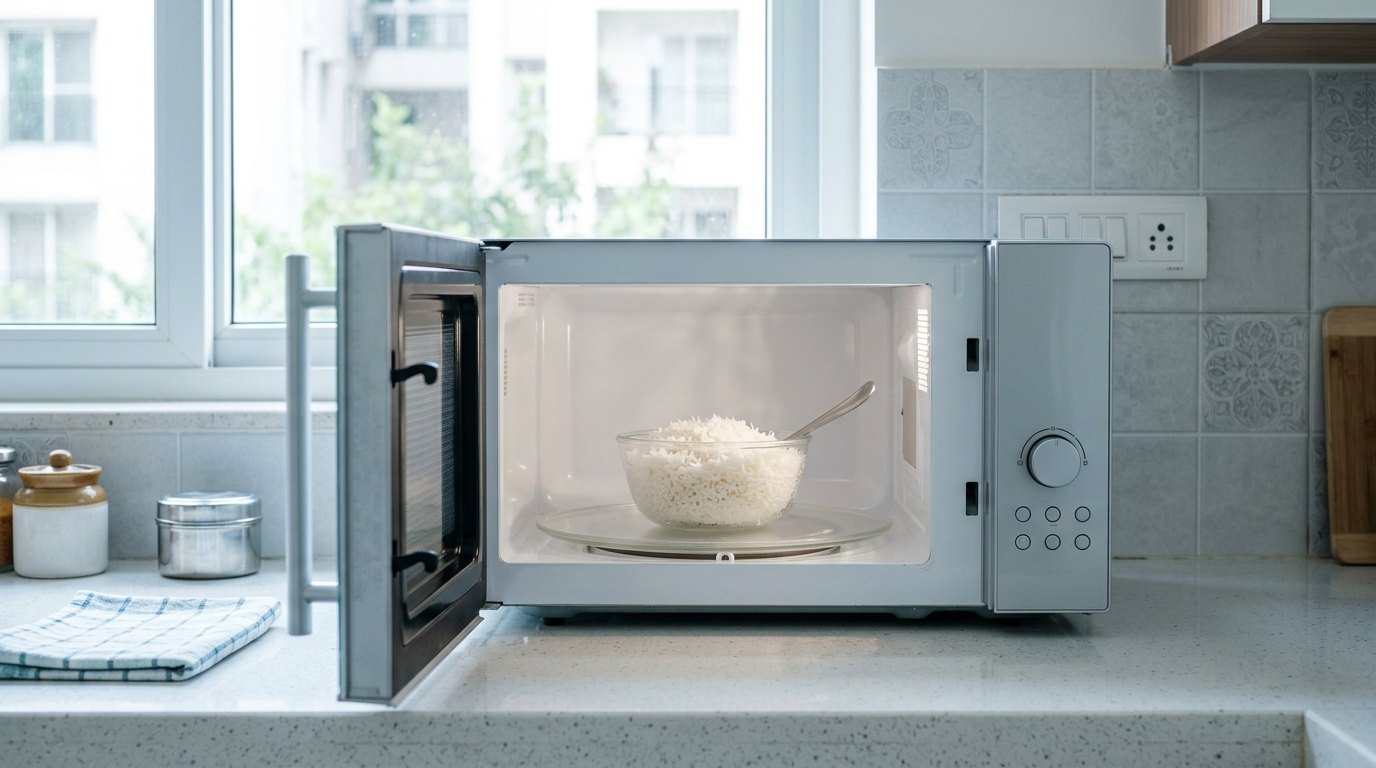
Cooking rice in a microwave: Samsung’s table
The plain-rice water and time table below is Samsung’s, for its 900 W convection model (convection p.52):
| Rice | Amount | Power | Time | Water and standing |
|---|---|---|---|---|
| White (parboiled) | 250 g | 900 W | 15 to 16 min | Double quantity of cold water; 5 min standing |
| White (parboiled) | 375 g | 900 W | 17½ to 18½ min | Same |
| Brown (parboiled) | 250 g / 375 g | 900 W | 20 to 21 / 22 to 23 min | Same |
| Mixed (rice + wild rice) | 250 g | 900 W | 16 to 17 min | 500 ml cold water; 5 min standing |
Samsung’s method: “Use a large glass bowl with lid – rice doubles in volume during cooking.” Cook covered and stir before standing. “Remark: the rice may not have absorbed all water after the cooking time is finished.” LG gives a power level for rice (60%) rather than a water table.
Cleaning basics
- Routine: a soft cloth in soapy water, then rinse and dry (Samsung p.10; LG p.11; IFB 20SC2 p.26).
- Avoid: abrasive cleaners and scouring pads (Samsung p.10, IFB p.26) and steam cleaners (Samsung p.5, LG p.6).
- Smells: Samsung heats a cup of diluted lemon juice in the empty oven for 10 minutes at maximum power, then waits for it to cool (convection p.10, solo p.9). IFB boils water, lemon peel and juice and a few cloves for several minutes, lets it cool, then wipes (p.26).
- Do not remove the mica waveguide cover (IFB p.26; LG solo p.15).
- Door seals: keep them clean (Samsung p.8, LG p.11). The turntable is dishwasher safe on the LG and IFB models (LG p.12, IFB p.26), but do not put a hot tray in water right after cooking (Samsung p.8, LG p.10).
What we could not verify
We searched the seven manuals and found no list of “five foods you should not reheat”. What they do name: eggs in shell, sealed containers, nuts and tomatoes (Samsung p.8), and large joints of meat, which Samsung says overcook before the centre is hot (p.52). In the manufacturer and regulator pages we read, we found nothing on whether microwaved rice is healthier than boiled rice, so we do not answer it.
For crisping and frying alternatives, see air fryer vs microwave; for full-size baking, difference between OTG and oven.
Buying a New Microwave? Start Here
The full comparison is in Best Microwave Oven in India (2026), the HomeVerdicts guide to microwave ovens. These are the first two products in that guide; the guide compares all of them.
Amazon India prices on 31 October 2026, rounded to the nearest ₹100 (prices change often). As an Amazon Associate, HomeVerdicts earns from qualifying purchases made through these links.
IFB 24PM2S 24L Solo
24 litre capacity, 900 W microwave output
IFB 20PG4S 20L Grill
20 litre capacity, 1000 W grill
FAQ
How do you use a microwave oven step by step?
Food in the centre of the turntable, door closed, choose the mode and power level, set the time, press START, then let it stand. Those are Samsung’s convection manual steps (p.12 to 13); LG’s solo manual uses Power, Time, START (p.18 to 19). Button names differ by model.
Can you cook rice in a microwave?
Yes. Samsung’s convection manual publishes times: 250 g of parboiled white rice takes 15 to 16 minutes at 900 W in a covered glass bowl, then 5 minutes standing (p.52).
Should I add water to my microwave rice?
Samsung says yes: double the quantity of cold water for white and brown rice, and 500 ml for 250 g of mixed rice (p.52).
Related reading on HomeVerdicts: Convection vs solo microwave · Air fryer vs microwave