How to Clean a Microwave (2026): Lemon, Vinegar or Neither, by Maker
Samsung, IFB and LG manuals give a lemon-water steam method, both LG manuals also allow vinegar, and Bosch India advises against both. Here is who says what, with the page it comes from, plus the one part you must never remove.
 Panasonic 20 L Solo Microwave NN-ST26JMFDGSolo microwave oven, 51 auto cook menus₹7,000Amazon, 8 Nov 2026★ 4.3Check price ↗
 IFB 24 L Solo Microwave 24PM2SSolo microwave oven, 69 auto cook menus₹8,500Amazon, 8 Nov 2026★ 4.4Check price ↗
 LG 28 L Convection Microwave MC2846BVConvection microwave oven, Health Plus menu₹14,000Amazon, 8 Nov 2026★ 4.3Check price ↗
 LG 20 L Grill Microwave MH2044DBGrill microwave oven, quartz heater₹8,500Amazon, 8 Nov 2026★ 4.3Check price ↗
The short answer. For routine cleaning, every maker we read agrees: a soft cloth with mild soapy water, then rinse and dry. For stuck-on grime and smells, the makers split. Each of the 5 manuals we read gives a lemon-water method, and the two LG manuals let you use vinegar instead. Bosch India’s support pages advise against both lemon juice and vinegar for microwaves. There is no single right answer across brands, so follow the manual for your model. And whatever method you use, do not remove the waveguide cover (the “mica” panel inside the cavity).
What we read, all of it on 30 September 2026:
- Manuals (5): Samsung MC28A5013AK (convection) and MS23A3513AK (solo); LG MC2846BG (convection) and MS2043DB (solo); IFB 20SC2 (convection). IFB page numbers are printed page numbers.
- Maker web pages (14): Samsung India support (8), LG India magazine (1), Bosch India support (5).
If you want the everyday operating steps rather than cleaning, see how to use a microwave oven.
Lemon, vinegar or neither: who says what
| Source | What it tells you to use | Heating time as published |
|---|---|---|
| Samsung manuals (MC28A5013AK p.10; MS23A3513AK p.9) | “a cup of diluted lemon juice on the centre of the turntable”, empty oven | “10 minutes at max power”, then wait until the oven cools |
| IFB 20SC2 manual (p.26) | 1 cup water, grated peel and juice of 1 lemon, several whole cloves | “Boil for several minutes using 100% power”, then let it stand until cool |
| LG manuals (MC2846BG p.219; MS2043DB p.48) | “Take 300 ml water in Microwave safe bowl, add 1 tbsp vinegar or lemon juice.” | Set by the Steam Clean programme; no time printed |
| Samsung India support (odour page) | Two cups of water with lemon juice or teabags, plus a wooden skewer or chopstick in the container | “five minutes or until the water comes to a boil”, then stand “ten to thirty minutes without opening the door” |
| Samsung India support (cleaning methods page) | “1/4 cup of vinegar and 1 cup of water” | No time given |
| LG India magazine | “a few slices of lemon” in about one cup of water | “three to five minutes”, door closed “another two to three minutes”; its own FAQ says 2 to 3 minutes |
| Bosch India support | Neither | “We advise you not to clean your microwave with lemon juice.” and, on vinegar, “It’s too aggressive and isn’t suitable for cleaning a microwave.” |
Three things stand out.
- Vinegar is not a manual-wide instruction. Of the 5 manuals we read, 2 name vinegar for cleaning, and both are LG. The Samsung and IFB manuals do not name it for cleaning. Samsung’s vinegar cleaning advice appears on its India support pages.
- Timings do not transfer. Samsung’s manuals say 10 minutes at maximum power; its own support page says five minutes or until boiling; LG’s magazine says three to five. Each figure belongs to its source. LG’s manuals leave the time to the programme.
- Bosch is the outlier, and it is speaking about microwaves. Bosch’s advice comes from its India support pages; we did not read a Bosch microwave manual. It does not carry over to Bosch’s HBF011BA1I built-in oven, whose manual (p.10) lists a vinegar solution for the enamelled oven interior.
Each maker is speaking about its own microwaves. If yours is a Bosch, skip the lemon and vinegar. If it is an LG with a Steam Clean menu, use that. If it is a Samsung or IFB, their manuals give lemon-water methods.
How to clean a microwave, step by step
- Switch it off first. IFB (p.26): “Disconnect the power cord before cleaning or leave the door open to inactivate the oven during cleaning.” Samsung (MC28A5013AK p.10) says to wait for the oven to cool down.
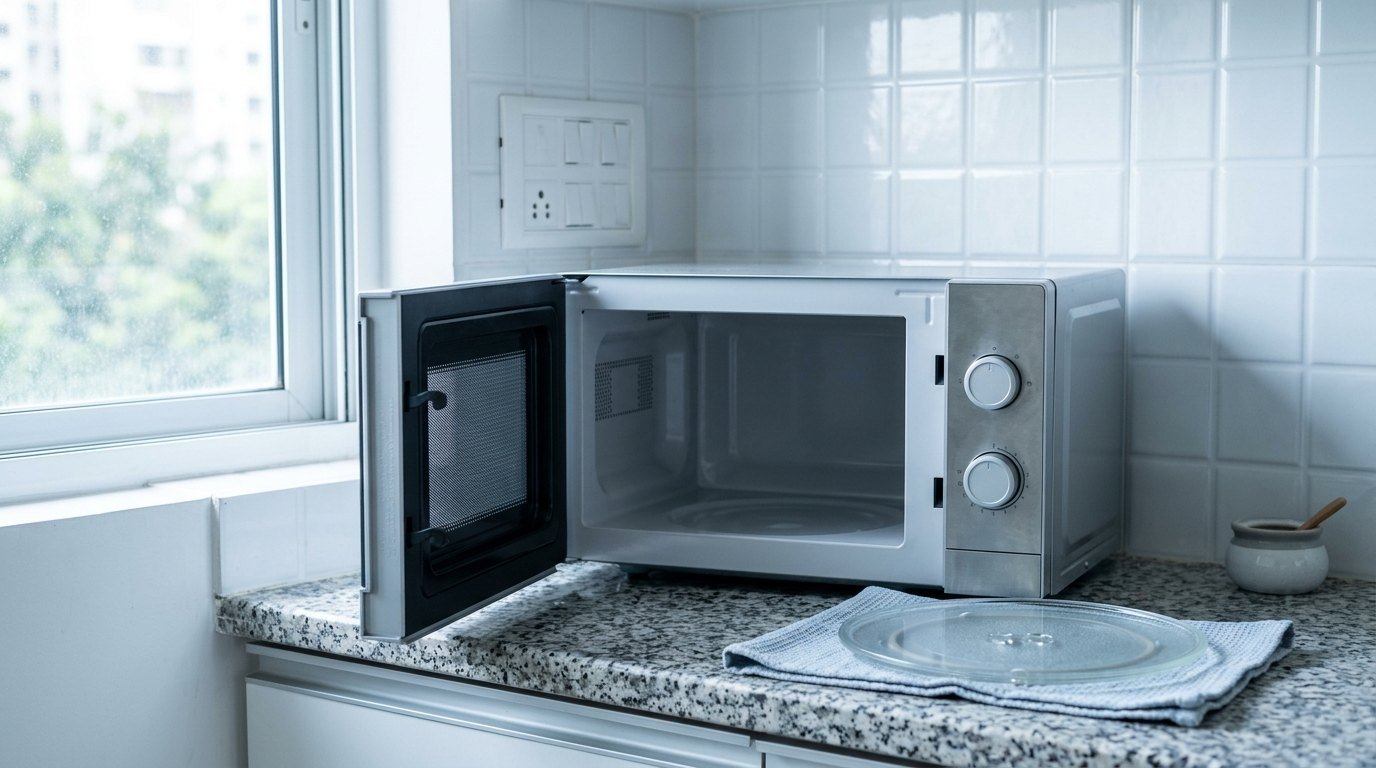
- Take out the turntable and roller ring. Bosch India support says to remove the turntable and clean it in soapy water. Details are in the turntable section below.
- Wipe the cavity with mild soapy water. Samsung (p.10): “Use a soft cloth in soapy water to clean both the inner and outer sides of the oven. Rinse and dry well.” LG (MC2846BG p.11, same in MS2043DB p.11): “Remove greasy spatters with a soapy cloth then rinse and dry.” IFB (p.26) says to wipe with a soft cloth and warm water.
- For heavier soil, use your maker’s method. IFB (p.26): “For heavier soil, use baking soda or a mild soap; rinse thoroughly with hot water.” For the steam options, use the table above.
- Keep water out of the vents. Samsung (p.10): “Take caution not to spill water into the oven vents.” LG (p.11): “Do not allow the water to seep into the ventilation openings”.
- On Samsung swing-heater models, lower the top element. Samsung (MC28A5013AK p.10; same text in MS23A3513AK p.9): “To clean the upper area of the cooking chamber, lower the top heating element by 45° as shown.” Put it back afterwards.
- Dry everything and refit the turntable. Samsung India support says: “Do not cook food without glass tray.”
How often. LG’s manual: “Clean your oven weekly or more often, if needed.” Bosch India support says to “always clean it immediately after warming and preparing food”, so dirt does not get baked on.
Built-in cleaning programmes (only on some models)
- LG Steam Clean menu: the vinegar-or-lemon recipe above (MC2846BG p.219; MS2043DB p.48), then “When beeps, wipe out with clean napkin. Press start.” and “Again wipe out.” The MS2043DB lists a 0.3 kg weight limit and a microwave-safe bowl (p.47).
- Samsung MC28A5013AK Deodorisation (p.48): for odours or smoke, after you “First clean the oven interior.” The time is set to 5 minutes, up to 15.
- Samsung “Steam Clean System”: a Samsung India support page describes filling a Steam Clean container and pressing a Steam Clean button, but it does not say which models have it. Check your own manual.
Programmes differ by model, so check yours before relying on one. If you are still choosing a microwave type, see convection vs solo microwave.
Turntable and roller ring
- Let it cool first. Samsung (MC28A5013AK p.8): “do not put the tray or rack in water shortly after cooking.” LG (MC2846BG p.10) says the same. LG’s magazine explains that hot glass can crack in cold water.
- Wash it. LG (p.12): “Wash the glass tray and rotating ring in mild, sudsy water.” IFB (p.26) says a “non-abrasive scouring sponge” for stubborn stains; LG’s manual says a “mild cleanser and scouring sponge” for heavy soil. Go with your own manual’s wording.
- Dishwasher: yes on the LG and IFB models (LG p.12; IFB p.26, “Use upper rack of dishwasher.”).
- The shaft: IFB (p.26): “The turntable motor shaft is not sealed, so excess water or spills should be wiped up immediately.”
- Rings: Samsung India support says to wash the rolling rings “at least a few times a year” so they do not get gummed up.
Door and door seal
Samsung (p.8): “Keep the door and door sealing surfaces clean by wiping with a damp cloth and then with a soft, dry cloth after each use.” LG (p.11): “Do not allow food or cleaner residue to accumulate on sealing surfaces of the appliance.” IFB (p.26) says to wipe the window on both sides and avoid sprays and harsh cleaners, which can stain or dull the door. On the glass, Samsung (p.6) and LG (p.5) warn that harsh abrasives or sharp metal scrapers can scratch it, “which may result in shattering of the glass.”
The waveguide cover: clean it, never remove it
This is the part of the cavity that carries a fire warning.
- IFB 20SC2 (p.26): “The waveguide cover is located on the ceiling in the microwave oven cavity. It is made from mica so requires special care.” Wipe spatters with a damp cloth as soon as they happen, because “Built-up splashes may overheat and cause smoke or possibly catch fire. DO NOT REMOVE THE WAVEGUIDE COVER.”
- LG MC2846BG and MS2043DB (p.15): “Do not remove the mica sheet from the inside cavity of the oven. It is there to protect the microwave components from food spatters.”
- Bosch India support calls the same part a “cardboard shield” and says that if you need to replace it, “you can almost certainly get a replacement part from us.”
IFB and LG call it mica; Bosch calls it cardboard. Where it sits varies: IFB says the ceiling, and the LG text we read does not say. Look for it in your own cavity rather than assuming a position.
What not to use
| Do not use | Who says so |
|---|---|
| Abrasive cleaners, scouring pads, steel wool | Samsung (p.10), LG (p.11), IFB (p.26) |
| Benzene, thinner, alcohol | Samsung (p.7) |
| Steam cleaner or water jet | Samsung (p.5), LG (p.6) |
| Oven cleaner | Bosch India support: “Oven cleaner should not be used under any circumstances.” |
| Rough side of a universal sponge | Bosch India support |
| Chemical cleaners on the control panel | IFB (p.26) |
| Foil, metal objects, gold or silver rims during the steam method | Samsung India support |
Baking soda is contested. IFB’s manual permits it for heavier soil and LG’s magazine suggests a small amount of paste. Samsung’s manual bans “abrasive or chemical substances” without naming baking soda, and Bosch lists only soapy water and a damp cloth. None of the 5 manuals we read forbids baking soda by name.
What we could not verify
- Panasonic, Whirlpool and Godrej: we could not read their India pages (Panasonic’s site refused the request; Whirlpool India showed a “Link paused” page and its microwave page was not found; Godrej’s links led to a group landing page and to commercial appliances). This page gives no instruction from these three brands.
- Why Bosch advises against lemon: this page has no reason from Bosch beyond its statement that “Lemon juice isn’t necessary for cleaning your microwave.” For vinegar it gives one: “too aggressive”.
- Samsung contradicts itself: one support page says “Do not use any abrasive or chemical substances for cleaning.” Another suggests “white vinegar and water or a grease-removing cleaning fluid.” We record both and do not resolve them.
For how microwaves differ from ovens, which clean differently, see difference between oven and microwave.
Buying a New Microwave? Start Here
The full comparison is in Best Microwave Oven in India (2026), the HomeVerdicts guide to microwave ovens. These are the first two products in that guide; the guide compares all of them.
Amazon India prices on 31 October 2026, rounded to the nearest ₹100 (prices change often). As an Amazon Associate, HomeVerdicts earns from qualifying purchases made through these links.
IFB 24PM2S 24L Solo
24 litre capacity, 900 W microwave output
IFB 20PG4S 20L Grill
20 litre capacity, 1000 W grill
FAQ
What is the best way to clean the inside of a microwave?
A soft cloth with mild soapy water or a damp cloth, then rinse and dry. That is the routine Samsung, LG and IFB manuals and Bosch India support share. Unplug first (IFB), let it cool (Samsung), keep water out of the vents (Samsung, LG) and leave the waveguide cover in place (IFB, LG).
Is it better to clean the microwave with lemon or vinegar?
It depends on your brand. The Samsung and IFB manuals give lemon-water methods. Both LG manuals allow “1 tbsp vinegar or lemon juice” in 300 ml water. Bosch India advises against both, calling vinegar “too aggressive”. Follow your own model’s manual.
What should you not use to clean a microwave?
Abrasive cleaners and scouring pads (Samsung, LG, IFB manuals), benzene, thinner or alcohol (Samsung), steam cleaners (Samsung, LG) and oven cleaner (Bosch India support). Samsung’s support page also rules out foil and metal during steam cleaning.
How can I clean my microwave without scrubbing?
Use a steam method your maker approves. Samsung’s manuals heat diluted lemon juice for 10 minutes at maximum, then you wait for it to cool and wipe. LG’s Steam Clean menu runs on its own; you wipe when it beeps. Samsung India support also suggests heating a wet towel on full power for 30 to 40 seconds. For a Bosch, its India support advises against lemon and vinegar and recommends a damp cloth.
Related reading on HomeVerdicts: How to use a microwave oven · Convection vs solo microwave · Difference between oven and microwave