BLDC Ceiling Fan vs Normal Ceiling Fan: Which Should You Actually Buy?
By Samiya
 atomberg Renesa Enzel 1200mmBLDC ceiling fan with remote₹3,700Amazon, 8 Nov 2026★ 4.1Check price ↗
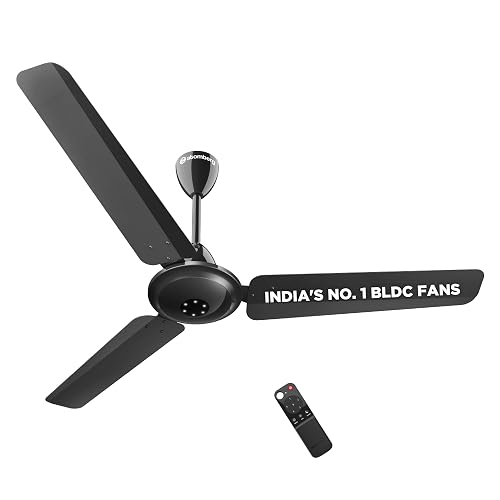 atomberg Efficio Alpha 1200mmBLDC ceiling fan with remote₹2,800Amazon, 8 Nov 2026★ 4.1Check price ↗


Prices and ratings in the boxes above are Amazon selling prices read on 8 Nov 2026, rounded to the nearest ₹100. Products are the most-rated ones of each type that we found, shown as examples, not a ranking. Prices quoted in the text below are from the dates given beside them and may differ from today’s Amazon price.
A BLDC ceiling fan usually costs more to buy and less to run. Whether that trade pays off is a rupee question, not a motor question, and it has a checkable answer. We could source two same-brand pairs where both fans carry a model number, share a 1200 mm sweep, and publish both a wattage and an air delivery figure: Havells and Bajaj. Run through two published state tariffs and two usage levels, the BLDC premium pays back in as little as about 1.4 years or as long as about 8.6 years. Your tariff slab and your hours decide which end you sit at.
The short answer. Choose a BLDC fan if your fan runs long hours and you pay a high tariff slab: on the Havells pair at Maharashtra’s 101 to 300 unit rate and 16 hours a day, the extra cost comes back in about 1.4 years. Think harder if you pay a low flat rate and run a fan part of the day: on the Bajaj pair at Karnataka’s flat rate and 8 hours a day, payback takes about 8.6 years.
BLDC vs normal ceiling fan on the spec sheet
These are the four models we found where the manufacturer’s own product page gives a model number plus a wattage and an air delivery figure in its spec block. All four are 1200 mm fans. The star ratings are each manufacturer’s own declared rating.
| Brand | Model | Motor | Rated input | Air delivery | Speed | Declared stars |
|---|---|---|---|---|---|---|
| Havells | Elio BLDC (FHCE15SBNC48-C) | BLDC | 28 W | 225 CMM | 350 RPM | 5 Star |
| Havells | Drove 390 HS Regular (FHCDVE1BRN48-c) | Induction | 48 W | 220 CMM | 390 RPM | 1 Star |
| Bajaj Electricals | Novella BLDC (SKU 251623EE) | BLDC | 35 W | 225 CMM | 350 RPM | 5 Star |
| Bajaj Electricals | Novella EE (SKU 251705EE) | Induction | 53 W | 220 CMM | 380 RPM | 1 Star |
Sources: havells.com and bajajelectricals.com product pages, read 13 September 2026.
Three things stand out. In both pairs the BLDC fan draws less power, 20 W less at Havells and 18 W less at Bajaj. It also delivers slightly more air, 225 CMM against 220. And it is rated at a lower speed, 350 RPM against 390 and 380. So this is not a weaker fan winning a watts-only contest: on the manufacturers’ own figures, the BLDC model moves a little more air on noticeably less power.
Two other brands publish partial figures for a BLDC model. Orient Electric lists its Ecotech Air BLDC (SKU 2134883812010) at 210 CMM in body copy and 32 W inside an energy savings calculator on the same page, not in a spec row. Atomberg lists its Renesa Prime (FG1095) at 235 CMM, with no model-specific wattage in its spec block. Neither gave us a matched non-BLDC sibling with the same published figures, so neither forms a pair, and we do not rank them against Havells.
Two ratios the marketing blurs
The same two numbers, watts and air, give two different percentages. Which one a claim uses changes the headline by a wide margin.
Ratio one: power cut. Rated input falls by 34.0% on the Bajaj pair (53 W to 35 W) and 41.7% on the Havells pair (48 W to 28 W). This is the ratio that drives your electricity bill.
Ratio two: air per watt. Divide air delivery by rated input (CMM/W, our arithmetic, not a figure either manufacturer publishes). The Bajaj pair goes from 4.15 to 6.43 CMM/W, 55% more air per watt. The Havells pair goes from 4.58 to 8.04 CMM/W, 76% more air per watt.
| Pair | Power cut (bill ratio) | CMM/W, induction | CMM/W, BLDC | Air per watt gain |
|---|---|---|---|---|
| Bajaj Novella | 34.0% | 4.15 | 6.43 | +55% |
| Havells Elio vs Drove | 41.7% | 4.58 | 8.04 | +76% |
Both are true. Only the first tells you how much less you pay. A “76% better” line can be defended on air per watt for the Havells pair, but it does not mean a 76% smaller bill. On these two pairs, the power cut is 34.0% or 41.7%.
The payback table: what the BLDC premium costs and returns
Here is the full calculation, with every input on the table.
Inputs, all stated:
- Watt gap (rated input): Havells 48 W minus 28 W = 20 W. Bajaj 53 W minus 35 W = 18 W.
- Price gap: Havells ₹3,990 minus ₹1,990 = ₹2,000. Bajaj ₹7,320 minus ₹4,700 = ₹2,620. These are single storefront listings on each manufacturer’s own site, read 13 September 2026, so treat them as prices as of September 2026, not market bands.
- Tariffs: BESCOM (Karnataka) LT-1 domestic, FY2026-27, ₹5.80 per kWh flat, no slab. MSEDCL (Maharashtra) LT I(B) residential, 101 to 300 unit slab, FY2026-27, ₹12.40 per kWh (energy ₹10.80 plus wheeling ₹1.60). Both are from the utilities’ published tariff documents. Fixed charges are left out because they do not change with the fan.
- Hours: our assumption, not a sourced figure. 16 hours a day is the figure Orient’s own calculator uses. 8 hours a day is our illustrative lower case. We could not source a measured figure for how long Indian households run ceiling fans.
Formula: kWh saved per year = watt gap ÷ 1,000 × hours per day × 365. Rupees saved = kWh × tariff. Payback = price gap ÷ rupees saved per year.
| Pair | Hours a day | kWh saved a year | Saved a year at ₹5.80 (BESCOM) | Payback at ₹5.80 | Saved a year at ₹12.40 (MSEDCL 101 to 300) | Payback at ₹12.40 |
|---|---|---|---|---|---|---|
| Havells (20 W, ₹2,000) | 8 | 58.4 | ₹338.72 | 5.90 yr | ₹724.16 | 2.76 yr |
| Havells (20 W, ₹2,000) | 16 | 116.8 | ₹677.44 | 2.95 yr | ₹1,448.32 | 1.38 yr |
| Bajaj (18 W, ₹2,620) | 8 | 52.56 | ₹304.85 | 8.59 yr | ₹651.74 | 4.02 yr |
| Bajaj (18 W, ₹2,620) | 16 | 105.12 | ₹609.70 | 4.30 yr | ₹1,303.49 | 2.01 yr |
What decides it. The fastest cell is the Havells pair at 16 hours a day on the MSEDCL 101 to 300 slab: 1.38 years. The slowest is the Bajaj pair at 8 hours a day on BESCOM’s flat ₹5.80: 8.59 years. Same motor type, more than a sixfold spread. Doubling the hours halves the payback. Moving from ₹5.80 to ₹12.40 cuts it to a little under half again. The Bajaj pair pays back more slowly than the Havells pair in every row, because its price gap is larger and its watt gap smaller.
So the useful question is not “is BLDC better?” It is: what do you pay per unit, and how many hours does this fan actually run? A bedroom fan running through the night on a high slab sits near the top of this table. A guest room fan on a low flat tariff sits near the bottom.
Limits that travel with this table:
- Two pairs, two brands. That is every same-brand, same-sweep, model-numbered pair we could source, not a sample from a larger set.
- Watts are rated input, not measured draw.
- None of these four product pages publishes wattage by speed, so the table assumes rated input for every hour. We cannot say how running at a lower speed changes it.
- Your own tariff will differ unless you are on one of these two.
What the manufacturers themselves claim
We found savings claims from six brands. Here they are, each attributed to its source. The “normal fan” wattages range from 55 W to 90 W, and the savings claims from 41.8% to “up to 65%”. None names a model-numbered comparator.
| Brand | “Normal fan” wattage | BLDC wattage | Savings claimed | Confidence |
|---|---|---|---|---|
| Atomberg (FAQ on Renesa Prime page) | 75 W (“unrated fans”) | 35 W (“at top speed”) | Not stated as a % | Read in full |
| Polycab (blog) | 80 W | 35 W | “up to 65% less power” | Read in full |
| Orient Electric (Ecotech Air calculator) | 55 W | 32 W | 41.8% (our arithmetic from its two wattages) | Read in full |
| Crompton (blog) | Not itemised | Not itemised | “50-60% electricity” | One source only, lower confidence |
| Bajaj Electricals (blog) | Not itemised | Not itemised | “55-65% less power… typically” | One source only, lower confidence |
| Panasonic (blog) | 70-90 W | 25-35 W | Not itemised as one % | One source only, lower confidence |
The last three rows come from excerpts of those brands’ blogs, not full-page reads, so they are those brands’ published claims as excerpted, not figures we have verified. Atomberg’s 35 W is a category statement about BLDC fans, not the Renesa Prime’s own rated input.
Orient is the one brand that shows its inputs. Its Ecotech Air page calculator assumes 16 hours a day, ₹8 a unit, 55 W for a “normal fan” and 32 W for the Ecotech Air. It arrives at ₹2,570 a year against ₹1,495, a saving of ₹1,075 a year or ₹5,375 over five years, and that arithmetic reproduces from its inputs. Two caveats: the 55 W comparator has no model number, and the ₹8 tariff is not tied to any named state or utility.
Set the power cuts from the matched pairs, 34.0% for Bajaj and 41.7% for Havells, beside these claims and the gap shows. Crompton’s and Atomberg’s claims cannot be checked against their own products: Crompton’s BLDC product page publishes no wattage in the page text we read, and Atomberg publishes no model-specific wattage. Bajaj Electricals’ claim can be checked, and its own Novella pair gives a 34.0% power cut.
Price bands, as of September 2026
Across the BLDC models we priced on manufacturers’ own storefronts on 13 September 2026, prices ran from ₹2,749 (Orient Ecotech Air) to ₹7,320 (Bajaj Novella BLDC). Where the same brand also sold a standard induction model we could price, those ran ₹1,990 to ₹4,700.
| Brand | BLDC premium over its standard model |
|---|---|
| Havells (Elio BLDC vs Drove 390 HS, both 1200 mm) | +100% |
| Crompton (Energion High Speed BLDC vs High Speed HS Star Rated, the latter a 42 inch sweep, not a matched pair) | +66% |
| Bajaj Electricals (Novella BLDC vs Novella EE, both 1200 mm) | +56% |
Across these three brands the premium ran 56% to 100%. Atomberg sells BLDC only, so it has no standard model to compare. These are single listings per model, not sampled market prices.
The star label: what we could not confirm
Ceiling fans in India carry a BEE star label, 1 to 5 stars, as declared by manufacturers. The stars in our spec table are the manufacturers’ own declared ratings. We searched for the current official band thresholds on beestarlabel.com and beeindia.gov.in on 13 September 2026, and both returned pages we could not read the schedule from. So we do not state what a 5 Star or 1 Star ceiling fan must achieve. A higher declared star is a manufacturer’s statement; the rated input and the payback table above are what you can check.
What we could not verify
- Lifespan, noise, heat and reliability. Our research for this page, built from the Havells, Bajaj Electricals, Orient, Atomberg and Crompton product pages above, holds no lifespan, noise, heat, repair or reliability figure for any model. We give none.
- Wattage by speed. Not published on any of the four paired product pages.
- Crompton’s BLDC wattage and air delivery, and Atomberg’s Renesa Prime wattage: not in the page text we read.
- Usha. We could not load any of the three Usha web addresses we requested, so no Usha model appears here.
- How many hours Indian households run fans. Not sourced, which is why the table shows two stated assumptions.
- BEE star thresholds, as above.
Cleaning and blade care are covered separately in our ceiling fan cleaning guide. Weighing an AC purchase too? Read our inverter AC vs non-inverter AC comparison.
FAQs
How much electricity does a BLDC fan consume per hour?
At its rated input, the Havells Elio BLDC (28 W) uses 0.028 kWh an hour and the Bajaj Novella BLDC (35 W) uses 0.035 kWh. Their induction siblings are rated at 48 W and 53 W, or 0.048 and 0.053 kWh an hour. These are rated input figures, not measured draw, and neither brand publishes per-speed wattage.
Which is better, a normal ceiling fan or a BLDC fan?
It depends on your tariff and hours. On the two pairs we could source, the BLDC premium pays back in 1.38 years (Havells, 16 hours a day, MSEDCL ₹12.40) or as late as 8.59 years (Bajaj, 8 hours a day, BESCOM ₹5.80). High slab plus long hours favours BLDC most.
What are the disadvantages of a BLDC motor?
The one our research supports is price: ₹2,000 more for Havells’ pair and ₹2,620 more for Bajaj’s, as of September 2026, and a 56% to 100% premium across three brands. We could not source reliability, repair or lifespan data, so we make no claim either way.
How long do BLDC fans last?
We could not source a lifespan figure. None of the product pages we read for this page publishes one, so we do not give one.
