How to Fix a High Flame on a Gas Stove (2026): What Glen and Faber Publish, and What They Do Not
We read three manufacturer troubleshooting pages from Glen and Faber on 13 September 2026, and none of them publishes a cause list or a fix for a flame that is uniformly too high.
By Samiya, HomeVerdicts. Researched from manufacturer-published troubleshooting and product documentation, read 13 September 2026. We do not test products. Every instruction below is quoted or paraphrased from a manufacturer page with the brand named, or it is labelled as something we could not source.
 Elica Vetro 3 Burner Gas StoveGlass top gas stove, 703 CT Vetro₹3,600Amazon, 8 Nov 2026★ 4.1Check price ↗
 Milton Premium 3 Burner Gas StoveBlack glass top, manual ignition₹3,300Amazon, 8 Nov 2026★ 4.0Check price ↗
 Whirlpool 70 cm 3 Burner HobBuilt-in hob, auto ignition₹11,000Amazon, 8 Nov 2026★ 4.0Check price ↗
 Faber 70 cm 3 Burner Hob Prime HT703Built-in hob, auto ignition₹18,000Amazon, 8 Nov 2026★ 4.5Check price ↗
Where the manufacturer says stop
Reproduced as published, not softened.
Glen, on smelling gas: “If you smell gas, immediately turn off the gas supply at the cylinder, open windows for ventilation, avoid using electrical switches, and evacuate the area. Contact a certified technician before using the stove again.“
Glen’s published “when to call a professional” list: persistent gas odours even when the stove is turned off; flames that won’t stay lit despite thorough cleaning; unusual hissing sounds from gas connections or the regulator; visible damage to gas lines, valves, or internal components; igniter problems that persist after cleaning.
Faber: “If you are unsure about repairing the problem yourself, you must contact an experienced professional.”
The finding: on the three pages we read, a low-flame playbook and no high-flame playbook
On 13 September 2026 we read three manufacturer troubleshooting pages for this question: Glen’s flame-problems guide, published 13 August 2026, Faber’s low gas stove flame article, and Faber’s article on gas stove burners.
- Glen’s guide covers exactly five faults: weak or low flame, yellow or orange flames, uneven flames, burner won’t ignite, and continuous clicking sound. A flame that is uniformly too high is not among them.
- Faber’s flame article is titled and scoped to a low flame only.
- Faber’s burner article gives only the knob direction as a flame-height control.
Across those three pages there is a detailed low-flame playbook and no high-flame playbook. That is what we found when we checked those three pages, not a claim that no manufacturer anywhere has published one. We also quote a fourth manufacturer page below, Crompton’s guide to cleaning gas cooktop burners, which mentions yellow and uneven flames as reasons to check and clean a burner. We did not read it as a troubleshooting page for flame height.
What the three pages do publish, and what this page stands behind: the knob, what Faber says burner size and holes control, one adjustable part whose published purpose is flame colour rather than height, the causes of a weak or low flame, and the points where the manufacturer says stop.
What a correct flame looks like, so you can tell “too high” from “wrong”
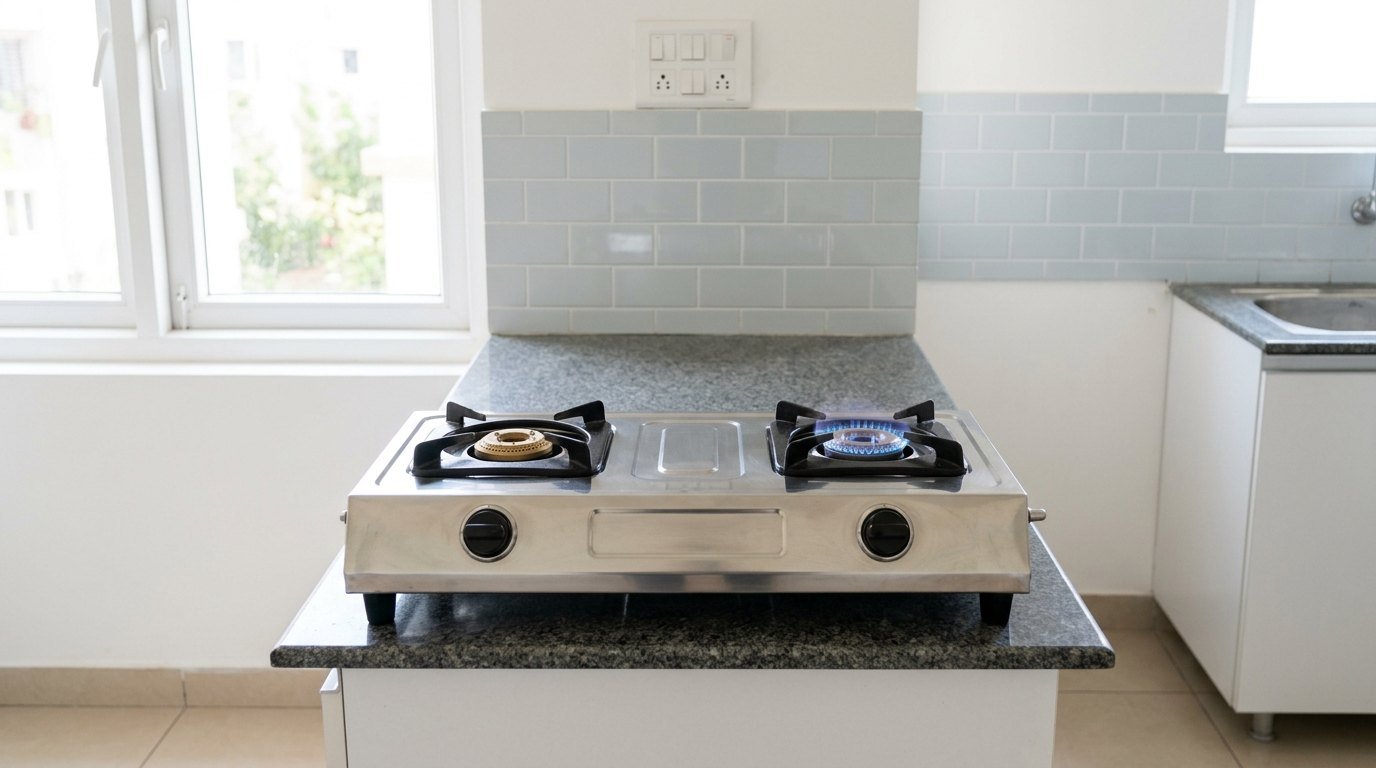
Glen publishes the reference: “A properly functioning gas stove produces steady blue flames with minimal yellow tips,” and “the flame should be uniform in height and burn quietly without sputtering.” On colour it is blunt: “Yellow or orange flames signal incomplete combustion, which reduces cooking efficiency and may produce carbon monoxide.” Crompton publishes the same signal independently: “If the flame appears yellow instead of blue, the burner may require cleaning.”
So a flame that burns yellow or orange, is not uniform in height, or sputters is not the correct flame Glen describes, and colour faults have published responses (below). A blue, quiet, uniform flame that is simply bigger than you want is the other problem, and it is the one none of the three troubleshooting pages we read publishes a fix for.
The knob: the one published height control
The only height control any of the three pages states is the knob, from Faber: “Turning the knob clockwise increases the amount of gas flowing to the burner and increases the size of the flame and the amount of heat produced. Turning the knob counter-clockwise decreases the amount of gas flowing to the burner.”
That is the whole published instruction. If the knob is already at its lowest and the flame is still bigger than you want, no further height adjustment appears on any of the three pages we read.
Faber’s burner article describes a burner as working by burning “natural gas or propane”, and Faber’s low-flame article lists fuel type among its causes of a weak flame: “Different gases have different energy density levels, hence the flame produced varies.” Glen’s air-shutter instruction, below, gives different settings for LPG and for natural gas.
Burner geometry controls flame size, per Faber
Faber, on the burner itself: “It’s made of brass or aluminium, and it features a series of vents in the bottom that allow the gas to flow out and ignite. The burner’s size and number of holes control the size and intensity of the flame.” Faber also publishes the material trade-off: “Brass burners are more robust, but they also cost more. Aluminium burners are less priced but less robust.”
That sentence is as far as the source goes. Faber states that burner size and hole count control the size and intensity of the flame; none of the three pages says what that means for the lowest setting, so we cannot tell you whether a flame that is too big at its lowest setting is a hardware limit or a fault. None of them publishes a procedure for changing burner size or hardware to lower a flame either, and we will not invent one on a page about a live LPG appliance.
The air shutter: published, adjustable, and scoped to colour
One adjustable part other than the knob carries a published setting, and its published purpose is colour. Glen, verbatim:
“Locate the air shutter beneath your burner. Adjust it gradually while observing the flame colour. Open the shutter slowly until the flame turns blue. For LPG gas, keep it half open. For natural gas, adjust to one-quarter open.”
Glen frames the shutter as the fix for a flame of the wrong colour, not the wrong height. Glen’s own cause list for yellow or orange flames includes “Blocked air intake shutters” and “Incorrect air shutter adjustment”. Nothing in the instruction promises a shorter flame, and this page will not repackage it as one.
Glen’s wording, “while observing the flame colour” and “until the flame turns blue”, describes an adjustment made while the burner is lit. Glen’s turn-off-and-cool rule is published for “any cleaning or maintenance” and is quoted with the cleaning steps below; this page does not join the two into one sequence. Faber’s low-flame article carries a general instruction, not written about the air shutter: “If you are unsure about repairing the problem yourself, you must contact an experienced professional.”
It is also published by one maker only. Faber’s low-flame article names “Inadequate Air Supply” among its causes of a weak flame but does not mention an air shutter, so it publishes no shutter position for either gas. The half-open LPG figure is Glen’s alone. We could not confirm it with an LPG distributor page (see what we could not verify), so do not read it as official LPG guidance.
The published causes of a weak or low flame
These lists are published for a weak or low flame. Neither manufacturer presents them as causes of a flame that is too high.
Glen, as causes of a weak or low flame, names clogged burner ports “from food spills and grease”, low gas pressure “from faulty regulators or empty cylinders”, and “blocked gas jets or orifices”. Faber’s list of causes of a weak flame runs to six: fluctuations in gas pressure, gas leaks or blockages, inadequate air supply, a regulator and valve issue (“If the regulator does not work properly, it can limit the amount of gas reaching the burner”), burner issues (“Clogged or broken burners may disrupt normal gas-air mixing”), and fuel type. The same Faber article opens with two possible explanations for a low flame: “the clogging of burner ports” and “A failing gas valve”.
Regulator and clogged ports appear on both Glen’s and Faber’s weak-flame lists; inadequate air supply is Faber’s alone. Clogged ports are what Glen’s cleaning steps below address. The regulator is not a DIY part. Glen: “Inspect the gas regulator for damage. Contact a certified technician for regulator replacement.“
A flame high on one side: Glen’s uneven-flame fault
One nearby fault gets described as a high flame, and Glen defines it exactly: “When one side of the burner produces a high flame while the other barely flickers, burner positioning or blockage causes the issue.” Its published causes are a misaligned burner cap, partially blocked burner ports on one side, and uneven debris buildup around the burner ring. The fix starts with the cap: “The cap must sit centred and level.” Glen’s uneven-flame fix ends: “Wipe away any moisture and allow the burner to dry completely before reassembling.” Faber publishes the same cap check, telling readers to make sure burner caps are properly positioned if flames appear uneven or too low.
The burner cleaning procedure, as Glen publishes it
Clogged ports appear on both the weak-flame and the uneven-flame lists above, and Glen, Crompton and Faber all publish burner cleaning. Crompton puts a cadence on it: “Weekly: Clean burner caps and rings”.
Glen’s rule for any cleaning or maintenance: “Always turn off the gas supply valve before performing any cleaning or maintenance. Allow burners to cool completely before touching components. Never use flammable cleaning products near your gas stove. Use only mild dish soap, baking soda, and water.”
Glen’s cleaning steps, in its own order:
- Turn off the gas supply and allow the burner to cool.
- Remove burner caps and grates.
- Soak burner heads in warm soapy water for 15-20 minutes with baking soda to break down grease.
- Use a soft-bristled toothbrush to scrub burner ports thoroughly.
- For stubborn blockages, use a thin wire to carefully clear each port.
Faber adds ventilation to its maintenance list, because “a lack of fresh air can have an impact on flame quality”.
What we could not verify
Each gap below is stated plainly.
- A published cause or fix for a uniformly too-high flame. Three manufacturer troubleshooting pages read on 13 September 2026 (Glen’s flame guide, Faber’s low-flame article, Faber’s burner article); none carries one. That is what we found on those pages, not a claim about every page that exists.
- What burner size means for the lowest knob setting. Faber says size and hole count control the size and intensity of the flame, and says no more than that.
- The half-open air shutter setting for LPG. One manufacturer, Glen. Faber’s low-flame article does not mention an air shutter and publishes no position for either gas.
- Any LPG distributor confirmation. Indane and IOCL, Bharat Gas and HP Gas safety pages were checked on 13 September 2026 and none gave us usable safety text. The LPG figure above therefore rests on a stove manufacturer, not on a gas distributor.
- Other Indian stove brands. Sunflame, Elica and Prestige were searched on 13 September 2026 and we found no flame troubleshooting article on their sites to cite.
- Any rupee figure. Nothing in the manufacturer material we have puts a price on a burner, a replacement burner or a technician visit, so this page publishes none.
How we decide what counts as sourced: how we research.
Frequently asked questions
Why is my gas stove flame too high?
None of the three manufacturer troubleshooting pages we read (Glen’s flame guide and two Faber articles) publishes a cause list for a uniformly too-high flame, so the diagnosis you are looking for is not on them. Faber does publish what controls flame size at the burner: “The burner’s size and number of holes control the size and intensity of the flame.” If the flame is weak or low, regulator and clogged ports are causes Glen and Faber both publish; if it is high on one side only, Glen publishes cap, port and debris causes (above); if it is yellow, see the last answer.
How do I adjust the flame on a gas stove?
With the knob. Faber: “Turning the knob clockwise increases the amount of gas flowing to the burner and increases the size of the flame and the amount of heat produced. Turning the knob counter-clockwise decreases the amount of gas flowing to the burner.” If it is already at its lowest and still too high, no further height adjustment is published on the three pages we read.
What does the air shutter do?
Glen publishes it as the control for flame colour: open the shutter slowly until the flame turns blue, half open for LPG and one-quarter open for natural gas, adjusting gradually while observing the flame colour. That is Glen alone, and it is scoped to colour rather than height. Glen publishes its turn-off-and-cool rule separately, for “any cleaning or maintenance”. Faber’s low-flame article carries a general instruction, not written about the shutter: “If you are unsure about repairing the problem yourself, you must contact an experienced professional.”
Why is my flame yellow or orange?
Glen: “Yellow or orange flames signal incomplete combustion, which reduces cooking efficiency and may produce carbon monoxide.” Glen’s causes for yellow or orange flames are insufficient air mixing with the gas, dirty or misaligned burner caps, blocked air intake shutters and incorrect air shutter adjustment. Two published responses in the material we have: Crompton’s, that the burner may require cleaning (Glen’s cleaning steps are above), and Glen’s shutter adjustment, opened slowly until the flame turns blue.
Related reading on HomeVerdicts: