How to Clean a Front Loading Washing Machine (2026): the Door Seal Is the Job
Two appliance manufacturers publish opposite instructions for the same rubber door seal, and this page prints both of them without picking a winner.
 LG 7 Kg 5 Star Front Load FHB1207Z2MFully automatic, DD technology, steam wash₹30,000Amazon, 8 Nov 2026★ 4.2Check price ↗
 Bosch 7 kg 5 Star Front LoadFully automatic front load washing machine₹28,000Amazon, 8 Nov 2026★ 3.9Check price ↗
 Samsung 7 kg 5 Star Top Load WA70BG4441YYTLFully automatic, Eco Bubble, Digital Inverter₹17,500Amazon, 8 Nov 2026★ 4.1Check price ↗
 VW Visio World 7.5 kg 5 StarAqua Spin semi automatic top load₹7,200Amazon, 8 Nov 2026★ 4.0Check price ↗
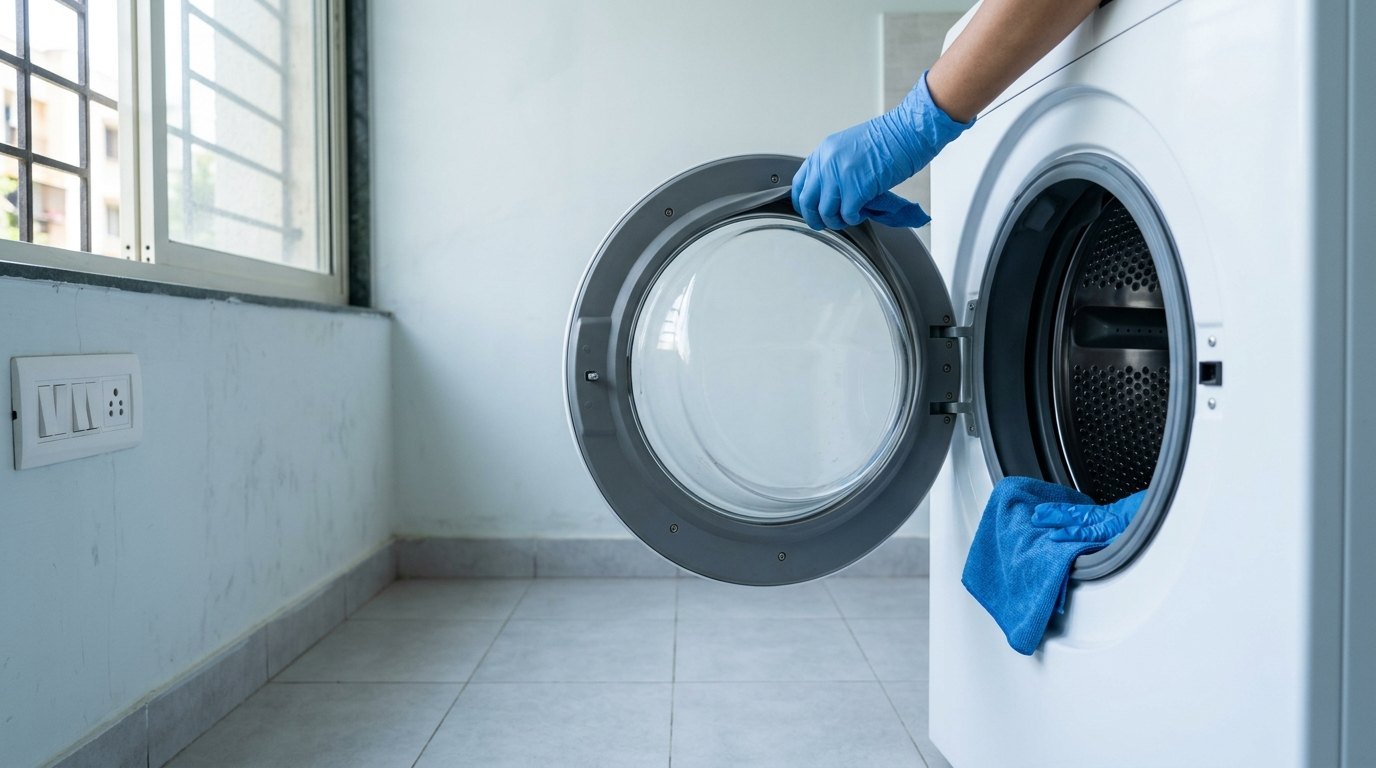
Quick answer: on a front loader the rubber door seal needs a routine of its own. Ariel says to pull the seal back and get the dirt from underneath it. Bosch says to wipe the rubber seals weekly, and again with a soft cloth after every clean cycle. What you wipe it with is where the brands split: Haier tells you to spray white vinegar directly on the rubber seal, and LG warns that vinegar can corrode the rubber seal. Both are manufacturers, neither outranks the other on our evidence, and your own manual is the tiebreak.
What makes a front loading washing machine different
Bosch India publishes two cleaning procedures on one page, one for a front loader and one for a top loader, and the gap between their last steps is this page’s whole subject. The front load procedure finishes: “After the cycle, wipe the rubber gasket, door, and detergent drawer with a soft cloth.” The top load procedure finishes: “Clean the Lid and Rim: Wipe off any residue with a soft cloth.” The component that separates the two is the rubber gasket.
Five brands among the sources this page uses name it, each in its own vocabulary: Ariel the rubber seal on the door, Bosch the rubber gasket and the rubber seals, Haier the rubber seal and the gasket, Samsung the door gasket, LG the machine seal. Two others, IFB and Godrej, publish cleaning material among those sources that never names either component. If you have not bought yet, our comparison of fully automatic and semi automatic washing machines covers that decision. This page assumes the front loader is already in your house.
The door seal, and why it is the front load problem
Bosch India publishes the symptoms that mean a machine is overdue for a cleaner, and the seal leads its list: “If you see any mold on the rubber gasket or detergent drawer, or experience bad water drainage, residue left on freshly washed clothes, or a sudden increase in noise or longer cycle times, it’s time to use a washing machine cleaner.”
Mould on the gasket, in Bosch’s framing, is not a cosmetic complaint. It is a trigger for a full clean.
Damp conditions sit behind all of that, and we want to be exact about whose idea that is, because it is ours. No manufacturer source we read names Indian monsoon conditions, and none of them states a humidity level of any kind. The nearest published sentence is generic and comes from LG’s Nepal locale support article, which we label rather than pass off as LG India: “If the unit is installed in a damp and dark area or have not been in used for a long time, more dust can build up to the tub.” That is LG on a damp, dark installation, not on a season or a climate. The monsoon reading is our editorial context for why a seal that stays wet deserves a weekly minute. It is not a claim any manufacturer we read has made.
The vinegar question, where two manufacturers give opposite instructions
This is the finding, and it is worth stating slowly, because the two sentences are about the same component.
Haier India: “Spray white vinegar on the rubber seal and in the detergent tray… Wipe the gasket and the tray with a microfibre cloth or sponge.”
LG India: spray the drum with white wine vinegar and wipe it down, but “make sure not to do this too frequently, especially near the machine seal, as the vinegar can corrode the rubber seal.”
Same part, opposite instruction, both of them appliance makers publishing about their own machines. The tiebreak we normally use, that a manufacturer beats a third party, cannot settle this one, because there is no third party in it. Each statement comes from the brand that made it alone. We are not going to average them, and we are not going to pick the one that makes for a tidier page.
LG’s published position does not settle into one line across its channels either. The same LG India article that carries the corrosion warning also says “you could use white vinegar along with a cotton bud, or carefully apply bleach around the seal”, while LG’s support documentation, in its Nepal locale, says flatly “avoid using bleaches”. We label that locale rather than leave it out, because the two sentences sit on two different LG sites, and a gap between them can be a difference between markets rather than one market contradicting itself. LG’s FAQ on the same article allows that “vinegar or baking soda can be used occasionally… but should be applied in moderation as part of regular maintenance”. Bosch India stays out of the argument altogether: vinegar appears nowhere in its procedure, which names only a purpose made washing machine cleaner.
What to do with a disagreement we cannot resolve for you: read your own machine’s manual before you put vinegar anywhere near the seal, and where that manual disagrees with this page, the manual wins. We also do not suggest mixing cleaning agents. Where a manufacturer publishes a dose, it is for that one agent on its own.
The sourced seal routine, step by step
Each step carries the brand that published it.
- Pull the seal back. Ariel: “Pull back the rubber seal on the door to get all the dirt from underneath.” The dirt is by definition where you cannot see it.
- Wipe the gasket, the door and the detergent drawer. Bosch names all three in one sentence and specifies a soft cloth. Haier’s version of the same step is a microfibre cloth or a sponge, on the gasket and the detergent tray.
- Treat the drawer as part of the seal job. Both brands pair them, and Bosch’s overdue list names mould on the gasket or the drawer in one breath. Ariel adds a drawer specific option: “You can add some bleach to the hot water if the dispenser drawer is very dirty.” That is Ariel on the dispenser drawer, not on the seal.
- Do the wipe weekly. Bosch: “Wipe down the drum, rubber seals, and detergent drawers weekly.” Bosch is the only brand among the sources this page uses publishing a seal wipe interval at all.
- And again after any clean cycle. Bosch’s front load procedure ends with the wipe rather than opening with it: empty drum, cleaner, the hottest and longest cycle with no prewash or rinse, then the soft cloth over gasket, door and drawer.
- LG’s seal treatment runs from inside the drum. “One of the most effective ways to clean your seal is to add 100g of baking soda directly into the drum of your Washing Machine and run it on an empty cycle at 90 degrees Celsius.” The 100 g and the 90 °C are LG’s, and LG publishes them about the seal, which is why they sit on this page rather than under drum cleaning.
The built in cycle, and the part of it that touches the gasket
Samsung India is the only brand among the sources this page uses with a gasket claim for a built in cycle. Of Drum Clean+, on the 12 kg front loader whose page we read, Samsung says “a water jet and fast spinning also remove grime from the door gasket”, and its own footnote ties that to testing witnessed by Intertek which “removes dirt from the rubber gasket”. That is Samsung on Samsung’s own cycle, from Samsung alone.
The cycles brand by brand, how often to run one, and what a home made clean costs against a bought cleaner in rupees are all on our washing machine drum cleaning guide. Running a cycle does not retire the wipe: Bosch puts its gasket wipe after the cycle, not instead of it.
Keeping the seal dry afterwards
Three of the sources this page uses publish the same habit independently, which makes it the best supported line on this page.
- LG India: “To prevent mould and mildew growth, leave the lid open after each wash to allow air circulation.”
- Bosch: “Leave the door open after every wash to let moisture escape.”
Of the two India locale sources, only Bosch’s sentence says door, and LG India’s wording says lid. The third source is LG again, in its Nepal locale support article, and it writes both words: “Leave the door/lid open after every cycle until the tub is completely dry.” That sentence also adds a condition neither India locale page carries. We label that locale deliberately, because it is LG Nepal and not LG India, and the condition travels with the label rather than without it.
The instruction underneath the wording is cheap and identical: when the wash finishes, leave the door open. Pair it with Bosch’s weekly wipe, and mould on the gasket, the first item on Bosch’s own overdue list, has less to work with.
What we could not verify
- Any Indian monsoon or humidity guidance from a manufacturer. We record this as not published, after reading the LG, Samsung, Bosch, Haier, Godrej and Ariel material we used. We did not fill the hole with a number.
- Whether vinegar and baking soda go in together. No source this page uses addresses combining them, so neither do we.
- Whether Haier’s spray and LG’s warning can be reconciled. Neither brand addresses the other’s position in anything we read. Both stand as published.
- Which machines can run an empty cycle at 90 °C. LG publishes the instruction without a model list. LG separately publishes, in the Nepal locale support article, that Clean Filter models (light blue, TR series) cannot select hot water for the Tub Clean cycle. LG does not connect that limitation to the baking soda instruction, and neither do we.
- Whether a weekly wipe is the right interval. Weekly is Bosch’s figure alone in our material, not a cross brand consensus.
Frequently asked questions
How do you deep clean a front loading washing machine?
Bosch’s published sequence for a front loader is an empty drum, a purpose made cleaner, the hottest and longest cycle with no prewash or rinse, then a soft cloth over the rubber gasket, door and detergent drawer. Add Ariel’s step of pulling the seal back to reach underneath it. LG publishes one seal specific alternative: 100 g of baking soda into the drum, run empty at 90 °C.
What is the best way to clean a front loader?
On the evidence on this page, the seal and the detergent drawer are the front load specific work. For the drum itself, LG, Samsung and IFB each publish a named cleaning cycle; Bosch publishes no cycle name we could find and gives a manual procedure instead, and Haier’s Self Clean is described as a smart ball component rather than a wash course you select. Our drum cleaning guide has the cycle names brand by brand. This page has the part the cycle documentation mostly leaves alone.
Can I put vinegar and baking soda in my washing machine to clean it?
Separately, yes, on published doses: Haier pours two cups of white vinegar into the dispenser for an empty hot cycle, and LG puts 100 g of baking soda into the drum for the seal. Together, we cannot tell you. Not one source this page uses says whether the two go in at the same time, and we would rather say so than reason it out from chemistry.
What is the best homemade way to clean a washing machine?
There is no single answer we can source, and on the seal the manufacturers point in opposite directions: Haier sprays white vinegar on the rubber seal, LG warns that vinegar can corrode it. Godrej publishes vinegar doses too, four cups into a top load drum. Bosch prescribes a purpose made cleaner and never mentions vinegar at all. Your manual is the tiebreak.
How do I stop mould coming back on the door seal?
Leave the door or lid open after the wash. Bosch publishes “leave the door open after every wash to let moisture escape”, and LG India publishes “leave the lid open after each wash to allow air circulation”. The two brands use different words for the same opening and we carry both rather than merge them into one. Then wipe the rubber seals weekly, which Bosch publishes. Mould on the gasket is the first item on Bosch’s list of signs that the machine needs a cleaner run through it.
Related reading on HomeVerdicts: